


Bitcoin (BTC) is demonstrating resilience, holding firm above crucial macro support zones that analysts suggest could be pivotal in determining the next significant phase of the current bull market. While short-term price action often captures the attention of day traders fixated on immediate resistance and support levels, the broader technical landscape is increasingly drawing scrutiny for its potential to catalyze substantial upward momentum in the coming months.
Macro Ascending Channel Support Holds Firm
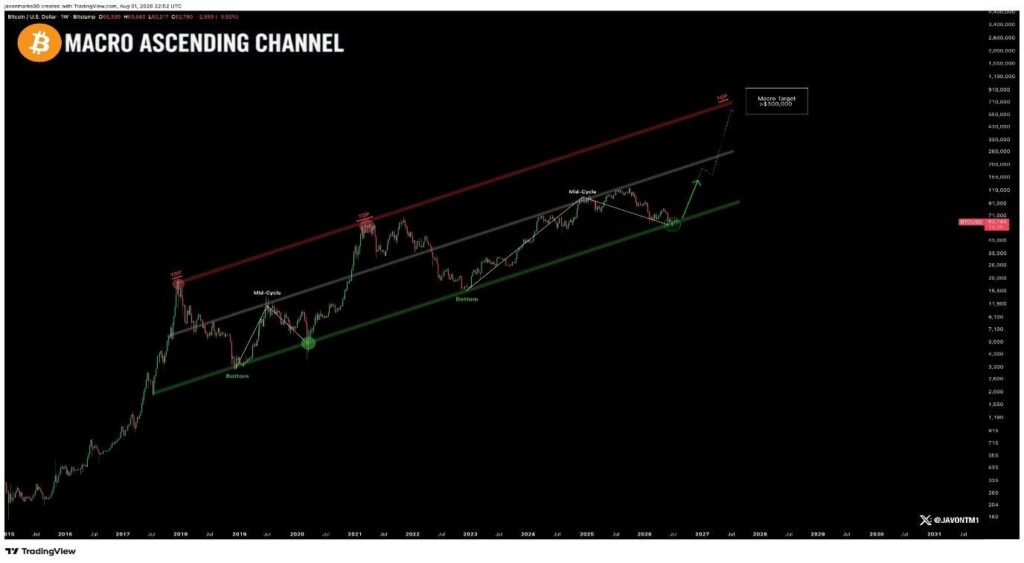
Market watchers are observing Bitcoin’s ability to maintain its position within a significant ascending channel on the macro chart. Analyst Javon Marks, a prominent voice in cryptocurrency analysis, has posited that if this structural integrity persists, the current all-time high, previously established around the $126,000 mark, might represent merely the midpoint of the ongoing cycle rather than its apex. Marks drew parallels to Bitcoin’s market structure in 2019, a period where the cryptocurrency successfully retested its support levels before embarking on what proved to be the most potent phase of that particular cycle.
The implications of this sustained support within the channel are substantial. Should Bitcoin continue to respect these technical boundaries, it could pave the way for a parabolic advance, potentially propelling the cryptocurrency towards the upper echelon of this ascending structure. Long-term projections, based on this scenario, have ventured into territory well above the $300,000 mark, signaling a significant potential for growth beyond current market expectations. This perspective suggests that rather than a peak, the market is in a period of consolidation that could precede a more aggressive upward trend.
Shorter-Term Technical Outlook and Key Price Levels
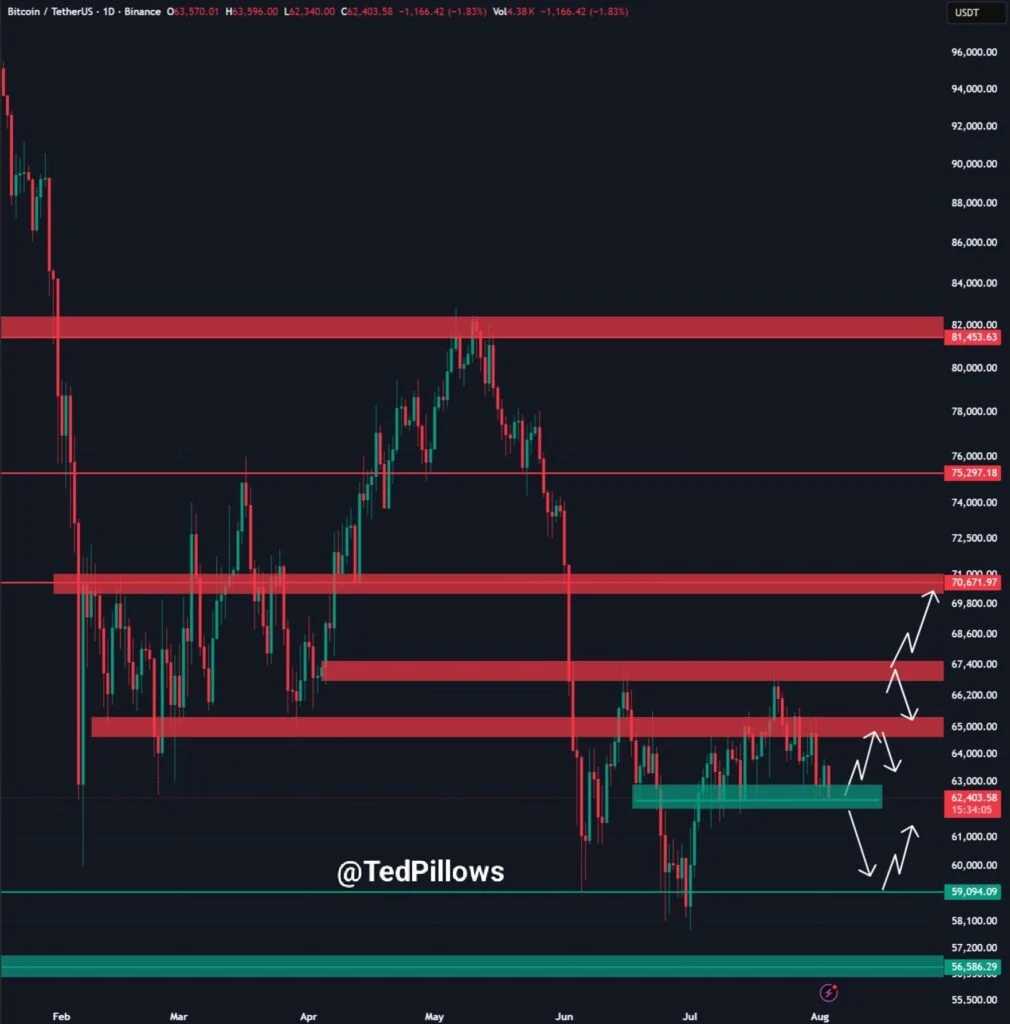
In the immediate trading environment, analysts are zeroing in on a critical support region situated between $62,000 and $62,500. According to analyst Ted, maintaining this zone could serve as a springboard for a rally towards the $65,000 resistance level. Conversely, a breach below this established support could expose Bitcoin to a downward correction, with potential targets hovering around the $60,000 mark. This short-term outlook underscores the importance of the $62,000 to $62,500 range as a near-term determinant of Bitcoin’s price trajectory.
As of Monday, the world’s leading cryptocurrency by market capitalization was trading within the mid-$60,000s, reflecting a modest gain of nearly 2% over the preceding week. This performance occurred despite a period of consolidation, indicating underlying buying pressure that is preventing a significant downturn. The market appears to be absorbing selling pressure effectively, a characteristic often seen in healthy uptrends.
Regulatory Landscape and Institutional Confidence
Beyond technical indicators, the evolving regulatory environment in the United States is also playing a notable role in shaping market sentiment. The recent advancement of the CLARITY Act, a legislative proposal aimed at establishing a more defined framework for digital assets, has been widely interpreted by investors as a positive development for the cryptocurrency industry. While the legislation has not yet triggered an immediate, dramatic market breakout, analysts believe that the prospect of clearer regulations could significantly bolster institutional confidence in the crypto space. Such enhanced confidence could, in turn, provide sustained support for Bitcoin as it becomes more feasible for major financial institutions to engage with the asset class.
The introduction of clear regulatory guidelines can mitigate perceived risks for institutional investors, who often require robust legal and operational frameworks before allocating significant capital. The CLARITY Act, by addressing some of the ambiguities surrounding digital asset classification and trading, could be a catalyst for increased institutional adoption, leading to greater liquidity and price stability for Bitcoin and other cryptocurrencies. This development aligns with a broader trend of traditional finance seeking to integrate digital assets into their portfolios and services.
On-Chain Data and Holder Behavior
Crucially, on-chain data has remained remarkably stable throughout the recent period of price consolidation. Analysis of exchange balances reveals a consistent trend, suggesting that there has been no significant wave of heavy selling pressure emanating from investors looking to liquidate their holdings. This stability in exchange balances is a strong indicator of conviction among current Bitcoin holders.
Furthermore, long-term holders, often referred to as "HODLers," continue to control a substantial portion of Bitcoin’s circulating supply. This behavior is characteristic of investors who have a high conviction in the long-term value proposition of Bitcoin and are less susceptible to short-term market fluctuations. The persistent accumulation and retention of Bitcoin by these sophisticated market participants contribute to the overall robustness of the asset’s market structure and reduce the likelihood of drastic price declines driven by panic selling.
On-chain metrics, such as the Net Unrealized Profit/Loss (NUPL) ratio, also provide insights into market sentiment. A NUPL ratio above a certain threshold can indicate that most holders are in profit, which might suggest a potential for profit-taking. However, the sustained stability in exchange balances and the continued dominance of long-term holders suggest that while some profit-taking may occur, it is not overwhelming the market and is being absorbed by ongoing demand.
Historical Context and Cycle Analysis
To better understand the current market dynamics, it is beneficial to examine historical Bitcoin cycles. The cryptocurrency has historically exhibited a pattern of boom and bust, characterized by periods of rapid price appreciation followed by significant corrections. However, each subsequent bull cycle has typically reached higher price levels than the previous one, suggesting an overall upward trend.
The current market cycle, which began after the Bitcoin halving event in April 2024, has shown characteristics of a sustained uptrend, interrupted by periods of consolidation. The halving, a programmed reduction in the rate at which new bitcoins are created, has historically acted as a catalyst for price increases due to the reduced supply of new coins entering the market. The current consolidation phase can be viewed as a natural part of this cycle, allowing the market to digest previous gains and build a stronger foundation for future appreciation.
The comparison made by analyst Javon Marks to the 2019 market structure is particularly relevant. In 2019, after a significant rally in the first half of the year, Bitcoin experienced a period of consolidation and correction. However, it subsequently found support and initiated another strong upward move. If the current situation mirrors this historical pattern, the ongoing consolidation could be a precursor to another significant leg up in the bull market.
Technical Indicators and Potential Catalysts
Beyond the ascending channel, other technical indicators are also being closely monitored. The "golden cross," a bullish signal where the 50-day moving average crosses above the 200-day moving average, has been a point of interest for analysts. A confirmed golden cross typically indicates a sustained bullish trend. While specific dates for such signals can vary, their appearance often correlates with periods of strong price appreciation.
The introduction of Bitcoin exchange-traded funds (ETFs) in the United States earlier this year marked a significant milestone for the cryptocurrency. These ETFs have provided a more accessible avenue for traditional investors to gain exposure to Bitcoin, leading to substantial inflows of capital. The continued demand from these ETFs can act as a consistent buying pressure, supporting the price even during periods of broader market uncertainty.
Potential catalysts for future price appreciation include further institutional adoption, positive regulatory developments, and broader macroeconomic factors that may drive investors towards alternative assets like Bitcoin as a hedge against inflation or economic uncertainty. The ongoing development of the Bitcoin ecosystem, including advancements in layer-2 scaling solutions and decentralized applications, also contributes to the long-term value proposition of the cryptocurrency.
Market Sentiment and Investor Psychology
Investor psychology plays a crucial role in the cryptocurrency market. During bull markets, optimism can lead to FOMO (Fear Of Missing Out), driving prices higher. Conversely, during bear markets or periods of uncertainty, fear can lead to panic selling. The current sentiment appears to be one of cautious optimism, with many investors recognizing the potential for further upside while remaining aware of the inherent volatility of the asset class.

The significant price run-up in early 2024 may have led some investors to anticipate a more immediate continuation of the rally. However, the current consolidation phase is a natural market correction that can help to rebalance the market and prevent overheating. This period of consolidation allows for a healthier, more sustainable upward trend to emerge.
Conclusion
Bitcoin’s current position above key macro support levels, coupled with positive on-chain data and a more favorable regulatory outlook, suggests a strong foundation for potential future price appreciation. While short-term fluctuations are inevitable, the longer-term technical picture, as interpreted by many analysts, points towards a continuation of the bull market. The ability of Bitcoin to hold these critical support zones will be closely watched by investors and traders alike as the market navigates the complexities of the current economic and regulatory landscape. The convergence of technical strength, institutional interest, and sustained holder conviction paints a picture of a cryptocurrency poised for further significant developments in the months ahead.
At the time of writing, BTC was trading at $63,683, reflecting a 0.30% gain over the past 24 hours, a testament to its resilience and the ongoing interest it commands in the global financial markets.














