



Arthur Hayes, a prominent figure in the cryptocurrency space and co-founder of BitMEX, has significantly revised his long-term price prediction for Bitcoin, adjusting his 2026 target from a bullish $500,000 down to $125,000. This recalibration, disclosed during a recent interview with a crypto journalist, marks a notable shift from his previous, highly ambitious forecast. Hayes, once a vocal proponent of Bitcoin reaching the half-million-dollar mark, has now cited liquidity concerns as the primary driver behind his revised outlook.
Hayes articulated his perspective by emphasizing that global liquidity remains the fundamental catalyst for Bitcoin’s price appreciation. He posited that without a sustained influx of new capital into the market, the leading digital asset is likely to experience stagnation or underperformance. This viewpoint contrasts with the prevailing narrative among some in the crypto community that technological advancements and network adoption are the primary determinants of price. "What does Bitcoin need to go higher? More money printing," Hayes stated during the interview, underscoring his conviction in the correlation between monetary policy and asset valuations. At the time of this reporting, Bitcoin was trading around the $78,000 mark, having struggled to maintain its footing above the crucial $80,000 resistance level, a threshold that, if breached decisively, could signal further upward momentum towards Hayes’ revised target.
This latest adjustment to his price projection adds another chapter to Hayes’ history of making bold, often controversial, predictions within the volatile cryptocurrency market. While he is widely recognized for his advocacy and deep understanding of digital assets, some of his prior pronouncements have not materialized as anticipated. His current emphasis on global liquidity as the pivotal factor in Bitcoin’s trajectory is particularly noteworthy, especially given that global liquidity metrics have shown considerable growth over the past couple of years. Despite this increase in available capital, Bitcoin’s price performance has been, at best, described as subpar by many observers, leading to renewed scrutiny of the relationship between macroeconomic factors and cryptocurrency valuations.
The Interplay of Global Liquidity and Bitcoin’s Price Trajectory
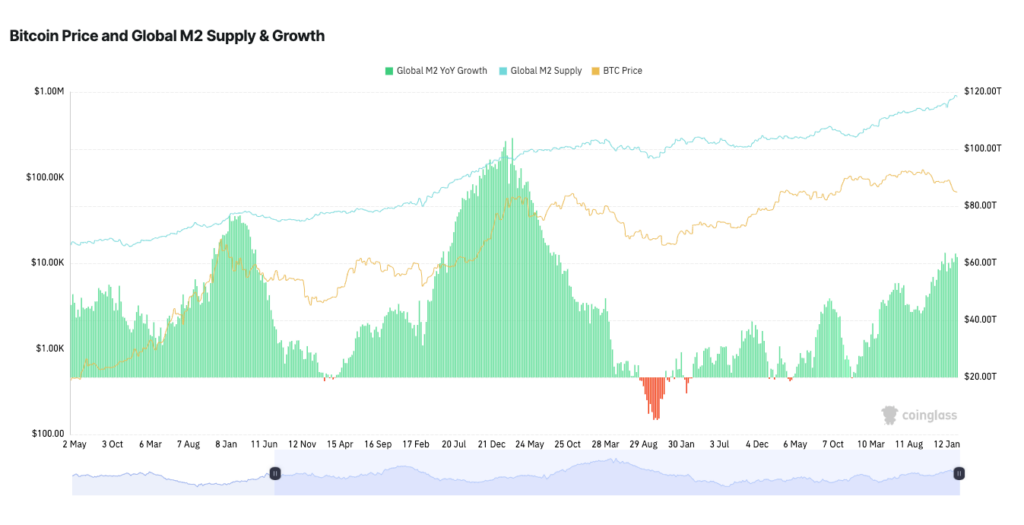
A closer examination of historical data reveals a compelling correlation between global M2 liquidity and Bitcoin’s price index over the past decade. The M2 money supply, a broad measure of money that includes M1 (currency in circulation and checking accounts) plus savings deposits, money market securities, mutual funds, and other time deposits, is often used as an indicator of overall liquidity in an economy.
Historical Correlation Analysis:

Historically, periods of significant expansion in global M2 have coincided with substantial rallies in Bitcoin’s price. The most striking example occurred in 2021, when unprecedented levels of quantitative easing and fiscal stimulus globally injected vast amounts of liquidity into financial markets. This surge in available capital fueled a speculative frenzy across various asset classes, with Bitcoin experiencing one of its most parabolic price increases, reaching all-time highs. The chart depicting the relationship between Bitcoin’s price index and global M2 liquidity clearly illustrates this pattern. During times of aggressive monetary expansion, Bitcoin’s value tended to climb, and conversely, periods of liquidity contraction or stagnation often corresponded with price declines or consolidation.
However, recent market dynamics have introduced a divergence from this established pattern. While global liquidity has shown signs of recovery and gradual upward movement in the current period, Bitcoin’s price has largely remained range-bound or experienced muted gains. This disconnect has led to a weakening of investor confidence and raised questions about the efficacy of liquidity as the sole driver of Bitcoin’s appreciation, particularly in the face of other prevailing economic and regulatory headwinds.
The Role of Monetary Policy:
Hayes’ assertion that "more money printing" is necessary for Bitcoin to ascend further highlights a prevailing belief among some market participants that central bank policies remain a primary influence on speculative asset prices. The Federal Reserve, European Central Bank, and other major monetary authorities have navigated complex economic landscapes, balancing inflationary pressures with the need to support economic growth. The decisions made by these institutions regarding interest rates and asset purchases have a direct and often immediate impact on the cost of capital and risk appetite in financial markets, including the cryptocurrency sector.
The debate over whether technological advancements or macroeconomic factors are more influential in driving Bitcoin’s price is ongoing. Proponents of the technological argument point to the increasing adoption of Bitcoin for remittances, its growing institutional interest, and ongoing developments in the Lightning Network for faster and cheaper transactions. However, Hayes and others who subscribe to the liquidity-driven thesis argue that these fundamental developments, while important for long-term viability, are often overshadowed by the sheer volume of capital available for investment.
Broader Macroeconomic Considerations and the AI Factor
Beyond the direct liquidity-Bitcoin nexus, Hayes also commented on broader macroeconomic trends, attributing the first quarter’s stock market volatility to what he termed "AI panic." This observation suggests a belief that the rapid advancements in artificial intelligence are creating deflationary pressures that even aggressive money printing is struggling to counteract.

AI’s Impact on Economic Dynamics:
The hypothesis posits that advanced AI technologies could lead to significant productivity gains, potentially suppressing wage growth and reducing consumer demand in various sectors. If businesses can automate tasks more efficiently and at a lower cost through AI, the need for human labor may diminish, leading to increased unemployment or stagnant wages. This, in turn, could dampen overall economic activity and consumer spending, creating a deflationary environment. In such a scenario, even substantial increases in the money supply might not translate into widespread inflation or a corresponding rise in asset prices, as the underlying economic forces are pushing in the opposite direction.
Hayes’ assessment implies a complex interplay between technological disruption and monetary policy. The central banks’ efforts to stimulate economies through liquidity injections might be facing an uphill battle against the disinflationary impact of AI-driven automation. This situation could lead to a scenario where traditional economic indicators and policy responses are less effective, creating uncertainty for investors across all asset classes, including cryptocurrencies.
Reactions from the Crypto Community
The cryptocurrency community has often been vocal in its responses to prominent figures like Arthur Hayes, particularly when their predictions undergo significant revisions. The perception among some observers is that crypto executives sometimes make highly publicized, ambitious forecasts to generate hype and influence market sentiment, only to later adjust these targets, often citing macroeconomic factors or unforeseen circumstances.
Critiques of Bold Predictions:
Several commentators on social media platforms, such as X (formerly Twitter), have expressed skepticism and criticism regarding the practice of making extravagant price predictions followed by subsequent retractions or modifications. The sentiment often revolves around the perceived lack of accountability and the potential for such pronouncements to mislead less experienced investors.
One user, identified as "@CryptoAdvice4u" on X, sarcastically commented on the trend, stating, "Ah yes, the predictable ‘liquidity concerns’ defense. Happens every time the $BTC moon ticket seems to be slightly delayed. The narrative always shifts, doesn’t it?" This sentiment reflects a broader frustration with what is sometimes viewed as a pattern of "talking the market" rather than relying purely on fundamental analysis.
Another user, "@MoneyMaker_MGT," offered a more pointed critique: "It’s fascinating how these ‘geniuses’ can predict a $500k Bitcoin then conveniently revise it to $125k when reality bites. Maybe they should focus on building sustainable projects instead of playing the prediction game." This remark highlights a desire for more concrete developments and less emphasis on speculative price targets.
The criticism directed at Hayes is not isolated. Other high-profile executives in the crypto space, such as Changpeng Zhao (CZ), the former CEO of Binance, have also faced scrutiny for behavior perceived as contributing to a "Fear Of Missing Out" (FOMO) environment, potentially influencing cryptocurrency prices through public statements and actions. The constant ebb and flow of bold predictions and subsequent revisions underscore the inherent volatility and speculative nature of the cryptocurrency market, as well as the significant influence that key personalities can wield.
Broader Implications and Future Outlook
Arthur Hayes’ revised Bitcoin target and his emphasis on liquidity underscore a critical debate within the financial world: the extent to which macroeconomic forces dictate the performance of digital assets. While Bitcoin was initially conceived as a decentralized alternative to traditional finance, its price action has increasingly shown a correlation with broader market liquidity and monetary policy.
Navigating Regulatory Uncertainty:
The context of Hayes’ remarks also coincides with a period of heightened regulatory scrutiny for the cryptocurrency industry. The U.S. Securities and Exchange Commission (SEC) and other regulatory bodies have been actively pursuing enforcement actions against various crypto firms, leading to uncertainty and impacting market sentiment. Despite these regulatory challenges, Bitcoin has demonstrated resilience, often bouncing back from news-driven dips. This resilience, however, may still be contingent on the overarching liquidity environment and investor sentiment driven by macroeconomic factors.

The Future of Bitcoin and Liquidity:
Hayes’ revised prediction, while lower than his previous one, still suggests a significant upside potential for Bitcoin. His focus on liquidity implies that future price surges will likely be tied to periods of monetary easing or substantial capital inflows into risk assets. The current economic climate, characterized by persistent inflation concerns and a tightening monetary policy in some regions, presents a challenging backdrop for such liquidity-driven rallies.
The broader implication of Hayes’ analysis is that investors should closely monitor central bank policies, global economic indicators, and the flow of capital. While technological innovation and adoption will continue to shape the long-term trajectory of Bitcoin, its short-to-medium term price movements may remain heavily influenced by the availability of global liquidity. The ongoing tension between technological potential and macroeconomic realities will continue to define the narrative surrounding Bitcoin and the broader cryptocurrency market. The community’s reaction also serves as a reminder of the need for critical assessment of pronouncements from market influencers, encouraging a focus on fundamental value and sustainable growth rather than solely on speculative price targets.














