



The global cryptocurrency market is currently witnessing a pivotal shift in capital allocation as Bitcoin, the industry’s primary benchmark, struggles to maintain its upward trajectory following a breach of a long-standing technical trendline. Market analysts, including the prominent strategist Justcryptopays, have observed that this technical breakdown may serve as the catalyst for a long-awaited "altcoin season," a period characterized by the outperformance of alternative digital assets relative to Bitcoin. As the market transitions into the first quarter of 2026, the rotation of liquidity from the safety of Bitcoin into higher-beta assets such as Ethereum, Solana, and various decentralized finance (DeFi) tokens suggests that investor appetite for risk is undergoing a significant transformation.
For much of the preceding year, Bitcoin has dominated market sentiment, often acting as a vacuum for liquidity during periods of macroeconomic uncertainty. However, the recent failure to decisively hold the psychological support level of $90,000 has introduced a sense of caution among institutional and retail traders alike. Currently trading at approximately $90,525, Bitcoin’s price action reflects a tug-of-war between long-term holders and those seeking more aggressive returns in the altcoin sector. This stagnation in the flagship cryptocurrency’s price has historically been the precursor to an "altcoin awakening," where the profits generated from Bitcoin’s previous rallies are redistributed into the broader ecosystem.
The Significance of the $90,000 Support Level
In technical analysis, round numbers like $90,000 carry immense psychological weight. These levels often act as "magnets" for liquidity and serve as critical battlegrounds for bulls and bears. When an asset like Bitcoin spends an extended period hovering around such a benchmark without a clear breakout, it often signals exhaustion among buyers. The recent breach of the key trendline—a diagonal support that has guided Bitcoin’s ascent through much of the late 2025 recovery—suggests that the immediate momentum has shifted.
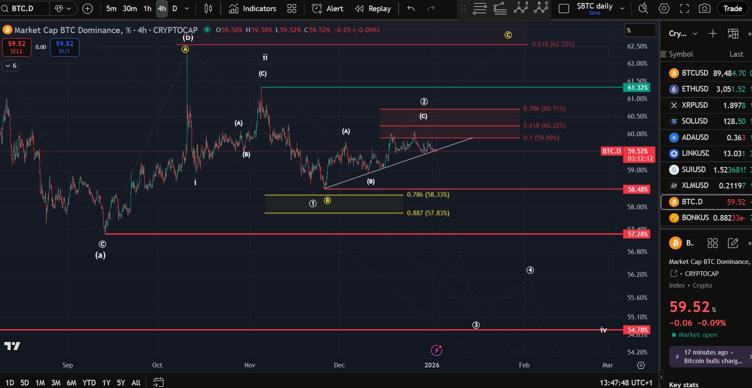
According to data from market observers, the breach of this trendline was accompanied by a slight decline in Bitcoin Dominance (BTC.D). This metric, which measures Bitcoin’s share of the total cryptocurrency market capitalization, is a vital indicator for timing altcoin cycles. When BTC.D begins to plateau or decline while the total market cap remains stable or grows, it indicates that capital is flowing into "Alts." The struggle to maintain $90,000 has prompted traders to look toward Ethereum (ETH), Solana (SOL), and Cardano (ADA) as potential vehicles for the next leg of the market cycle.
Understanding Capital Rotation and the Altcoin Cycle
The phenomenon of capital rotation follows a well-documented path within the digital asset industry. Typically, a market cycle begins with Bitcoin leading the charge, drawing in institutional capital and "smart money." Once Bitcoin reaches a perceived local top or enters a consolidation phase, investors begin to move their profits into large-cap altcoins, primarily Ethereum. From there, the liquidity trickles down into mid-cap assets, and eventually into high-risk, high-reward sectors like memecoins and emerging Web3 protocols.

The current market environment mirrors the early stages of this rotation. With Bitcoin’s volatility narrowing at the $90,000 mark, the "wealth effect" is starting to take hold. Investors who realized gains during Bitcoin’s run from the $60,000s to the $90,000s are now seeking to diversify their portfolios. This is not merely a retail-driven trend; institutional desks are also increasingly looking at the "Ethereum-to-Bitcoin" (ETH/BTC) exchange rate as a signal to rebalance their holdings. If Ethereum can capitalize on Bitcoin’s sideways movement, it could trigger a massive rally across the decentralized application (dApp) ecosystem.
Performance Analysis of Major Altcoins: ETH, SOL, and XRP
As the market eyes an altcoin resurgence, several key assets are positioned at the forefront of this potential rally. Ethereum remains the primary beneficiary of any rotation, given its role as the foundational layer for the majority of DeFi and NFT activity. While Ethereum faced criticism in 2025 for its relatively sluggish price performance compared to Bitcoin, the start of 2026 has seen a renewed focus on its deflationary mechanics and the growing adoption of Layer 2 scaling solutions.
Solana (SOL) has emerged as a formidable challenger, often leading the market in terms of percentage gains during periods of high trading activity. Its high throughput and low transaction costs have made it a favorite for retail-centric applications and memecoin launches. Analysts suggest that if Solana can break through its own respective resistance levels, it could act as a leading indicator for the broader altcoin market’s health.
Meanwhile, assets like XRP and Cardano (ADA) continue to attract interest from investors looking for "laggard" plays—tokens that have historically underperformed but possess the potential for rapid catch-up growth. XRP, in particular, remains sensitive to regulatory developments, while Cardano’s community-driven governance and academic approach to development provide a different value proposition for long-term holders. Even the memecoin sector, often dismissed as speculative, is being monitored closely. Tokens such as Dogecoin and newer entrants serve as liquidity magnets that can signal the peak of retail euphoria.
Chronology of the Market Shift: From 2025 Bearishness to 2026 Optimism
To understand the current market dynamics, one must look back at the trajectory of the past twelve months. The year 2025 was characterized by a grueling recovery process. After the volatility of previous years, the market spent much of 2025 shaking off bearish sentiment, driven by regulatory crackdowns and a restrictive global monetary environment.
- Q1-Q2 2025: Bitcoin led a cautious recovery, slowly climbing from mid-range support levels as institutional interest in Spot ETFs provided a steady floor for prices. Altcoins remained largely stagnant during this period.
- Q3-Q4 2025: Bitcoin broke into the $80,000 range, sparking a wave of optimism. However, the broader altcoin market failed to keep pace, leading to a multi-year high in Bitcoin Dominance.
- January 2026: Bitcoin reached the $90,000 milestone but immediately faced heavy selling pressure. The breach of the key trendline identified by Justcryptopays occurred in the first two weeks of the year.
- Present Day: Market participants are now observing a divergence. While Bitcoin’s price action remains choppy and range-bound, trading volumes for Ethereum and Solana are on the rise, suggesting that the "Alt-Season" engine is beginning to prime.
Institutional Perspectives and the Role of Spot ETFs
The landscape of 2026 is markedly different from previous cycles due to the deep integration of traditional finance. The approval and success of Bitcoin and Ethereum Spot ETFs (Exchange-Traded Funds) have created a permanent bridge for institutional capital. This institutional presence tends to dampen extreme volatility but also changes the mechanics of capital rotation.
Financial advisors and hedge funds are no longer just "buying Bitcoin." They are increasingly looking at "crypto-native" metrics to justify allocations to other assets. The rotation we are seeing today may be partly driven by institutional rebalancing. As Bitcoin hits a significant percentage of a fund’s total portfolio value due to its recent price appreciation, fund managers are mandated to sell portions of their Bitcoin holdings and buy other assets—often Ethereum—to maintain their target allocations. This programmatic buying provides a more stable foundation for an altcoin rally than the retail-driven "pump and dump" cycles of the past.
Broader Economic Implications and the Path Forward
The potential for an altcoin resurgence carries implications beyond just price charts. A thriving altcoin market typically correlates with increased activity in the DeFi and Web3 sectors. This means higher usage of decentralized exchanges, increased lending and borrowing activity, and more resources flowing into the development of blockchain-based technologies.
However, the path forward is not without challenges. The "bearish momentum of 2025," as noted by market analysts, still casts a shadow over the industry. For a sustained altcoin season to occur, the market must overcome the "overhead supply"—the large number of investors who bought at higher prices in previous years and are looking to exit at break-even points. Furthermore, global macroeconomic factors, such as interest rate decisions by the Federal Reserve and geopolitical stability, will continue to influence capital flows into the crypto space.
In conclusion, the breach of Bitcoin’s key trendline and its struggle to maintain the $90,000 level may be the "warning shot" that precedes a significant market realignment. While Bitcoin remains the undisputed leader and the ultimate store of value within the digital asset space, the current data suggests that the spotlight is shifting. For vigilant investors and traders, this period of capital rotation represents a strategic opportunity to position themselves in assets that may define the next phase of the 2026 market cycle. Whether this leads to a full-blown altcoin season or a more balanced, multi-asset growth phase, the coming months will be critical in determining the long-term structure of the digital asset economy.














