



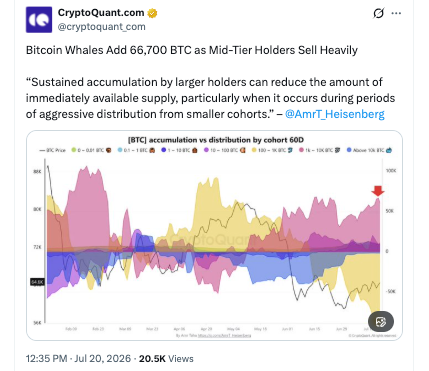
A significant shift in Bitcoin holdings has been observed, with large-scale investors, often referred to as "whales," aggressively accumulating Bitcoin while smaller holders appear to be liquidating their positions. Over the past 60 days, these major players have reportedly added over $4.3 billion worth of Bitcoin to their reserves, according to data compiled by the prominent cryptocurrency analytics platform, CryptoQuant. This accumulation by whales stands in stark contrast to the actions of smaller investors, who have divested approximately $5 billion in BTC during the same period.
The data categorizes investors into distinct groups based on their holdings. "Fish" are defined as wallets holding between 100 and 1,000 BTC, while "whales" are those possessing more than 10,000 BTC. The recent trend indicates that these smaller investors have been predominantly selling their Bitcoin throughout June and July. This pattern suggests a potential re-evaluation of their investment strategies as the market navigates current price levels.
CryptoQuant highlighted this trend in a recent social media post, sharing a chart that visually represented the divergence in behavior between different investor demographics. The graph illustrated a notable increase in Bitcoin outflows from exchanges associated with smaller holders, coinciding with substantial inflows into the wallets of larger entities. This observation prompts questions about the underlying motivations driving these contrasting actions within the Bitcoin ecosystem.
Divergent Investor Strategies: Whales Accumulate, Fish Disengage
Upon closer examination of the data, it appears that the smaller investors, the "fish," may be seeking to offload their Bitcoin holdings at current price points. This selling activity follows a period of significant buying throughout the first and second quarters of the year. The rationale behind this sudden shift in strategy remains somewhat unclear, especially given that Bitcoin has been trading below the $70,000 mark, a level where substantial profits might not be readily apparent for those who acquired their holdings at higher prices.
One plausible explanation is that these smaller investors had anticipated a rapid return to a bull market, prompting them to acquire Bitcoin earlier in the year. However, the anticipated surge has not materialized, and the leading cryptocurrency has experienced a period of relative stagnation. This lack of significant upward momentum may have led these investors to cut their losses or reallocate their capital to assets perceived as offering more immediate returns, such as the booming stock and equities markets, which have shown robust performance in recent quarters.
Dolphins Join the Accumulation Trend
Adding another layer to this unfolding narrative is the behavior of "dolphins," a demographic defined as holding between 1,000 and 10,000 BTC. This group has also engaged in aggressive Bitcoin buying over the past couple of months, even exhibiting a more pronounced accumulation trend than the whales themselves. The parallel behavior between dolphins and whales, and their distinct divergence from the fish, could be interpreted as a bullish signal. It might suggest that these larger, more established players perceive the current market conditions as an opportune moment to build their positions, potentially indicating that a long-term bottom has been established.
This coordinated buying by substantial holders can have a significant impact on market dynamics. By removing large quantities of Bitcoin from exchanges and placing them into cold storage or private wallets, these investors reduce the available supply on the market. This scarcity, coupled with sustained demand, can exert upward pressure on prices. The act of moving assets off exchanges also signals an intention to hold for the longer term, rather than engage in short-term trading, further reinforcing the idea of a conviction in Bitcoin’s future value.

Background Context: A Volatile Market Landscape
The current market environment is characterized by a complex interplay of factors. Bitcoin has experienced a volatile period following its all-time highs. The halving event in April 2024, which reduced the reward for mining new blocks, has historically been a precursor to bull markets. However, the post-halving period has been marked by consolidation and price fluctuations, leading to a degree of uncertainty among investors.
The approval of spot Bitcoin Exchange-Traded Funds (ETFs) in the United States earlier this year was a landmark event, opening the door for increased institutional adoption. These ETFs have seen significant inflows, particularly from major asset managers like BlackRock. These inflows represent a validation of Bitcoin as an asset class and have been a key driver of price appreciation in certain periods. However, the sustained momentum of these institutional inflows is crucial for maintaining positive market sentiment.
Institutional Interest and the Missing Retail Element
The recent accumulation by whales and dolphins is unfolding against a backdrop of recovering institutional interest, primarily driven by U.S. spot Bitcoin ETFs. July, in particular, has witnessed encouraging streaks of inflows for prominent ETFs, including BlackRock’s iShares Bitcoin Trust (IBIT). On July 20th alone, these exchange-traded funds collectively added approximately $227 million in Bitcoin, with a five-day tally exceeding $700 million. This renewed institutional appetite suggests a growing confidence in Bitcoin’s long-term prospects among traditional financial players.
However, a critical component of any sustained market rally is the participation of retail investors. While institutional interest fluctuates, the broader public’s engagement is essential for broader market growth and stability. The current data indicates a lack of significant retail buying activity. If retail investors do not step up and begin accumulating Bitcoin, the cryptocurrency may continue to experience periods of stagnation or limited upward movement in the near future. The absence of widespread retail enthusiasm can dampen the overall market sentiment and limit the potential for explosive growth.
Bitcoin’s Price Performance and Market Positioning
Bitcoin’s price has recently stabilized above the crucial $60,000 support level. After testing lower supports in the range of $58,000 to $60,000 earlier in the summer, the cryptocurrency has been trading within the $63,000 to $66,000 range. This consolidation above a key psychological and technical level is a positive sign, indicating that the selling pressure may be subsiding.
Despite this recent stabilization, Bitcoin’s performance over the last three quarters has been relatively subdued. This period of consolidation has led some short-term speculators to seek out more dynamic investment opportunities in other markets, such as the aforementioned booming stock and equities markets. The pursuit of quicker returns in more volatile, yet potentially more rewarding, sectors can draw capital away from cryptocurrencies that are experiencing a period of slower growth.
Analysis of Implications: A Potential Foundation for Future Growth
The current market dynamics, characterized by whale and dolphin accumulation and retail selling, present a complex but potentially bullish scenario for Bitcoin. The large-scale acquisition by sophisticated investors suggests a belief in the long-term value proposition of Bitcoin. This behavior is often seen as a precursor to significant price appreciation, as these entities are typically well-capitalized and possess a deeper understanding of market cycles.
The fact that these large holders are moving their Bitcoin off exchanges further solidifies the argument for a long-term accumulation phase. This practice, known as "hodling," reduces the readily available supply, creating a tighter market. When demand increases, particularly from institutional inflows and a potential resurgence of retail interest, this reduced supply can lead to more pronounced price rallies.
However, the absence of robust retail participation remains a key factor to monitor. A truly parabolic ascent, characterized by rapid and sustained price increases, often requires broad-based demand across all investor segments. If retail investors remain on the sidelines, the pace of Bitcoin’s recovery could be slower, and the market may be more susceptible to corrections driven by the actions of larger players.
The role of U.S. spot Bitcoin ETFs cannot be overstated. Their continued inflows demonstrate that traditional finance is increasingly embracing Bitcoin. This institutional adoption not only adds capital to the market but also lends legitimacy and stability to the asset class. As more institutions enter the space, the perception of Bitcoin as a speculative asset may gradually shift towards that of a legitimate investment vehicle.
Looking Ahead: The Road to Recovery
The coming months will be critical in determining Bitcoin’s trajectory. The sustained accumulation by whales and dolphins, coupled with the positive trend in institutional ETF inflows, provides a strong foundation for a potential recovery. However, the market will be closely watching for signs of increased retail engagement. A confluence of these factors – continued institutional demand, sustained large holder accumulation, and a resurgence of retail interest – could trigger the next major bull run for Bitcoin.
The cryptocurrency’s ability to hold the $60,000 support level is also a vital indicator. A sustained break above this level and a move towards retesting previous all-time highs would signal a strong market recovery. Conversely, a sustained fall below this key support could indicate that the current accumulation phase is insufficient to overcome broader market headwinds, potentially leading to further consolidation or a deeper correction.
In conclusion, the current Bitcoin market is experiencing a fascinating divergence in investor behavior. While smaller players are liquidating, the larger entities are aggressively accumulating, signaling a strong conviction in Bitcoin’s future. The ongoing institutional adoption through ETFs further bolsters this optimistic outlook. The ultimate success of a sustained bull run will likely depend on the broader market’s ability to attract and retain retail investors, thereby completing the ecosystem’s participation in this potentially transformative phase for digital assets.














