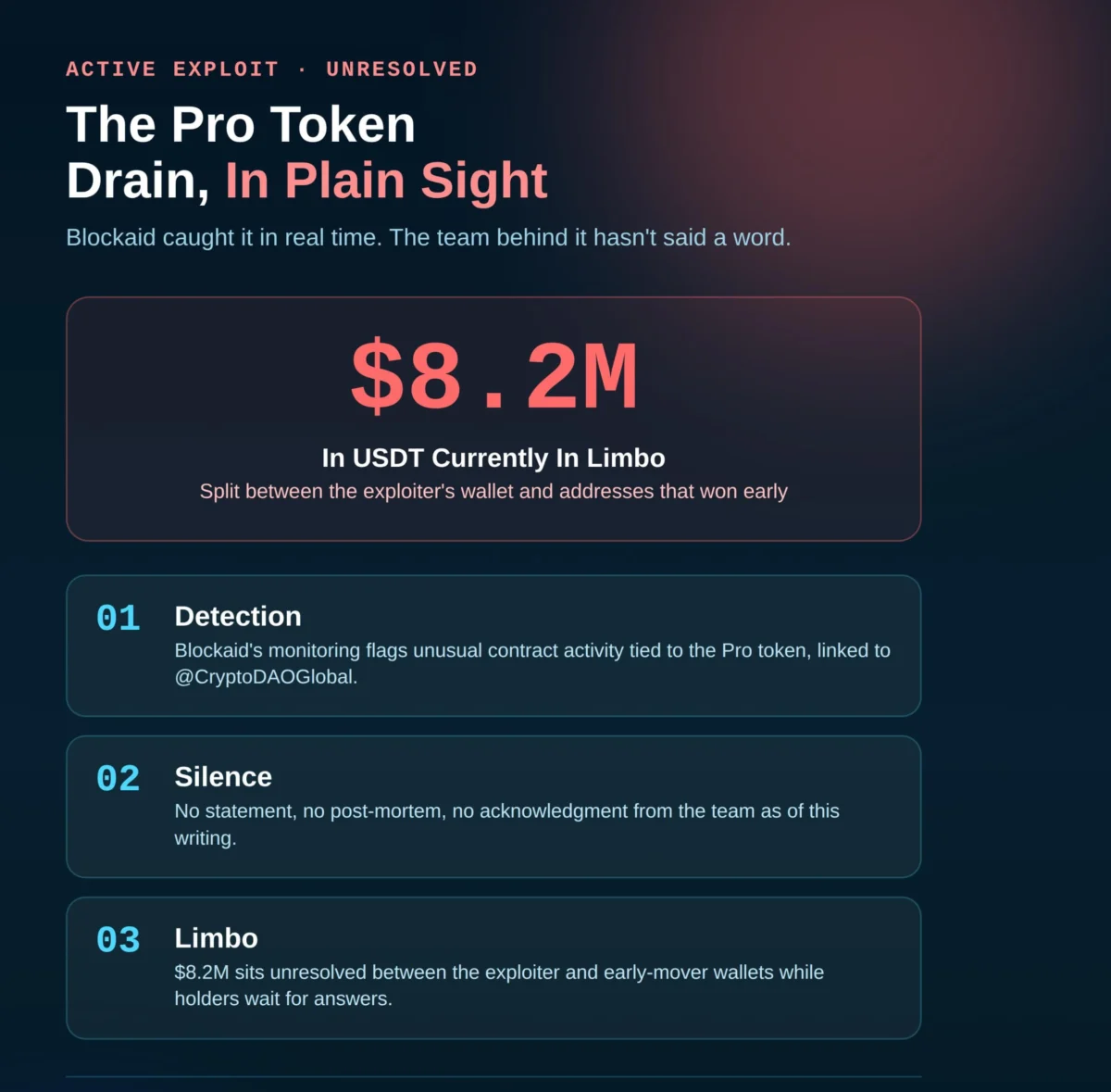
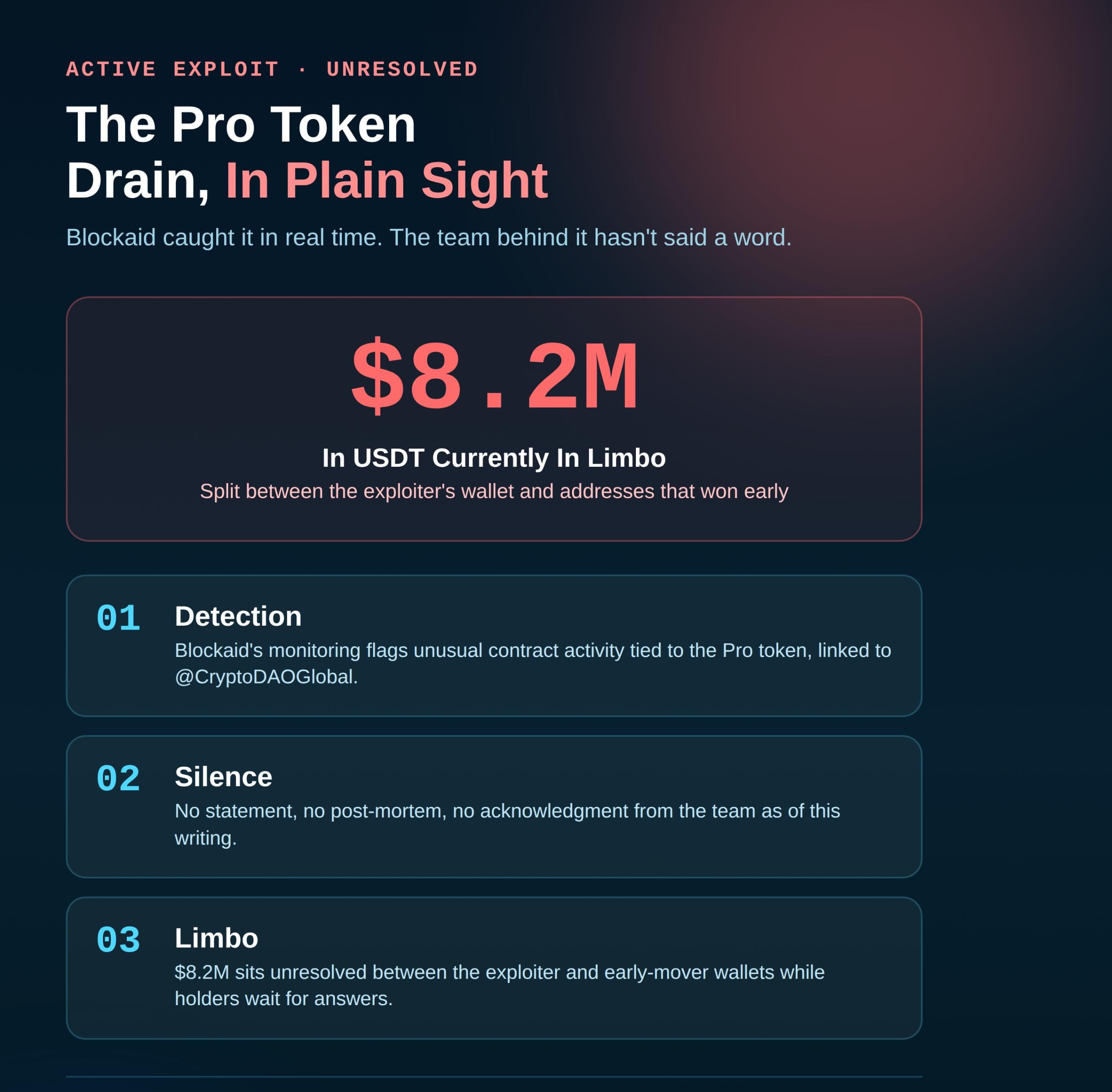
The cryptocurrency world is once again grappling with a significant security breach as an estimated $8.2 million in USDT has been siphoned from the Pro token project, with its associated team, CryptoDAOGlobal, maintaining a concerning silence in the wake of the incident. This exploit, swiftly identified by the blockchain security firm Blockaid, serves as a stark reminder of the escalating risks in the digital asset space, particularly during a period that has already seen the first half of 2026 register an unprecedented volume of on-chain security incidents and financial losses. For holders of the Pro token, the inability to glean any official communication from the project team regarding the active exploit has compounded the frustration, leaving them to monitor blockchain explorers and social media for any semblance of clarity.
The Unfolding of the Pro Token Exploit: A Real-Time Detection
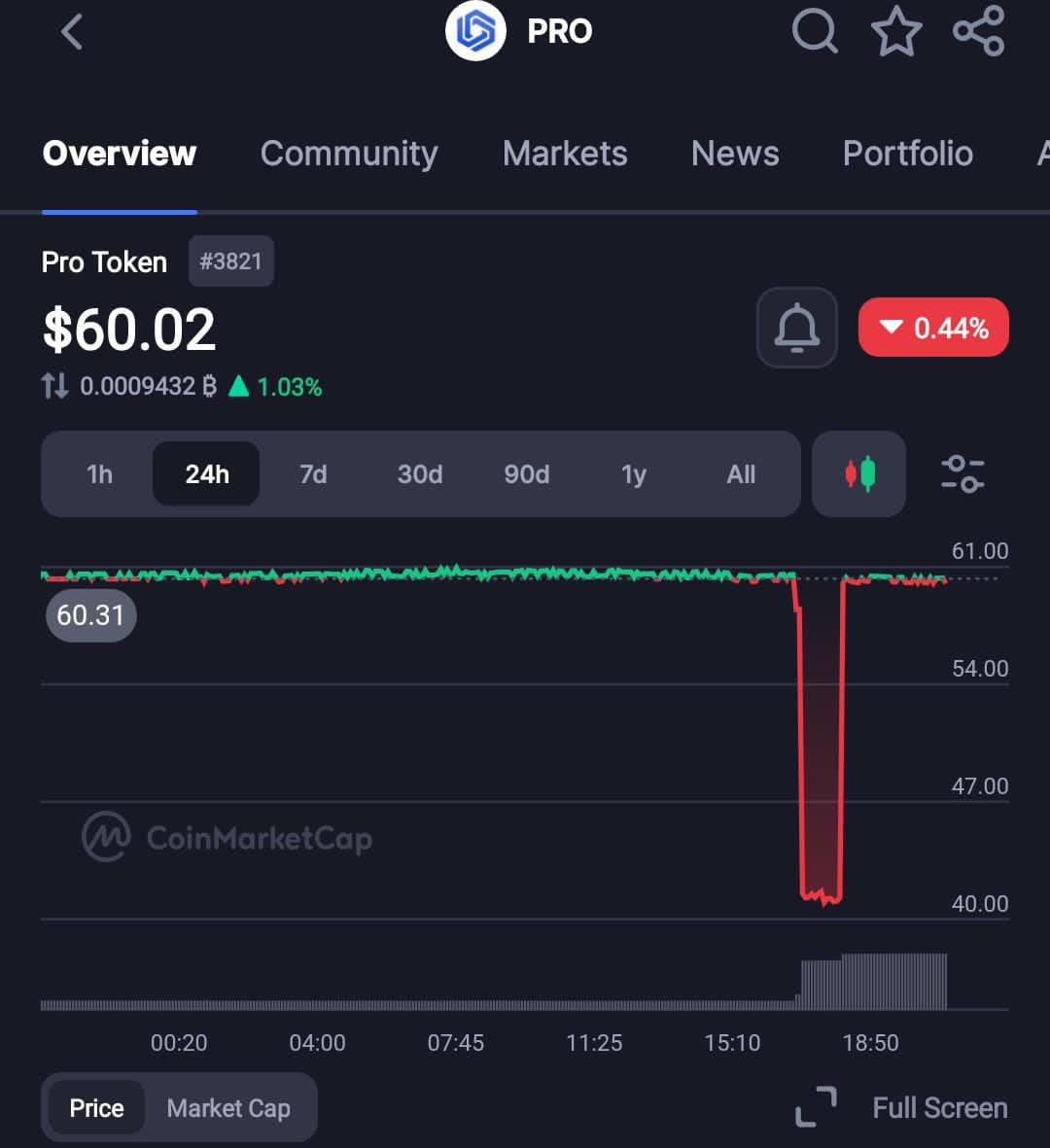
The breach targeting Pro token, an asset whose market movements are now closely scrutinized by its community, was detected in real-time by Blockaid’s sophisticated monitoring systems. These systems, designed to continuously scan on-chain activity for anomalous behavior, flagged the exploit as it was actively transpiring. Details shared by Blockaid via social media outlined that approximately $8.2 million in USDT was observed moving into an exploiter’s wallet, with additional funds appearing in a cluster of addresses believed to have benefited from the chaos. This phenomenon often includes front-running the exploit transaction itself or leveraging the subsequent market instability to gain an advantage. The rapid identification by a third-party security firm underscores a recurring pattern in 2026, where external security intelligence frequently outpaces internal project responses to critical incidents.
Blockaid, renowned for its prowess in real-time threat detection, has built a formidable reputation by catching a spectrum of exploits, from intricate bridge compromises to governance takeovers, often before the broader crypto community becomes aware of any irregularities. The Pro token incident aligns perfectly with this operational profile: an active, unresolved exploit, a substantial sum of digital assets in flux, and a project team conspicuously absent from public discourse at a moment when transparent communication is paramount. The current status of the $8.2 million, now residing in the exploiter’s control and associated addresses, serves as the most concrete public record of the event, thereby highlighting a significant accountability gap prevalent within the industry.
CryptoDAOGlobal’s Stalling Silence and Its Ramifications
As of the latest reports, the CryptoDAOGlobal team, the entity behind the Pro token, has yet to issue any form of official statement. There has been no acknowledgment of the exploit, no post-mortem analysis, and no basic update to reassure its community or provide guidance. This protracted silence has not only amplified investor anxieties but has also become a "red flag" in its own right, fitting into a concerning trend observed by security researchers throughout the year. The pattern reveals that project teams are increasingly discovering critical vulnerabilities and active exploits through public alerts from security firms, rather than through their own internal monitoring or incident response protocols.

For Pro token holders, this lack of communication is arguably the most infuriating aspect of the entire ordeal. In an industry where trust is paramount and volatile market conditions are the norm, swift and transparent communication during a crisis is non-negotiable. The absence of such communication can erode investor confidence, lead to panic selling, and potentially inflict long-term damage on a project’s reputation, irrespective of the technical details of the exploit itself. The silence from CryptoDAOGlobal suggests either a severe lack of preparedness for incident response, an inability to regain control, or a deliberate decision to avoid public engagement, all of which carry significant negative implications for the project’s future viability and its community’s trust.
A Broader Landscape of Crypto Crime: H1 2026 Report Revelations
The Pro token exploit, while significant in its own right, is unfortunately just one data point within a much larger, grim narrative unfolding in the first half of 2026. Blockaid’s comprehensive research arm has verified an astonishing 212 separate security incidents across this period alone. This volume represents a staggering 3.4-fold increase compared to the entirety of 2025, signaling an unprecedented surge in malicious activity targeting the digital asset ecosystem. The sheer frequency of these attacks means that an industry that once measured major exploits in dozens per year is now confronting a similar count every few weeks. This acceleration confirms a widespread sentiment among market participants: the constant barrage of exploit alerts on social media timelines is not merely anecdotal, but firmly supported by alarming statistical data.
The total verified losses for the first six months of 2026 have surpassed $1.1 billion, with the Ethereum and Solana ecosystems bearing the brunt of the financial damage. This escalating trend highlights a critical vulnerability within the rapidly expanding decentralized finance (DeFi) sector and the broader Web3 landscape. Despite continuous advancements in blockchain technology and security auditing practices, attackers are adapting at an even faster pace, exploiting new vectors and preying on systemic weaknesses. The sheer scale of these losses underscores an urgent need for the industry to collectively re-evaluate its security posture, moving beyond reactive measures to proactive and comprehensive defense strategies.
The Evolving Threat: Operational Security Failures Dominate
Perhaps the most crucial finding from Blockaid’s H1 2026 report, one that demands a fundamental re-evaluation of security paradigms across the crypto space, is the revelation concerning the nature of these exploits. A staggering 74% of all funds stolen in the first half of 2026 did not originate from smart contract bugs, which have traditionally been the primary focus of security audits and developer attention. Instead, the overwhelming majority of losses stemmed from operational security (OpSec) failures.
These OpSec vulnerabilities manifest in various forms: compromised private keys, hijacked signer infrastructure, and sophisticated social engineering tactics designed to trick insiders into inadvertently approving malicious transactions. This shift in attack vectors indicates that while robust code audits remain essential, they are no longer the ultimate safeguard against large-scale theft. The "finish line" for security has moved beyond the codebase itself, extending to the human element and the procedural frameworks that govern access and control over critical digital assets.
This paradigm shift has profound implications for how projects are evaluated and how investors conduct due diligence. A clean audit badge on a project’s landing page, once a hallmark of trustworthiness, now provides an incomplete picture of its true security posture. Investors must now delve deeper, asking critical questions about a team’s internal operational security protocols: How are private keys managed? What multi-signature (multisig) requirements are in place? How robust are their internal communication channels and social engineering defenses? The weakest link is increasingly found not within the lines of code, but within the laptops, multisig setups, or even the Slack workspaces of project teams.
The Shadow of State-Sponsored Actors: DPRK’s Pervasive Influence
Further complicating the security landscape is the persistent and growing threat of state-sponsored actors. Blockaid’s attribution data for H1 2026 unequivocally points to North Korea-linked operators as responsible for an outsized share of the damage, accounting for a staggering 55% of all reported losses. This concentration aligns with independent findings from other prominent blockchain security firms, which have also highlighted the increasing sophistication and scale of Pyongyang’s crypto theft operations. These are not opportunistic "smash-and-grab" hacks; rather, they represent meticulously planned, patient, and methodical campaigns.
Researchers describe a consistent pattern: sophisticated infiltration tactics often beginning with fake job offers targeting developers, impersonated venture capital outreach to gain trust, and the gradual embedding of malicious elements within trusted infrastructure long before any funds are moved. This means that a project team might unknowingly have a compromised individual on staff for months, slowly gathering intelligence and establishing footholds, before launching a devastating attack. This long-game approach makes detection incredibly challenging and underscores the critical importance of rigorous vetting processes, continuous security awareness training, and robust internal monitoring for all cryptocurrency projects. The implication for holders is sobering: the security of their assets may depend on the operational integrity of individuals they have never met, working for a project whose internal defenses may have been silently compromised for an extended period.
Anticipating the Next Wave: Blockaid’s Forward-Looking Analysis
Beyond cataloging past incidents, Blockaid’s research offers invaluable forward-looking insights into emerging attack vectors expected to scale through the second half of 2026. These patterns, currently observed in isolated incidents, possess the potential to become industry-wide trends, much like operational compromises and infrastructure targeting rapidly transitioned from edge cases to the dominant forms of attack earlier in the year. While specific details of these nascent vectors are often proprietary or withheld to avoid tipping off malicious actors, the general warning emphasizes that the next wave of losses is unlikely to resemble the last.
This foresight demands a proactive and adaptive approach from both builders and investors. The critical questions for any project should extend beyond "was the code audited?" to encompass queries such as: "Who holds the keys to critical infrastructure?" "What are the mechanisms for changing or revoking access?" and "How would I, as an investor, be informed of such changes or potential compromises?" The rapidly evolving threat landscape necessitates a continuous reassessment of security assumptions and a shift towards holistic risk management that accounts for both technical vulnerabilities and human-centric exploits.
Implications for the Industry and Investors
The ongoing Pro token exploit and the broader findings from Blockaid’s H1 2026 report paint a sobering picture for the cryptocurrency industry. The persistent vulnerability to large-scale theft, the evolving sophistication of attackers, and the critical role of operational security highlight a fundamental challenge: the industry continues to innovate and build at a pace that often outstrips its ability to secure itself comprehensively. This creates an environment ripe for exploitation, where malicious actors are consistently identifying and capitalizing on the gaps.
For individual investors, the imperative for rigorous due diligence has never been greater. Relying solely on a project’s whitepaper or a superficial audit report is no longer sufficient. A deeper understanding of a project’s operational security practices, team background, incident response plans (or lack thereof), and transparency during crises is essential. The Pro token exploit serves as a stark case study within this larger narrative, illustrating the devastating consequences when a project team goes silent as an asset’s chart plummets. In a landscape where the next wave of attacks is always on the horizon, awareness, critical evaluation, and a healthy dose of skepticism are the most potent tools for safeguarding digital assets.
Disclosure: This article is for informational purposes only and does not constitute financial, investment, or trading advice. Readers are strongly encouraged to conduct their own research and consult with qualified professionals before making any investment decisions in the volatile cryptocurrency market.