Chainlink (LINK), the decentralized oracle network’s native cryptocurrency, recently experienced a significant price rally, climbing from approximately $9 to over $15, effectively breaking out of a prolonged seven-month trading range. This bullish momentum, however, has been accompanied by an unusual divergence in its exchange reserves, a key on-chain metric often indicative of potential selling pressure. Unlike previous major price surges for LINK, this latest rally did not trigger a corresponding sharp increase in exchange reserves, which have instead remained notably flat, hovering around 124 million LINK. This distinct behavior, highlighted by analyst R3N on CryptoQuant, suggests a potentially evolving investor sentiment and supply-side dynamics that warrant closer examination.
A Detailed Look at Chainlink’s Market Performance and On-Chain Data
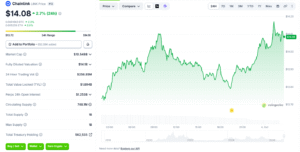
For much of 2023, Chainlink’s token, LINK, was confined to a relatively tight trading band, oscillating between $7 and $10. This period of consolidation, spanning approximately seven months, saw the asset accumulate foundational support while market participants awaited a definitive directional move. The breakthrough arrived in September, with LINK initiating a robust upward trajectory that propelled its value beyond $15.50. While the token subsequently experienced a modest retracement, trading around $14.08 at the time of this analysis, the breakout from its established range marked a significant shift in its market perception.
The accompanying on-chain data, particularly the balance of LINK held on centralized exchanges, presents a fascinating counterpoint to this price action. Exchange reserves, which represent the total amount of a cryptocurrency available for trading on exchanges, are widely considered a crucial indicator of potential selling pressure. A substantial increase in these reserves typically signals that more tokens are being moved onto exchanges, often by holders intending to sell, thus potentially contributing to price weakness. Conversely, stable or declining reserves can suggest that holders are opting to HODL (hold on for dear life) their assets or move them into cold storage, thereby reducing immediate selling pressure.
The Anomaly in Exchange Reserve Behavior
Analyst R3N’s observations point to a historical pattern in Chainlink’s exchange reserves, characterized by a recurring "sawtooth" formation. This pattern involves a gradual accumulation of LINK on exchanges, followed by a sharp, often sudden, spike in reserves. This cycle has historically played out numerous times, with R3N citing at least six or seven instances dating back to late 2023, including distinct periods in early 2024, mid-2024, late 2024, early 2025, mid-2025, and early 2026. Crucially, many of these sharp spikes in exchange reserves have coincided with, or immediately preceded, local price tops or periods of price weakness for LINK. This historical correlation has led analysts to interpret these spikes as potential precursors to increased selling activity, as large quantities of LINK were moved to exchanges, presumably to be liquidated.
However, the most recent rally, spanning from September to October, has deviated significantly from this established script. Despite LINK’s impressive ascent from $9 to over $15, its exchange reserves remained remarkably stable, fluctuating narrowly between 124 million and 130 million LINK. The characteristic sharp spike that historically accompanied previous rallies was conspicuously absent. This flatlining of reserves during a period of strong price appreciation presents a compelling anomaly, suggesting a fundamental shift in how LINK holders are reacting to upward price movements.

Supply on Exchanges Near Multi-Year Lows: A Structural Shift
Further underscoring the significance of this observation is the current absolute level of Chainlink exchange reserves. At approximately 124.3 million LINK, the total supply on exchanges is near the lowest point recorded within the multi-year window examined by R3N. This figure stands in stark contrast to the peak of 190 million LINK observed in early 2024, representing a substantial decline of roughly 66 million LINK.
This downtrend in available exchange supply is not a recent phenomenon but rather a reflection of a long-term structural decline that has persisted across multiple price cycles. The reduction has been a combination of gradual outflows and, at times, more pronounced drops, even amidst the periodic spikes. The overarching direction, however, has consistently been downward, indicating a sustained trend of LINK tokens being removed from exchange wallets. This consistent reduction in exchange supply, irrespective of short-term price fluctuations, suggests a broader shift in investor behavior towards long-term accumulation and self-custody, diminishing the immediate accessible supply for trading and potential selling.
Implications for Investor Behavior and Market Dynamics
The divergence between LINK’s recent price rally and the subdued behavior of its exchange reserves carries several significant implications for understanding current investor sentiment and future market dynamics. The absence of a typical reserve spike, which historically signaled an influx of fresh supply onto exchanges in anticipation of selling, suggests a different kind of market participant at play. It implies that a significant portion of the LINK supply is being held by long-term investors (often referred to as "HODLers") who are not immediately compelled to sell into price strength.
This phenomenon could indicate several underlying factors:
- Reduced Selling Pressure: With fewer tokens moving to exchanges, the immediate selling pressure on LINK is inherently lower, potentially allowing for more sustained upward price momentum or at least reducing the likelihood of sharp, sell-off driven corrections.
- Increased Investor Confidence: The reluctance of holders to capitalize on the rally by moving tokens to exchanges might reflect stronger conviction in Chainlink’s long-term value proposition and future growth prospects. This could be tied to ongoing developments within the Chainlink ecosystem, such as the expansion of its Cross-Chain Interoperability Protocol (CCIP) or increased adoption by institutional entities.
- Accumulation vs. Distribution: The observed pattern suggests a phase of accumulation rather than distribution, where existing holders are either adding to their positions or simply maintaining them, rather than offloading. This can contribute to a healthier, more organic price appreciation.
- Maturing Asset Class: For some analysts, such behavior might also signal the maturing of an asset, where its investor base becomes less reactive to short-term price swings and more focused on fundamental value.
Chainlink’s Role and Ecosystem: Context for Investor Confidence
To fully appreciate the significance of these on-chain metrics, it’s essential to understand Chainlink’s foundational role within the broader Web3 ecosystem. Chainlink operates as a decentralized oracle network, providing tamper-proof inputs and outputs for smart contracts. This crucial function enables smart contracts to interact securely with real-world data and off-chain systems, unlocking a vast array of use cases in decentralized finance (DeFi), gaming, NFTs, and enterprise applications.
Key developments, such as the continuous expansion and adoption of its CCIP, are central to Chainlink’s growth narrative. CCIP facilitates secure and reliable cross-chain communication, enabling dApps to transfer tokens and arbitrary data across various blockchain networks. This interoperability is a critical component for the future scalability and integration of the decentralized web. As CCIP gains traction and more institutions explore its capabilities, the fundamental utility and demand for the LINK token, which is used to pay for oracle services and secure the network through staking, are expected to grow. This underlying utility provides a strong rationale for long-term holding, potentially influencing the observed exchange reserve dynamics.
Analyst Perspectives and Future Outlook
While R3N cautions that the absence of a reserve spike is not definitive proof that the rally will continue indefinitely, it undeniably presents a different dynamic compared to past cycles. The analyst and others in the on-chain analytics community will be closely monitoring for any eventual spike in Chainlink exchange reserves, especially if LINK pushes back towards or surpasses its recent highs. Historically, these price levels have been critical junctures where the "sawtooth" pattern typically manifests.
Should a spike eventually appear, it would signal a potential shift in investor sentiment or a renewed interest in taking profits. However, until such a pattern emerges, the sustained low levels of exchange reserves suggest a market characterized by strong conviction among holders. This implies that any future significant price movements, particularly upwards, might be met with less immediate supply-side resistance than in previous cycles.
Moreover, this phenomenon could set a precedent for how market participants interpret on-chain data for Chainlink going forward. The historical reliability of the reserve spike as an indicator of potential selling pressure now faces a challenge, requiring a more nuanced interpretation of market sentiment. Investors and analysts will need to consider whether this new pattern represents a temporary deviation or a more permanent evolution in LINK’s market structure, driven by its increasing adoption and a maturing investor base.
In conclusion, Chainlink’s recent price rally, unburdened by the typical surge in exchange reserves, marks a noteworthy departure from its historical market behavior. With LINK reserves resting near multi-year lows, the prevailing sentiment appears to be one of long-term holding rather than short-term profit-taking. This structural shift in supply dynamics, underpinned by Chainlink’s expanding ecosystem and critical role in Web3 infrastructure, paints a picture of evolving investor confidence and a potentially more resilient market for the decentralized oracle token. The coming months will be crucial in determining whether this anomaly signals a new era for LINK’s market dynamics or merely a temporary pause in a well-established pattern.