


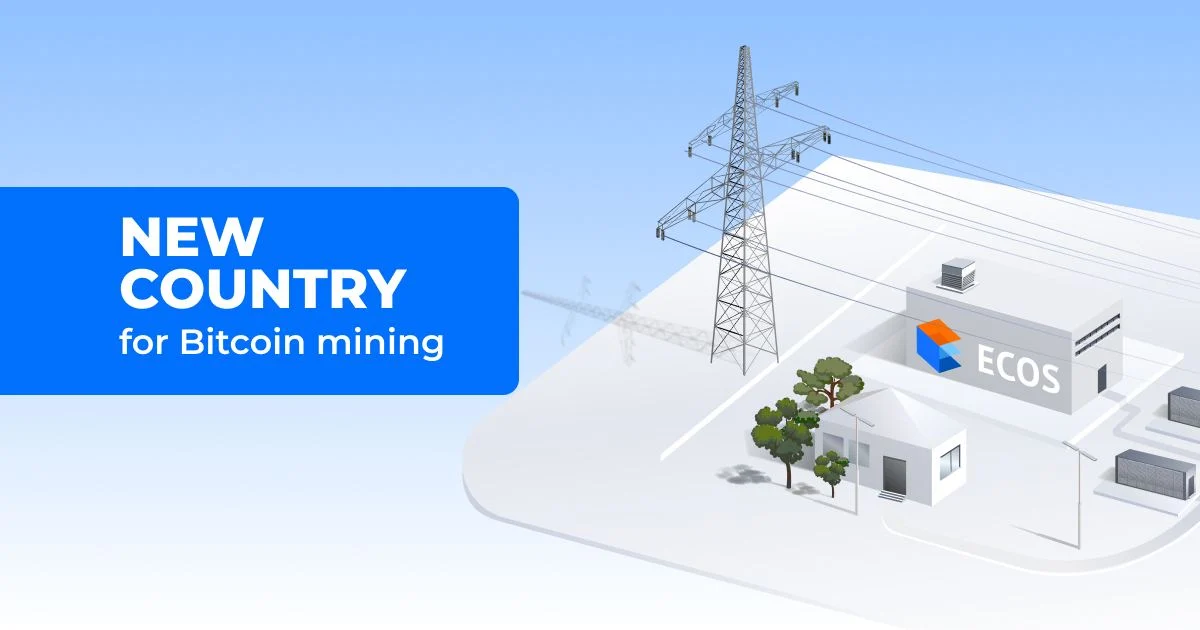
The international blockchain infrastructure provider ECOS has officially announced the commissioning of a new 60-megawatt (MW) data center located within the Free Economic Zone (FEZ) in Hrazdan, Armenia. This strategic expansion marks a significant milestone in the company’s efforts to provide institutional and retail investors with high-efficiency cryptocurrency mining solutions, supported by comprehensive state-level incentives and a robust energy grid. By leveraging Armenia’s unique legislative framework and favorable climatic conditions, ECOS aims to solidify its position as a dominant force in the global digital asset mining sector, offering a suite of services that range from hardware hosting to cloud-based mining operations.
The development of the Hrazdan facility is the culmination of a long-term partnership between ECOS and the Armenian government, which began in 2018. At that time, the Armenian authorities issued a decree designating ECOS as the official organizer and operator of a specialized Free Economic Zone dedicated to the development of high technologies and the blockchain industry. This initiative was part of a broader national strategy to diversify the Armenian economy, attract foreign direct investment, and establish the South Caucasus nation as a regional hub for technological innovation. Today, the ECOS ecosystem serves more than 250,000 users worldwide, providing a bridge between traditional finance and the decentralized economy through its end-to-end infrastructure.
A Strategic Geographical and Climatic Advantage
The selection of Hrazdan as the site for the new 60 MW data center was predicated on several critical geographic and technical factors. One of the most significant advantages is the region’s climate. Hrazdan, situated at a high altitude, experiences an average annual temperature of approximately 4.8°C (40.6°F). In the energy-intensive world of cryptocurrency mining, heat management is one of the primary operational expenses. High ambient temperatures require sophisticated and costly cooling systems to prevent hardware degradation and maintain optimal hash rates. By utilizing the naturally cool air of the Armenian highlands, ECOS is able to significantly reduce its cooling costs, passing these savings on to its clients and ensuring a higher degree of hardware longevity.
Furthermore, the data center is situated on a 2.2-hectare plot that has been engineered for scalability. While the current operational capacity stands at 60 MW, the site possesses the infrastructural foundation to expand to a total of 200 MW in the coming years. This potential for growth is supported by direct access to high-voltage power networks, ensuring a stable and nearly 100% uptime electricity supply. In an era where many mining hubs—such as those in Central Asia or parts of North America—face intermittent power shortages or regulatory instability regarding energy consumption, the ECOS facility in Armenia offers a rare combination of stability and affordability.
The Legal Framework: 25 Years of Tax Incentives
The most compelling aspect of the ECOS data center for many international investors is the legal and fiscal environment provided by the Free Economic Zone. The Armenian government’s patronage of the blockchain sector has resulted in a legislative package that is arguably among the most favorable in the world. Under the terms of the FEZ, companies operating within the zone are granted a 25-year exemption from several major taxes. This includes a 0% rate on corporate income tax, 0% Value Added Tax (VAT), and 0% import and export duties. Additionally, participants are exempt from property and real estate taxes.
These incentives are designed to maximize the return on capital for mining partners. In traditional jurisdictions, the cost of importing high-end ASIC (Application-Specific Integrated Circuit) miners can be inflated by 20% or more due to customs duties and VAT. By eliminating these costs, ECOS allows its clients to deploy more hardware for the same initial investment. The long-term nature of these exemptions—spanning a quarter-century—provides a level of regulatory certainty that is often lacking in the volatile cryptocurrency market.
Comprehensive Infrastructure and Service Ecosystem
The new data center is not merely a warehouse for servers but a fully integrated service hub. The facility includes on-site warehouses, a dedicated service center for hardware repairs, and a continuous supply of spare parts to minimize downtime. Security is maintained 24/7 by armed guards and a specialized staff of technicians who monitor the health of the mining rigs in real-time.
ECOS has streamlined the entry process for both institutional and retail miners through its end-to-end service model. The company handles the entire lifecycle of the mining process: from the procurement of the latest equipment from leading manufacturers like Bitmain to the installation, configuration, and daily maintenance of the machines. For clients looking to migrate their existing hardware from less stable jurisdictions, ECOS provides logistics support to move equipment to the Hrazdan facility.
To enhance transparency and user control, ECOS has integrated its hardware hosting and cloud mining services into a mobile application. This allows investors to monitor their assets, track real-time earnings, and manage their portfolios directly from their smartphones. According to Ilya Goldberg, Managing Partner of ECOS, this simplicity is a core component of the company’s philosophy. "We have come a long way from legalizing mining in Armenia to launching our own energy infrastructure that is ready for scaling," Goldberg stated. "We want to offer our partners simplicity in everything: from launching your mining business on our data center to daily monitoring of the result in the application without leaving your home. Our bundled product is made to serve both institutional and retail clients from any part of the world."
Chronology of Development and Market Context
The launch of the 60 MW facility comes at a pivotal time for the global cryptocurrency industry. The timeline of ECOS’s development mirrors the maturation of the blockchain sector:
- 2018: The Armenian government legalizes cryptocurrency mining and appoints ECOS as the manager of the Free Economic Zone.
- 2019–2020: Initial infrastructure is established, and cloud mining services are launched to a global audience.
- 2021: As the global hash rate shifts following regulatory changes in China, ECOS begins planning for a massive expansion of its physical hosting capabilities.
- 2023–2024: Construction and testing of the 60 MW Hrazdan site are completed, incorporating advanced high-voltage connectivity.
- 2025: The facility officially reaches full operational status for its first phase, with the 200 MW expansion roadmap finalized.
The global context for this launch is defined by a search for "safe havens" for mining. Following the 2021 ban on mining in China, a significant portion of the global hash rate migrated to the United States and Kazakhstan. However, these regions have faced their own challenges, including rising energy costs in the U.S. and political and energy instability in Kazakhstan. Armenia, by contrast, has maintained a consistent and supportive stance toward the industry, viewing it as a cornerstone of its "Silicon Mountains" initiative to promote high-tech growth.
Technical Analysis and Economic Implications
The technical specifications of the ECOS data center suggest a high degree of operational efficiency. With a 60 MW capacity, the site can accommodate more than 20,000 mining devices. Assuming the use of latest-generation Bitmain Antminers, this represents a significant contribution to the global Bitcoin hash rate. The stability of the Armenian grid—which relies on a mix of nuclear, hydroelectric, and thermal power—provides a "cleaner" energy profile compared to regions heavily dependent on coal.
From an economic perspective, the ECOS expansion is likely to have a multiplier effect on the local Armenian economy. Beyond the direct investment in infrastructure, the FEZ attracts international tech talent and encourages the development of ancillary services such as software development, cybersecurity, and financial technology. For the global investor, the ECOS model represents a shift toward "Mining-as-a-Service" (MaaS), where the complexities of hardware management and regulatory compliance are abstracted away, leaving the investor with a pure-play exposure to the underlying digital asset.
Conclusion and Future Outlook
As the cryptocurrency market moves past the "crypto winter" and enters a new phase of institutional adoption—bolstered by the approval of spot Bitcoin ETFs in various global markets—the demand for professional-grade mining infrastructure is expected to reach all-time highs. The ECOS 60 MW data center in Armenia is positioned to meet this demand by offering a secure, tax-advantaged, and climatically optimal environment for digital asset production.
The company’s commitment to transparency, coupled with the explicit backing of the Armenian state, provides a blueprint for how public-private partnerships can foster innovation in the blockchain space. With the potential to expand to 200 MW, ECOS is not just launching a data center; it is building a long-term pillar of the global decentralized financial infrastructure. As the industry continues to evolve, the Hrazdan facility stands as a testament to the viability of regulated, large-scale mining operations in a stable and supportive jurisdiction. For those looking to participate in the securing of the Bitcoin network while maximizing fiscal efficiency, the ECOS Free Economic Zone represents one of the most sophisticated opportunities currently available on the market.














