Ethereum, the second-largest cryptocurrency by market capitalization, experienced a period of relative price stability on Friday, trading largely flat. This subdued movement occurred despite a modest gain of nearly 3% over the preceding week. The cryptocurrency’s muted price action is occurring against a backdrop of significant ETH withdrawals from centralized exchanges, with over 116,000 ETH, valued at approximately $300 million at current market rates, reportedly removed from these platforms in just a 48-hour span. This trend, according to prominent crypto analyst Ali Martinez, suggests a potential shift in asset availability, which could influence future price dynamics.
The sustained outflow of Ethereum from exchanges reduces the immediate supply available for potential selling. While such withdrawals alone do not definitively guarantee a price surge, their significance is amplified by Ethereum’s current trading pattern. Martinez has observed that ETH has been consolidating within a narrow price range, oscillating between approximately $2,370 and $2,530 since August 26. He anticipates that a clearer indication of the market’s next major direction will emerge once Ethereum achieves an hourly closing price outside this established range.
Analyzing Ethereum’s Price Action and Exchange Dynamics
The current consolidation phase for Ethereum is characterized by its tight trading band, a pattern that often precedes significant price movements. Crypto analysts are closely monitoring this period, seeking indicators that could signal a potential breakout. Ali Martinez’s observation that Ethereum has been confined between $2,370 and $2,530 for an extended duration highlights the market’s indecision or the formation of a strong base. The substantial withdrawal of ETH from exchanges during this period is a key factor drawing attention.

"A sustained decline in exchange-held ETH can reduce the amount of the cryptocurrency immediately available for selling," stated Martinez in his analysis. This reduction in readily available supply, when combined with consistent buying pressure, could theoretically lead to an upward price adjustment. The analyst’s projection suggests that a decisive break above the $2,530 mark could strengthen the bullish sentiment, potentially propelling Ethereum towards the $2,700 level. Therefore, the confluence of compressed price action and decreasing exchange balances presents a scenario where an increase in buying pressure could act as a catalyst for upward price movement.
Technical Indicators and Analyst Forecasts
Further analysis from other market observers corroborates the notion that Ethereum is poised for a significant move. Daan Crypto Trades, another respected analyst, noted that ETH has been trading just above its "breakout point" for approximately three weeks, maintaining this position within a narrow trading band. This prolonged period of price compression, according to Daan Crypto Trades, is historically indicative of an impending larger price fluctuation, similar to the initial breakout that preceded the current consolidation.
This analyst has identified the $2,350 area as a critical support level for Ethereum bulls. Maintaining a price above this zone is seen as crucial for preserving the current bullish structure. Conversely, a breach below $2,350 could trigger a "liquidity sweep," where stop-loss orders are activated, potentially leading to a temporary price dip before Ethereum re-enters its broader trading range. This perspective underscores the importance of key support and resistance levels in determining the cryptocurrency’s immediate trajectory.
Key Resistance Levels and Potential Upside Targets
Beyond the immediate support, analysts are also focusing on the upper bounds of Ethereum’s current trading range. The $2,550 level is highlighted as another significant area to monitor. Daan Crypto Trades indicated that this resistance has consistently capped Ethereum’s advances, suggesting that a decisive move beyond this point would be a strong indicator of Ethereum’s ability to establish a more robust uptrend.

Adding to the optimistic outlook, analyst Michaël van de Poppe also foresees the potential for substantial upside movement if Ethereum continues to hold its ground at key support levels. He specifically pointed to the $2,520 area, suggesting that a successful breakout through this resistance could pave the way for Ethereum to target the $3,000 mark. This aligns with the idea that overcoming established resistance levels is a prerequisite for significant price appreciation.
Long-Term Bullish Outlook and Market Sentiment
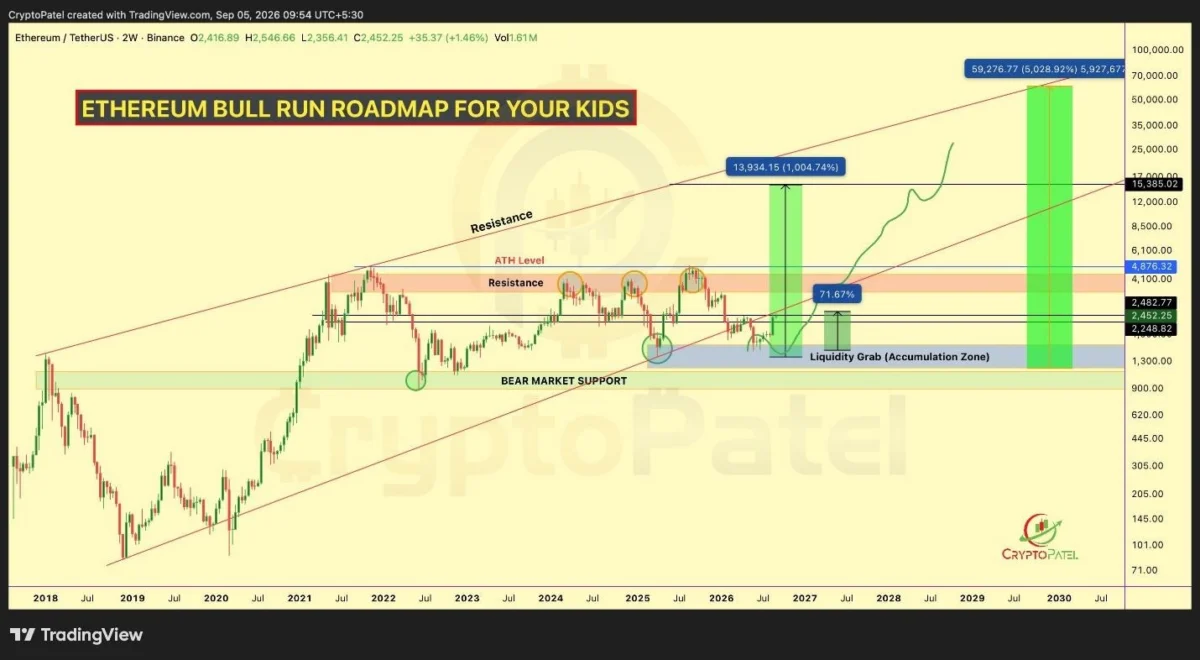
In a broader context, the long-term sentiment surrounding Ethereum remains notably bullish among some prominent figures in the crypto space. Crypto Patel, for instance, maintains a perspective that Ethereum’s long-term trajectory could extend far beyond current price expectations, potentially reaching over $15,000. This analyst views significant price dips not as reasons for concern but as potential accumulation opportunities for long-term holders, reinforcing a conviction in Ethereum’s future value appreciation. This perspective suggests that short-term price fluctuations are less critical than the underlying technological development and adoption trends.
The prevailing sentiment among these analysts, therefore, is that Ethereum is currently in a state of accumulation and consolidation, with strong underlying support and potential catalysts for upward movement. The significant outflow of ETH from exchanges, coupled with the technical indicators suggesting an impending breakout, paints a picture of a market poised for a potential rally.
Broader Implications and Market Reaction
The implications of these developments extend beyond immediate price action. A sustained increase in ETH holdings by investors, rather than exchange-based trading, can signal a long-term belief in the asset’s value. This shift can reduce volatility in the short term, but also potentially lead to sharper price increases if demand outstrips the now-limited supply. The market’s reaction to the $2,520 to $2,550 resistance zone will be a critical determinant of whether the reduced exchange supply translates into sustained price appreciation.

As of the latest reporting, Ethereum was trading at $2,436, reflecting a 2.89% decrease over the preceding 24-hour period. This figure, while showing a slight daily dip, does not negate the broader trend of consolidation and exchange outflows that analysts are closely watching. The interplay between these factors—technical price patterns, exchange dynamics, and analyst sentiment—will likely shape Ethereum’s performance in the coming days and weeks.
The narrative surrounding Ethereum’s current market position is one of anticipation. The cryptocurrency has demonstrated resilience by holding key support levels while exhibiting signs of accumulating upward momentum, despite broad market fluctuations. The significant withdrawal of ETH from exchanges is a tangible signal that investors are moving their assets into self-custody, often a precursor to a belief in future price appreciation or a strategy to reduce exposure to exchange-related risks.
The focus remains on the critical resistance levels, particularly the $2,520 to $2,550 range. A decisive breach of this area would not only validate the bullish outlook but could also trigger a cascade of buying activity as traders and investors react to the established uptrend. Conversely, a failure to overcome these resistance points could lead to a retracement, offering further opportunities for accumulation for those who believe in Ethereum’s long-term potential.
The broader market context, including the performance of Bitcoin and the overall sentiment within the cryptocurrency ecosystem, will also play a role. However, the specific on-chain data and technical analysis pertaining to Ethereum suggest that the cryptocurrency is currently navigating a crucial juncture. The coming days will be pivotal in determining whether the current consolidation phase gives way to a significant upward trajectory, as many analysts anticipate, or if further price discovery occurs within the established trading ranges. The continued outflow of ETH from exchanges remains a key metric to track, as it directly impacts the available supply and could be a significant driver of future price movements.