Ethereum, the second-largest cryptocurrency by market capitalization, is currently navigating a pivotal juncture, trading below the $2,700 mark and exhibiting signs of indecision. This prolonged consolidation period suggests a potential lack of conviction among market participants, prompting analysts to scrutinize the cryptocurrency’s immediate future. The prevailing sentiment is one of cautious observation, as Ethereum hovers precariously above key technical indicators, with the potential for significant price movements in either direction.
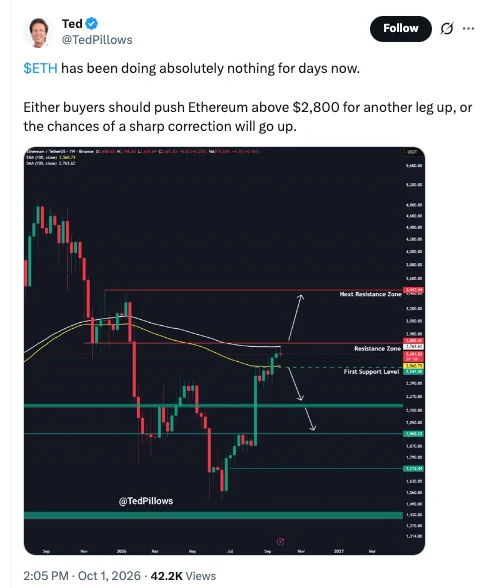
The current price action for Ethereum places it in a precarious position, hovering around the $2,620 level at the time of reporting. This price point sits between two significant moving averages: the 100-day Simple Moving Average (SMA), which is currently established around $2,780, and the 100-day Exponential Moving Average (EMA), sitting at approximately $2,560. The proximity of the current trading price to both these averages indicates a delicate balance, where either bullish or bearish forces could seize control and dictate the next significant trend. This technical setup is a classic illustration of market indecision, where traders and investors are awaiting a clear signal to commit to a particular direction. The absence of a strong directional bias suggests that underlying market sentiment is mixed, with both buyers and sellers exerting influence without achieving decisive dominance.
Prominent crypto analyst Ted Pillows, in a recent social media post, highlighted the significance of the $2,800 level as a critical threshold for Ethereum. According to Pillows, a sustained break above this resistance level is paramount for the bulls to maintain upward momentum and potentially initiate a more substantial rally. Conversely, a failure to overcome this barrier could invite significant selling pressure, leading to a sharp price correction. This perspective underscores the importance of technical analysis in understanding the short-term outlook for cryptocurrencies, where key price levels often act as psychological barriers or springboards for future price action. The $2,800 mark, therefore, represents a crucial battleground for market sentiment, with its breach or defense likely to shape Ethereum’s trajectory in the coming days and weeks.
Historical Context: The "Uptober" Myth and its Recent Revisions
The month of October has historically been associated with a bullish sentiment in the cryptocurrency market, a phenomenon often referred to as "Uptober." This perception is rooted in historical data, which suggests that in 13 out of the last 10 years, October has witnessed net positive price movements for cryptocurrencies. This statistical trend has often been cited by market participants as a reason for optimism as the month begins.
However, this optimistic outlook has been tempered by recent events. Last October, for instance, served as a stark reminder of the market’s inherent volatility. The period saw unprecedented levels of derivatives liquidations, exceeding $15 billion, which effectively signaled an early end to the 2024-2025 bull market. This event demonstrated that historical trends are not infallible predictors of future performance and that unforeseen market shocks can rapidly alter the prevailing sentiment. The magnitude of liquidations witnessed last year suggests a systemic deleveraging event, where highly leveraged positions were forcibly closed, cascading through the market and leading to significant price declines. This serves as a cautionary tale for investors relying solely on historical patterns.
This year’s October has, thus far, not provided a definitive bullish signal. The initial week, often considered crucial for setting the tone, has seen major cryptocurrencies trading sideways or experiencing modest declines. This lack of strong upward momentum is a cause for concern for bulls who had hoped for a robust start to the month. While there is still ample time for the market to shift, the current sluggish performance does not align with the optimistic "Uptober" narrative that many had anticipated. The fact that key levels just below multi-month highs are still being defended offers a sliver of hope for the bulls, but the overall picture remains uncertain.

Technical Analysis and Potential Downside Risks
The immediate technical outlook for Ethereum presents a scenario where a breach of critical support levels could trigger a cascade of further declines. If the bearish forces manage to push Ethereum below its current trading range, analysts are closely watching several key price levels as potential downside targets. These include $2,547, which represents the next significant support. A break below this level could then lead to further declines towards $1,965 and subsequently $1,713. These figures are not arbitrary; they often represent historical price floors or areas where significant buying interest has previously emerged.
The interplay between the 100-day SMA and EMA offers further insight into the current market dynamics. The fact that Ethereum’s spot price is trading between these two averages signifies a period of equilibrium, where neither the short-term trend (represented by the EMA) nor the medium-term trend (represented by the SMA) is clearly dominant. This precarious balance implies that a catalyst, either positive or negative, could easily disrupt this equilibrium and propel the price decisively in one direction.
The 100-day SMA, acting as a benchmark for medium-term price trends, is currently at $2,780. If Ethereum can reclaim and sustain a position above this level, it would signal a resurgence of bullish momentum and potentially pave the way for further upside. Conversely, a sustained failure to break above this average could be interpreted as a confirmation of bearish sentiment, increasing the probability of a downward move towards the aforementioned support levels. The EMA, which gives more weight to recent price data, sits at $2,560. This level is currently acting as a more immediate support. A decisive break below $2,560 would likely accelerate the selling pressure, bringing the lower support levels into play.
The Role of Bitcoin and Market Dominance
In the broader cryptocurrency ecosystem, Bitcoin (BTC) often plays the role of a market leader, setting the trend for many other digital assets, including Ethereum. Therefore, the performance of Bitcoin is closely scrutinized by investors looking to gauge the overall health and direction of the cryptocurrency market. Similarly, Ethereum’s own market dominance, a measure of its market capitalization relative to the total market capitalization of all cryptocurrencies, is a significant indicator.
Ethereum’s substantial role in the decentralized finance (DeFi) sector and its position as the backbone for a vast array of decentralized applications (dApps) mean that its performance has far-reaching implications for the entire altcoin market. The altcoin market, which encompasses all cryptocurrencies other than Bitcoin, is often heavily influenced by Ethereum’s price action and overall network health. If Ethereum falters, it can create a ripple effect, leading to broader declines across the altcoin space. Conversely, a strong performance from Ethereum can often lead to increased investor confidence and capital flowing into other altcoins.
Currently, Ethereum’s positioning appears vulnerable, if not weak, according to market observers. This vulnerability stems from its inability to break through key resistance levels and its proximity to significant support. This precarious state suggests that any significant negative catalyst could lead to a sharp decline, not only impacting Ethereum’s price but also potentially triggering a broader downturn in the altcoin market. The market is keenly observing whether Ethereum can regain its footing and demonstrate resilience, or if it will succumb to the prevailing bearish pressures, thereby signaling a more challenging period ahead for the broader cryptocurrency landscape.

Broader Implications and Investor Sentiment
The current market conditions surrounding Ethereum have significant implications for a wide range of stakeholders, including individual investors, institutional players, and developers building on the Ethereum network. For individual investors, the uncertainty translates into a period of caution. Many may be adopting a "wait-and-see" approach, deferring new investment decisions until a clearer trend emerges. This can lead to reduced trading volumes and a general slowdown in market activity.
For institutional investors, who have shown increasing interest in cryptocurrencies in recent years, the current environment presents both challenges and opportunities. While the volatility may deter some, it also creates potential entry points for those with a long-term investment horizon. However, the lack of clear directional momentum can make it difficult to deploy capital strategically. Institutions often rely on robust data and clear market signals before making significant commitments.
For developers and projects building on the Ethereum blockchain, sustained price weakness or significant volatility can have a dampening effect. While the underlying technology and innovation continue to advance, a prolonged bear market can impact funding, user adoption, and overall sentiment within the ecosystem. The success of the Ethereum network is intrinsically linked to the economic viability and growth of the dApps and protocols it supports.
The current situation also raises questions about the long-term growth prospects of cryptocurrencies, particularly in the context of evolving macroeconomic conditions. Factors such as inflation rates, interest rate policies, and global economic stability can all influence investor appetite for riskier assets like cryptocurrencies. As central banks around the world continue to navigate complex economic landscapes, the correlation between traditional financial markets and the cryptocurrency market is likely to remain a significant factor influencing price movements.
Ultimately, the coming days and weeks will be crucial for Ethereum. The ability of the bulls to defend current support levels and mount a sustained push above key resistance will determine whether the cryptocurrency can regain its upward momentum. Conversely, a failure to do so could usher in a period of significant price correction, impacting not only Ethereum but also the broader digital asset market. The narrative of "Uptober" remains to be written, and the market is eagerly awaiting the unfolding chapters. The resilience of Ethereum, and by extension the altcoin market, hinges on its capacity to overcome current technical hurdles and a potentially shifting market sentiment.