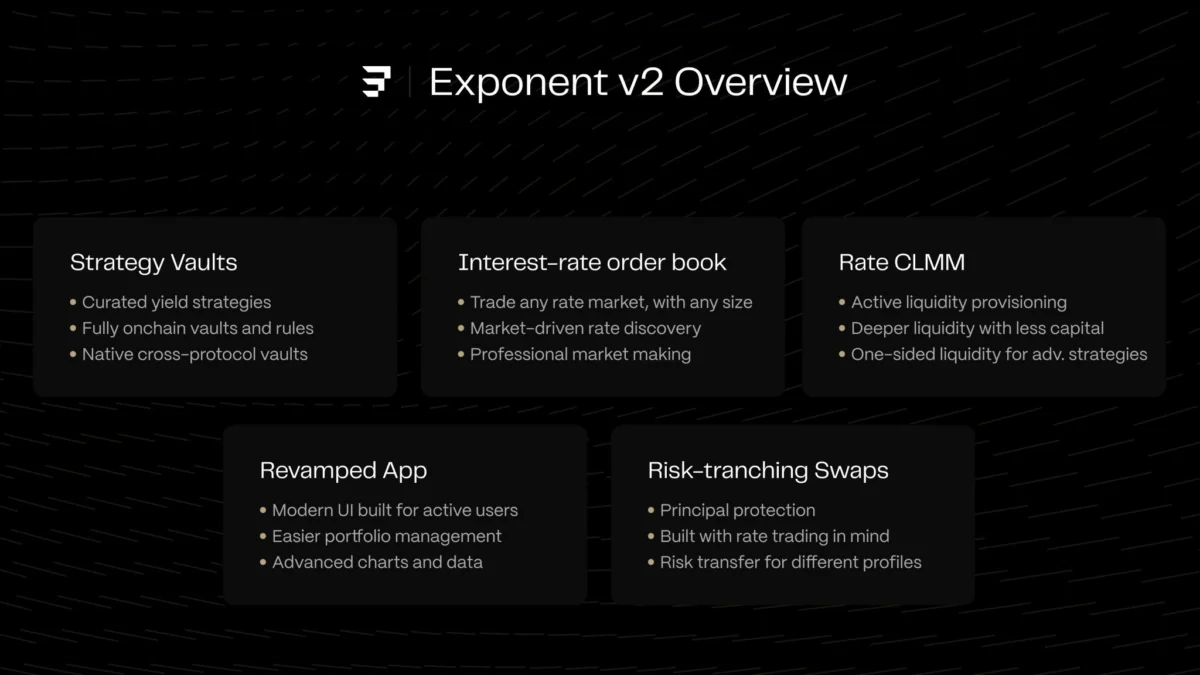
Exponent Finance has launched its V2 platform, marking a significant evolution from its origins as a primarily interest rate swap niche product to a comprehensive, fully institutionalized on-chain capital and yield management marketplace. This strategic pivot positions Exponent as a pivotal infrastructure layer within the burgeoning decentralized finance (DeFi) ecosystem, particularly on the Solana blockchain. The upgrade introduces a suite of advanced features designed to attract and accommodate institutional capital, including flagship rate markets, sophisticated Strategy Vaults, a dedicated rate order book, innovative Rate Concentrated Liquidity Market Maker (CLMM) infrastructure, and groundbreaking risk-tranching swaps that enable principal-protected strategies. Coinciding with this monumental platform upgrade, Exponent is also launching a robust rewards campaign, offering users over $200,000 to encourage liquidity provision and platform utilization.
This launch represents one of the most ambitious undertakings to seamlessly integrate fixed-income-style infrastructure into the very fabric of decentralized finance. While several protocols within DeFi have previously introduced sophisticated interest rate and yield-management systems, often drawing parallels to those prevalent in traditional financial markets, the prevailing focus of DeFi has historically gravitated towards speculative activities such as token trading or opportunistic lending. Exponent’s V2 aims to redefine this narrative, describing its upgraded platform as one "built for outliers" and asserting its role as fundamental infrastructure for next-generation rate markets and advanced on-chain capital allocation strategies. This move is indicative of a broader industry trend towards a more mature, institutionally-ready DeFi landscape.
The Evolution of Exponent: From Niche Swaps to Comprehensive Marketplace
Exponent Finance’s journey began by addressing a specific yet crucial segment of financial markets: interest rate swaps. In traditional finance, interest rate swaps are over-the-counter derivative contracts between two parties that agree to exchange future interest payments based on a specified principal amount, typically exchanging a fixed interest rate for a floating one or vice-versa. These instruments are fundamental for hedging against interest rate risk, speculating on future rate movements, and managing liabilities or assets with different interest rate sensitivities. Bringing such complex financial primitives on-chain presents unique technical and liquidity challenges, which Exponent initially tackled by focusing on this specialized niche.
The V2 upgrade signifies a dramatic expansion of this initial focus. The transformation into an "on-chain capital and yield management marketplace" implies a much broader scope, encompassing a range of services that allow users to deploy, manage, and optimize their digital assets for yield generation directly on the blockchain. The term "fully institutionalized" is particularly noteworthy in the context of DeFi. It suggests the integration of features and assurances that meet the stringent requirements of institutional investors, such as robust security protocols, transparent risk management frameworks, compliance readiness, high liquidity depth, and the capacity to handle large transaction volumes without significant slippage. This shift is critical for bridging the gap between the nascent, often volatile world of DeFi and the established, risk-averse environment of traditional finance, where institutional players control trillions in assets. By building out this comprehensive framework, Exponent aims to provide the stability, predictability, and sophistication that institutional capital demands, moving DeFi beyond its retail-centric origins.
Unpacking Exponent V2’s Core Infrastructure Upgrades
The V2 release bundles several significant infrastructure updates, each designed to enhance the platform’s functionality, efficiency, and appeal to a broader user base, particularly institutional participants.
-
Flagship Rate Markets: These markets are designed to facilitate the transparent and efficient discovery of interest rates for various on-chain assets. Unlike simple lending protocols where rates are often determined algorithmically or by supply/demand with limited customization, flagship rate markets imply a more sophisticated mechanism for price discovery, potentially involving various tenors and underlying assets, similar to bond markets in traditional finance. This allows for more precise risk management and yield planning.
-
Strategy Vaults: A cornerstone of the V2 upgrade, Strategy Vaults automate capital allocation strategies across multiple rate markets and yield opportunities. In traditional finance, actively managed funds or hedge funds employ complex strategies to optimize returns, often requiring constant monitoring and rebalancing. Strategy Vaults bring this level of automation and sophistication to DeFi, enabling users to access advanced yield strategies without the onerous task of manually managing a myriad of positions and constantly rebalancing their exposure. This significantly lowers the barrier to entry for complex yield farming strategies, making them accessible even to less experienced users, while providing institutional-grade tools for advanced users.
-
Dedicated Rate Order Book: The introduction of a dedicated rate order book is a critical enhancement for liquidity and price discovery. While many DeFi protocols rely on Automated Market Makers (AMMs), which can sometimes lead to slippage, especially for large orders, an order book allows for precise limit orders and provides a clearer view of market depth. This feature is crucial for institutional traders who require predictable execution, tight spreads, and the ability to place large orders without significantly impacting market prices, mirroring the trading environments found on traditional exchanges.
-
Rate CLMM Infrastructure: Exponent V2 integrates Concentrated Liquidity Market Maker (CLMM) infrastructure specifically tailored for rate markets. CLMMs, popularized by platforms like Uniswap V3, allow liquidity providers to concentrate their capital within specific price ranges, significantly increasing capital efficiency compared to traditional AMMs that distribute liquidity evenly across all possible prices. For rate markets, this means liquidity providers can earn higher fees on their deployed capital by focusing on expected interest rate ranges, leading to deeper liquidity where it matters most and better pricing for traders.
-
Risk-Tranching Swaps to Enable Principal-Protected Strategies: Perhaps one of the most significant innovations in V2, risk-tranching swaps directly address a major hurdle for institutional adoption: the lack of robust risk management tools that enable capital preservation. Risk tranching involves segmenting a financial product’s cash flows and risks into different classes, or "tranches," each with a different risk/return profile. This allows participants to choose a tranche that aligns with their risk appetite. By enabling principal-protected strategies, Exponent allows investors to participate in yield-generating opportunities while safeguarding their initial capital, or a significant portion thereof, against market volatility. This mechanism is paramount for institutions bound by fiduciary duties or strict risk mandates, making DeFi a more viable investment avenue.
To accelerate adoption and reward early participants, Exponent has concurrently launched a rewards campaign exceeding $200,000. Such incentives are common in DeFi to bootstrap liquidity and attract users to new platforms or significant upgrades, fostering a vibrant ecosystem from the outset.
Solana’s DeFi Maturation: A Shift Towards Institutional-Grade Primitives
The V2 rollout by Exponent Finance also underscores the continued and rapid maturation of Solana’s decentralized finance ecosystem. For a considerable period, particularly during the previous market cycle, Solana’s DeFi landscape was largely characterized by its focus on blazing-fast spot exchange infrastructure, speculative memecoin trading, and high-throughput but often less complex applications. Its technical prowess, boasting high transaction speeds and low fees, made it a favored chain for retail traders and high-frequency speculative activities.
However, a discernible shift has been underway. The ecosystem is now witnessing the emergence of newer players and protocols that are building a much wider array of institutional-grade financial primitives. This includes sophisticated structured products, more intelligent derivatives, and capital-efficient yield vehicles that were previously the exclusive domain of traditional finance. Exponent’s V2 architecture is a prime example of this evolution, directly contributing to Solana’s growing reputation as a hub for advanced, professional-grade DeFi.
This transformation is critical for Solana’s long-term viability and its ability to attract deeper pools of capital. Institutional investors, including hedge funds, asset managers, and corporate treasuries, are increasingly exploring opportunities within the crypto space. However, their participation is contingent upon the availability of products and infrastructure that offer robust risk management, predictable returns, and compliance-friendly features. By fostering an environment where protocols like Exponent can develop complex financial instruments such, Solana is strategically positioning itself to become a leading blockchain for institutional DeFi, moving beyond its initial image as a speculative playground. This shift across the board indicates that DeFi infrastructure is naturally evolving into more complex financial ecosystems capable of supporting structured principal-protected (PTs) institutional capital, as opposed to strictly retail speculation.

Advanced Yield Products: Strategy Vaults and the Power of Risk Tranching
Two of the most impactful innovations within Exponent V2 are the implementation of Strategy Vaults and the risk-tranching swap infrastructure. These features are designed to significantly enhance engagement in structured yield products and sophisticated portfolio management systems, directly competing with and emulating mechanisms commonly observed in traditional fixed income and institutional investment markets.
Strategy Vaults are designed to streamline the automation of capital allocation strategies across diverse rate markets and yield opportunities. In essence, they act as automated portfolio managers for DeFi assets. Instead of users needing to constantly monitor and manually rebalance their positions across various protocols, lending pools, and rate markets to optimize yield or manage risk, Strategy Vaults execute predefined strategies automatically. This not only saves considerable time and effort for users but also allows them to access advanced, algorithmically driven yield strategies that would otherwise require deep expertise and constant attention. This level of automation and strategic execution is a hallmark of institutional investment products in traditional finance, where asset managers use sophisticated software to manage client portfolios.
Concurrently, Exponent has introduced risk-tranching swaps, specifically engineered to facilitate principal-protected strategies. This innovation holds immense significance for the broader adoption of DeFi by larger institutional players. A major impediment to institutional engagement in DeFi has been the perceived high risk and volatility, coupled with a notable absence of structured risk management tools that enable capital preservation, particularly during turbulent market conditions. Risk tranching directly addresses this by allowing participants to partition the risk and return of an underlying asset or pool into different classes. For instance, a "senior" tranche might offer lower but more stable returns with strong principal protection, while a "junior" or "equity" tranche might offer higher potential returns but absorb initial losses, thereby exposing itself to greater risk.
This framework is fundamental to traditional finance, serving as the basis for a wide array of products such as Collateralized Debt Obligations (CDOs), structured credit instruments, and various yield-focused investment vehicles. CDOs, for example, pool together various types of debt and then divide the aggregate cash flows into different tranches, each with varying levels of seniority and risk. The integration of such sophisticated risk management and structuring tools into decentralized finance represents a crucial next step in the evolution of on-chain financial engineering. It provides institutions with the familiar structures and risk mitigation capabilities they require, making the leap into DeFi less daunting and significantly more appealing.
The DeFi Yield Battleground: A Race for Capital Markets Infrastructure
The expansion of Exponent Finance with its V2 mirrors a larger, increasingly intense theme across the entire crypto market: the fierce race to capture and dominate on-chain yield infrastructure. As decentralized finance continues its rapid evolution, the focus is increasingly shifting from rudimentary spot exchanges and basic lending protocols towards the development of comprehensive capital markets infrastructure. This includes new types of lending mechanisms, sophisticated fixed income products, complex structured products, robust treasury management solutions for decentralized autonomous organizations (DAOs) and corporations, and institutional-grade liquidity systems.
Yield has rapidly ascended to become one of the most coveted products in blockchain finance. Protocols are now intensely vying for supremacy in providing scalable interest rate discovery, optimizing capital allocation, and delivering superior risk-adjusted returns to a diverse spectrum of end-user segments. These segments range from individual retail traders and desk workers seeking passive income to large corporate treasury managers looking to deploy idle capital efficiently and safely within the digital asset space. The demand for stable, predictable, and capital-efficient yield opportunities is a powerful driving force behind innovation in DeFi.
Exponent firmly positions itself within this crucial "yield battleground." Its protocol layer is deliberately focused on rate markets rather than merely building out spot trading infrastructure. This involves creating an underlying asset aggregation mechanism for future yield expectations while dynamically adjusting for capital efficiency. This strategic emphasis on interest rate products is not arbitrary; it draws a direct parallel to the evolution of traditional cash-based markets. In conventional finance, interest rate products—ranging from government bonds to corporate debt and complex derivatives—have become one of the largest and most systemically important segments. They play critical roles in credit systems, treasury operations, derivatives pricing, and institutional portfolio management, acting as benchmarks and fundamental building blocks for financial stability and growth. Decentralized finance appears to be heading into a remarkably similar stage of development, where sophisticated interest rate management will become indispensable.
Navigating the Challenges of Decentralized Innovation: Community Feedback and Operational Hurdles
While the excitement surrounding the launch of a product as complex and ambitious as Exponent V2 is palpable, the deployment of such large-scale infrastructure in a decentralized environment is rarely without its initial challenges. Community feedback, an invaluable component of open-source and decentralized development, has already highlighted some early operational issues that underscore the inherent difficulties of building cutting-edge financial infrastructure on nascent decentralized primitives.
Specific concerns raised by users include difficulties connecting to certain Solstice YT-USX/eUSX markets on the new Exponent V2 user interface after attempting connections through the Solstice website. Another point of feedback related to the lack of 16 Sep26 markets, which could pose a challenge for users aiming to maintain alignment with their Total Weighted Average TVL (Total Value Locked) positioning for 01Jun26 market maturations. While these specific problems might appear to be isolated or one-off instances, they collectively illuminate the intricate complexities involved in constructing higher-level financial infrastructure over a foundation of decentralized protocols.
The nature of decentralized systems, characterized by their composability and reliance on interoperability between various independent protocols, introduces unique challenges. Ensuring seamless integration between different on-chain components, liquidity providers, vault infrastructure, and external exchanges becomes paramount. This ecosystem-wide interoperability is not merely a convenience but a critical requirement for the stability and functionality of institutional-grade products. Furthermore, maintaining a consistent and intuitive user experience across a decentralized environment, where different wallets, browsers, and network conditions can introduce variability, adds another layer of complexity. The infrastructure behind institutional products demands not only cutting-edge design and robust security but also stable, trustless interoperability and a consistently reliable user experience.
Such immediate operational experiences are not entirely surprising following large-scale protocol updates. In fact, they often represent critical trials that test the long-term viability and scalability of the platform. The ability of the development team to promptly address these issues and iterate based on community feedback will be crucial for Exponent’s sustained success and for fostering trust within its user base. On the whole, the market response to Exponent V2 has been largely positive, given the extensive nature of the infrastructure improvements rolled out simultaneously. This release, despite its initial teething problems, clearly demonstrates the ongoing emergence of decentralized finance on Solana, transitioning from being primarily a speculative trading platform to one that actively supports and facilitates an entire financial ecosystem with complex capital markets infrastructure.
Future Outlook and Implications for DeFi on Solana
Exponent Finance’s V2 launch is more than just a product update; it is a significant indicator of the trajectory of decentralized finance, particularly on the Solana blockchain. The shift towards institutional-grade capital and yield management tools signals a maturing industry poised to attract a far wider array of participants than ever before.
The broader implications of this evolution are profound. Firstly, the introduction of sophisticated risk management tools like risk-tranching swaps is instrumental in bridging the credibility gap between traditional finance and DeFi. By offering mechanisms for principal protection and structured risk profiles, protocols like Exponent are directly addressing the primary concerns of institutional investors, potentially unlocking vast pools of capital currently hesitant to enter the crypto space due to perceived volatility and lack of regulated safeguards.
Secondly, this development reinforces Solana’s position as a leading blockchain for innovation in high-performance DeFi. Its technical architecture, characterized by high throughput and low transaction costs, makes it an ideal environment for complex financial instruments that require rapid execution and frequent interactions. As more institutional-grade primitives emerge on Solana, it is likely to attract further development and investment, solidifying its role as a key player in the next phase of DeFi growth.
Finally, the increasing focus on capital markets infrastructure over simple spot trading infrastructure suggests a long-term vision for DeFi as a comprehensive, autonomous financial system. Just as traditional financial markets evolved from basic exchanges to complex networks of derivatives, fixed income, and structured products, DeFi is charting a similar course. This trajectory promises a more robust, resilient, and integrated financial ecosystem that could eventually rival or even surpass aspects of traditional finance in efficiency and transparency. Exponent V2, with its ambitious array of features, stands as a testament to this evolving vision, paving the way for a future where decentralized finance serves as a fundamental pillar of the global economy.