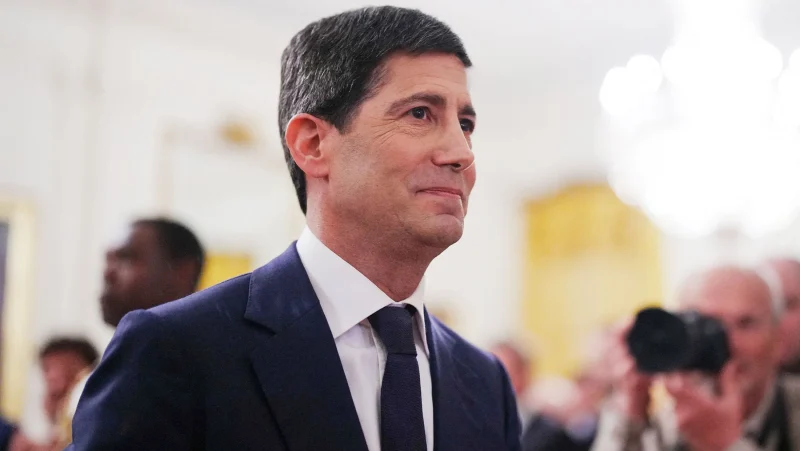
The Federal Open Market Committee (FOMC) concluded its two-day policy meeting on Wednesday, June 17, 2026, marking a significant milestone in American monetary history as Kevin Warsh presided over his first session as Chair of the Federal Reserve. In a move that aligned with the consensus of Wall Street economists and institutional investors, the Committee voted unanimously to maintain the target range for the federal funds rate at 3.50% to 3.75%. This decision represents a tactical pause in the central bank’s ongoing effort to balance robust economic expansion against persistent inflationary pressures that remain stubbornly above the long-term 2% objective.
The 12-0 vote to hold rates steady was accompanied by a directive to continue the Fed’s policy of maintaining ample reserves within the banking system, a technical necessity designed to ensure the smooth functioning of short-term lending markets. While the rate freeze was widely anticipated, the atmospheric tension surrounding the meeting was palpable, as markets sought to decipher the "Warsh doctrine"—the policy leanings and communication style of the new Chair, who succeeded Jerome Powell earlier this year.
The Dawn of the Warsh Era and Market Response
Kevin Warsh, a former member of the Federal Reserve Board of Governors and a figure long associated with market-centric monetary philosophy, took the gavel at a time of complex cross-currents. His first policy statement as Chair was scrutinized for every nuance, with traders looking for shifts in rhetoric compared to the previous administration. The immediate reaction across financial sectors suggested a degree of disappointment among those hoping for a more "dovish" or accommodative signal regarding future rate cuts.
Bitcoin, often viewed as a high-beta barometer for liquidity and risk sentiment, fell nearly 1% shortly after the announcement. This decline extended a period of intraday weakness, as crypto investors reacted to the Fed’s firm stance on inflation. The broader digital asset market followed suit, trading with notable caution as participants awaited the Chair’s first post-meeting press conference.
Traditional equities also faced headwinds. The S&P 500 and the tech-heavy Nasdaq Composite both registered declines of approximately 1% in the hours following the release. Market analysts suggested that the sell-off was less about the rate decision itself—which had been 98% priced in according to the CME FedWatch Tool—and more about the lack of a definitive "pivot" toward easing. The markets appeared to be recalibrating for a "higher for longer" environment, particularly as the Fed emphasized that price stability has not yet been fully restored.
Economic Assessment: Productivity vs. Uncertainty
The FOMC’s policy statement provided a comprehensive overview of the current macroeconomic landscape, characterizing economic activity as expanding at a "solid pace." This assessment is supported by recent data showing resilient consumer spending and a surprising surge in corporate capital investment. However, this growth is occurring against a backdrop of "elevated uncertainty," much of it stemming from the ongoing conflict in the Middle East.
One of the more optimistic notes in the statement was the mention of strong productivity growth. Economists generally view rising productivity as a "holy grail" for central bankers, as it allows the economy to grow faster without necessarily triggering inflation. By producing more output per hour worked, firms can offset rising wage costs, potentially cooling the labor-market-driven component of inflation.
Despite these gains, the labor market remains a point of intense focus. The Fed noted that job gains have largely kept pace with the growing workforce, and the unemployment rate has remained relatively stable at historically low levels. While a strong labor market is generally a sign of economic health, the Fed remains wary that an overly tight job market could sustain wage-price spirals, complicating the return to the 2% inflation target.
The Inflation Challenge and Supply-Side Shocks
Inflation remains the primary antagonist in the Federal Reserve’s narrative. While the headline Consumer Price Index (CPI) has retreated significantly from its post-pandemic peaks, it continues to hover above the 2% goal. The Committee’s statement explicitly linked current price pressures to supply shocks, particularly in the energy sector.
The volatility in global energy markets, exacerbated by geopolitical tensions in the Middle East, has created a "sticky" inflation environment. The Fed’s acknowledgment of these supply-side issues is significant; it suggests that while the central bank can control demand through interest rates, it is currently grappling with factors outside its direct influence.
In a direct and firm signal to the markets, the statement included the phrase: the Fed “will deliver price stability.” This wording is seen by veteran Fed watchers as a hawkish commitment, indicating that the Committee is prepared to sacrifice short-term economic growth if necessary to prevent inflation from becoming entrenched. The refusal to "declare victory" on inflation suggests that the threshold for a rate cut remains high, requiring more definitive proof that price increases are on a sustainable downward trajectory.
Chronology of Policy Shifts
To understand the current 3.50% to 3.75% range, one must look at the trajectory of the Fed’s actions over the past 24 months. Following a period of aggressive tightening to combat the inflation surge of 2022-2023, the Fed entered a "restrictive hold" phase.
- Late 2024 – Early 2025: The Fed maintained rates at a multi-decade high to break the back of persistent core inflation.
- Late 2025: As inflation began to cool, the FOMC initiated a series of "recalibration" cuts, bringing the rate down to the current mid-3% range to avoid an unnecessary recession.
- June 2026: Under Chair Warsh, the Fed has hit the pause button. This pause is intended to allow the Committee to observe the lagging effects of previous hikes and the impact of the renewed energy crisis.
This chronology highlights the "data-dependent" nature of the FOMC, a mantra that Warsh appears to have embraced in his first outing.
The Dot Plot and Future Projections
The focal point for institutional investors now shifts to the "Summary of Economic Projections," commonly known as the dot plot. This chart, updated quarterly, maps out where each FOMC member expects interest rates to be over the next several years.
Early analysis of the updated projections suggests a divergence of opinion within the Committee. Some members appear to favor one or two more cuts before the end of 2026, citing the potential for productivity gains to keep inflation in check. Others, however, have moved their "dots" upward, reflecting concerns that the Middle East conflict could lead to a secondary inflation wave.
Chair Warsh’s press conference is expected to provide the necessary context for these dots. Markets are particularly interested in his view on the "neutral rate"—the theoretical interest rate that neither stimulates nor restrains the economy. If Warsh believes the neutral rate has risen due to structural changes in the economy, it would imply that the current 3.50%-3.75% range is not as restrictive as previously thought, potentially justifying a longer hold or even a return to hikes if inflation re-accelerates.
Broader Impact and Global Implications
The Federal Reserve’s decision does not exist in a vacuum; it has profound implications for the global financial system. As the issuer of the world’s primary reserve currency, the Fed’s "higher for longer" stance puts pressure on other central banks.
- Currency Markets: A steady and relatively high US interest rate supports the strength of the US Dollar. This, in turn, makes imports cheaper for Americans (helping to lower inflation) but increases the cost of dollar-denominated debt for emerging markets.
- The European Central Bank (ECB) and Bank of England (BoE): These institutions are facing similar inflationary struggles but with weaker economic growth than the US. The Fed’s pause gives them some breathing room, but a strong dollar continues to export inflation to their shores by making energy (priced in dollars) more expensive.
- Geopolitical Stability: The mention of the Middle East conflict in the FOMC statement highlights the intersection of monetary policy and global security. Prolonged instability in the region could force the Fed’s hand, necessitating a more aggressive stance to counter energy-led inflation, regardless of the domestic growth outlook.
Institutional Reactions and Analysis
Initial reactions from leading financial institutions suggest a "wait and see" approach. Goldman Sachs analysts noted that "Chair Warsh has successfully navigated his first meeting without triggering a market tantrum, but the hawkish undertones regarding price stability suggest the ‘Fed Put’—the idea that the Fed will quickly step in to save markets—is currently out of the money."
JP Morgan’s chief economist remarked that the emphasis on productivity is the most "Warsh-like" element of the statement, reflecting his long-held belief that supply-side health is just as important as demand-side management. "Warsh is signaling that he won’t just look at the labor market; he’s looking at the efficiency of the entire US economic machine," the report stated.
Conclusion: A Cautious Path Forward
The June 2026 FOMC meeting will be remembered as the moment the Federal Reserve transitioned into a new chapter of leadership. By keeping rates unchanged, Kevin Warsh has signaled a commitment to continuity while simultaneously hardening the bank’s rhetoric on inflation.
The path forward remains fraught with challenges. The Fed must navigate the "last mile" of its inflation fight without tipping a resilient but sensitive economy into a downturn. With the shadow of geopolitical conflict looming over energy prices and the transformative potential of productivity gains offering a glimmer of hope, the Warsh-led Fed is walking a fine line. For now, the message to the markets is clear: the era of easy money is a distant memory, and the "delivery of price stability" remains the paramount mission of the central bank.