



Foundry, the digital asset infrastructure firm and operator of the world’s largest Bitcoin mining pool, has officially announced its strategic expansion into the privacy-preserving cryptocurrency sector with the upcoming launch of a dedicated Zcash (ZEC) mining pool. Slated for a commercial debut in April 2026, the new initiative is designed specifically to cater to the stringent requirements of institutional investors, public corporations, and large-scale enterprise miners who require a compliant and robust environment for securing the Zcash network. This move marks a significant milestone in the evolution of privacy-focused digital assets, as it signals a bridge between high-level financial anonymity and the transparency required by global regulatory frameworks.
The announcement comes at a pivotal time for Foundry, which currently dominates the Bitcoin mining landscape through Foundry USA. By leveraging its established reputation for reliability and its North American operational base, Foundry aims to address a critical infrastructure gap in the Zcash ecosystem. While Zcash has long been recognized for its sophisticated cryptographic foundations, the mining infrastructure supporting the token has often lacked the enterprise-grade features necessary to attract significant institutional capital. With the introduction of this new pool, Foundry seeks to provide a localized, secure, and professionalized platform for Equihash-based mining, mirroring the success it has achieved with the SHA-256 algorithm used by Bitcoin.
The Strategic Shift Toward Institutional Privacy
The decision to launch a Zcash-specific pool is rooted in the belief that financial privacy is becoming a prerequisite for institutional participation in the decentralized economy. Mike Coyler, the CEO of Foundry, emphasized that while Zcash has achieved the status of an institutional-grade asset due to its longevity and technological rigor, the supporting mining infrastructure has historically lagged. The new pool is intended to harmonize the inherent privacy features of Zcash with the operational standards expected by publicly traded companies and large-scale funds.
Zcash, which launched in October 2016, distinguishes itself from Bitcoin through its use of Zero-Knowledge Succinct Non-Interactive Arguments of Knowledge, or zk-SNARKs. While Bitcoin transactions are pseudonymous—meaning all transaction details, including sender, receiver, and amount, are visible on a public ledger—Zcash offers "shielded" transactions. These transactions allow users to prove the validity of a transfer without revealing any sensitive data. For institutions, this technology provides a mechanism to conduct business on a blockchain without exposing proprietary financial strategies or sensitive corporate data to competitors, all while maintaining a verifiable audit trail for compliance purposes.

Understanding the Zcash Network and Mining Mechanics
To appreciate the impact of Foundry’s entry, it is essential to understand the underlying mechanics of Zcash. The protocol was originally developed based on the Bitcoin codebase, inheriting many of its core economic principles. Like Bitcoin, Zcash has a hard supply cap of 21 million tokens. It also utilizes a proof-of-work (PoW) consensus mechanism, where miners solve complex mathematical puzzles to secure the network and validate transactions. In exchange for their computational efforts, miners are rewarded with newly minted ZEC tokens and transaction fees.
However, Zcash utilizes the Equihash algorithm, which differs significantly from Bitcoin’s SHA-256. Equihash is a memory-oriented proof-of-work algorithm that was initially designed to be resistant to Application-Specific Integrated Circuits (ASICs), though specialized ASIC miners for Equihash eventually entered the market. Foundry’s move into this space suggests a commitment to supporting diverse mining hardware and broadening its influence across different proof-of-work ecosystems.
The Zcash network also features a "halving" mechanism similar to Bitcoin’s. Approximately every four years, the block reward issued to miners is reduced by 50%. This deflationary model is designed to ensure the long-term scarcity of the asset. As the next halving cycles approach, the entry of a massive player like Foundry could provide the necessary hashrate stability to ensure network security during periods of reward reduction.
Recent Trends in Zcash Hashrate and Market Performance
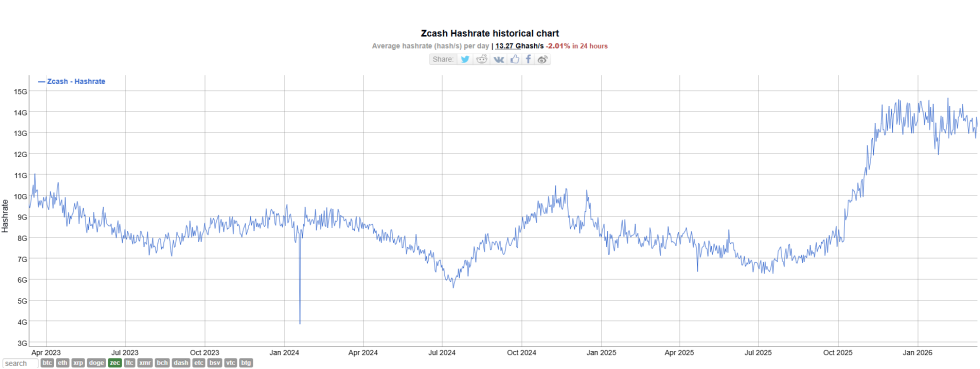
Foundry’s expansion is supported by recent data indicating a resurgence in interest in Zcash mining. According to metrics from BitInfoCharts, the Zcash network hashrate—the total computational power dedicated to the blockchain—has seen a substantial increase over the last two quarters. In October of the previous year, the hashrate languished below 8 Ghash/s. By March 2026, that figure has climbed to over 13 Ghash/s, representing a growth of more than 60% in a relatively short window.
This surge in hashrate suggests that miners are either deploying more efficient hardware or that new participants are entering the space in anticipation of increased institutional adoption. Higher hashrate levels generally correlate with increased network security, making the blockchain more resistant to 51% attacks and other malicious activities. For institutional players, a high hashrate is a key indicator of a network’s health and viability as a long-term investment.

Despite the positive technical indicators for the network, the price of ZEC has experienced volatility. At the time of the announcement, Zcash was trading at approximately $209, reflecting an 11% decline over the preceding week. This price retracement follows a broader market correction, yet the long-term trend for Zcash has shown resilience as privacy becomes a more prominent topic in global financial discourse.
Chronology of the Foundry Zcash Initiative
The path toward the April 2026 launch has been marked by several key developmental milestones:
- Late 2024 – Early 2025: Foundry begins internal feasibility studies on expanding beyond Bitcoin into other proof-of-work assets, identifying Zcash as a primary candidate due to its regulatory-friendly privacy features.
- October 2025: The Zcash network experiences a notable uptick in hashrate, crossing the 8 Ghash/s threshold, signaling renewed miner interest.
- January 2026: Foundry initiates technical integration tests for an Equihash-compatible mining interface, ensuring the pool can handle the high-throughput demands of institutional clients.
- March 2026: Official public announcement of the Zcash mining pool. Stakeholders including Shielded Labs express public support for the project.
- April 2026 (Projected): Formal launch of the Foundry Zcash pool, with several unnamed institutional partners expected to migrate their hashrate to the new platform.
Official Reactions and Industry Support
The announcement has been met with enthusiasm from key figures within the Zcash community. Zooko Wilcox, the founder of Zcash and currently the Chief Product Officer at Shielded Labs, lauded Foundry’s decision to establish a North American presence in the ZEC mining space. Shielded Labs, an independent organization based in Switzerland dedicated to supporting the Zcash ecosystem, views Foundry’s entry as a validation of Zcash’s maturation.
"We at Shielded Labs are delighted that Foundry—the largest Bitcoin mining pool, and one based in North America—is launching an enterprise-grade Zcash mining pool," Wilcox stated. He highlighted that the involvement of a major US-based operator provides a level of legitimacy and operational transparency that will likely encourage more conservative financial institutions to explore the benefits of Zcash.
Industry analysts suggest that Foundry’s move may also be a response to the evolving regulatory landscape in the United States and Europe. With the implementation of frameworks like the Markets in Crypto-Assets (MiCA) regulation in the EU, there is a growing demand for service providers who can demonstrate strict adherence to anti-money laundering (AML) and know-your-customer (KYC) protocols, even when dealing with privacy-centric assets. Foundry’s "institutional-grade" label implies that its pool will include the necessary compliance reporting tools that smaller, decentralized pools often lack.
Broader Implications for the Crypto Mining Industry
Foundry’s expansion into Zcash could trigger a ripple effect across the mining industry. For years, the dominance of Bitcoin has led many large infrastructure providers to focus almost exclusively on SHA-256 mining. Foundry’s diversification suggests that the industry is entering a new phase where large-scale operators seek to control hashrate across multiple high-value protocols.
Furthermore, the focus on North American operations is a continuation of the "hashrate migration" that began after the 2021 mining crackdown in China. By housing the Zcash pool in the U.S., Foundry offers domestic miners lower latency, legal protections, and the ability to operate within a familiar regulatory environment. This could potentially centralize a significant portion of Zcash’s hashrate within the U.S., a development that brings both increased stability and questions regarding the decentralization of the network.
From a technical standpoint, the launch will likely drive demand for the latest generation of Equihash ASIC miners. Manufacturers like Bitmain have historically released specialized hardware for Zcash, and a surge in institutional mining could incentivize further research and development in hardware efficiency.
Conclusion: Privacy as an Institutional Standard
As the digital asset market continues to professionalize, the distinction between "public" and "private" blockchains is becoming more nuanced. Foundry’s upcoming Zcash mining pool represents a bet on a future where privacy is not seen as a tool for evasion, but as a necessary component of a sophisticated financial system. By providing the "plumbing" for institutional Zcash mining, Foundry is positioning itself at the intersection of cutting-edge cryptography and traditional corporate finance.
The success of this venture, starting in April 2026, will be closely watched by the wider industry. If Foundry can replicate its Bitcoin success within the Zcash ecosystem, it may pave the way for other privacy assets to gain institutional acceptance, ultimately reshaping how the world views the relationship between blockchain transparency and financial confidentiality. For now, the significant growth in network hashrate and the backing of major industry players suggest that Zcash is entering a new era of enterprise-level utility.














