



Foundry, the digital asset infrastructure provider that operates the world’s largest Bitcoin mining pool, has officially announced its strategic expansion into the privacy-preserving cryptocurrency sector with the planned launch of a Zcash (ZEC) mining pool. Scheduled to go live in April 2026, the new initiative is designed specifically to cater to the requirements of institutional investors, public companies, and large-scale enterprise miners who require a higher tier of compliance, transparency, and operational reliability than what is currently available in the Zcash ecosystem. This move marks a significant milestone for Foundry, which currently dominates the Bitcoin mining landscape via Foundry USA, as it seeks to bridge the gap between sophisticated financial institutions and the specialized world of privacy-centric blockchain networks.
The decision to enter the Zcash market comes at a time of renewed interest in the coin’s underlying technology and its role in the broader digital asset economy. According to Foundry CEO Mike Colyer, while Zcash has matured into an institutional-grade asset with robust cryptographic foundations, the supporting mining infrastructure has historically lagged behind the standards expected by professional market participants. By launching a North American-based, institutional-grade pool, Foundry aims to provide a regulated and secure gateway for entities that wish to participate in securing the Zcash network but have been hesitant due to the decentralized or offshore nature of existing mining pools.
The Strategic Importance of Foundry’s Expansion
Foundry’s dominance in the Bitcoin mining sector provides a formidable foundation for this new venture. As a subsidiary of Digital Currency Group (DCG), Foundry has played a pivotal role in the professionalization of the North American mining industry. Its Bitcoin pool, Foundry USA, consistently captures the largest share of the global hashrate, often exceeding 25% to 30% of the total network computing power. This success has been built on a "compliance-first" approach, providing miners with the necessary tools for tax reporting, audit trails, and regulatory adherence—features that are often missing from smaller, community-run pools.
The expansion into Zcash represents a logical progression for Foundry as it diversifies its revenue streams and leverages its existing data center relationships and hardware procurement expertise. Zcash, which utilizes the Equihash hashing algorithm, requires different specialized hardware (ASICs) than Bitcoin’s SHA-256 algorithm. However, the operational logic of managing a large-scale mining pool—including payout distribution, security protocols, and client relations—remains largely the same. By applying the "Foundry USA model" to Zcash, the company expects to attract a significant portion of the network’s hashrate from miners who prioritize jurisdictional stability and professional service.

Zcash and the Paradox of Institutional Privacy
Zcash was launched in 2016 as a fork of the Bitcoin codebase, aiming to solve the inherent lack of privacy in public ledgers. While Bitcoin and Ethereum transactions are pseudonymous, their entire history is visible on a public blockchain, allowing sophisticated chain analysis firms to deanonymize users. Zcash addresses this through the use of Zero-Knowledge Succinct Non-Interactive Arguments of Knowledge (zk-SNARKs), a form of cryptography that allows transactions to be verified without revealing the sender, receiver, or transaction amount.
For institutions, Zcash presents a unique paradox. On one hand, financial privacy is a prerequisite for many corporate activities, such as payroll management, supply chain payments, and proprietary trading, where revealing transaction details to competitors would be detrimental. On the other hand, the "privacy coin" label has historically drawn scrutiny from global regulators concerned about money laundering and illicit finance.
Foundry’s entry into this space is an attempt to resolve this tension. The company’s press release emphasized that Zcash demonstrates how financial privacy and compliant digital infrastructure can coexist. By providing a transparent and verified mining pool environment based in the United States, Foundry offers a "white-label" solution that meets the "Know Your Customer" (KYC) and "Anti-Money Laundering" (AML) standards required by public companies.
Analyzing the Recent Zcash Hashrate Surge
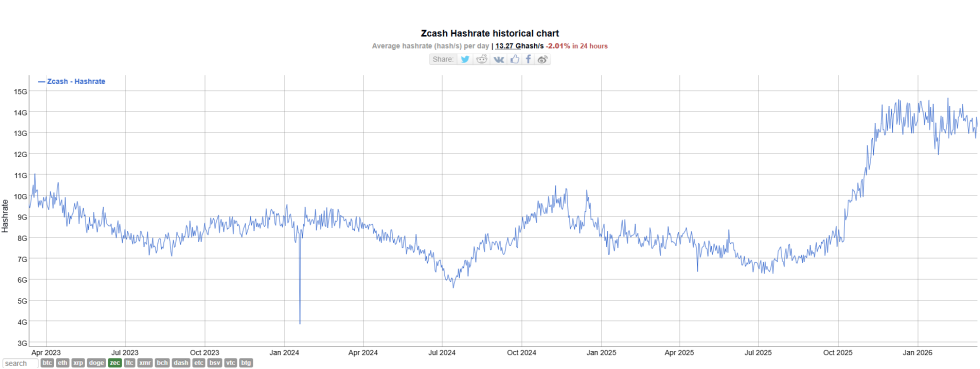
The timing of Foundry’s announcement coincides with a period of remarkable growth in the Zcash network’s computational security. Data from blockchain analytics providers like BitInfoCharts indicates that the ZEC hashrate has undergone a substantial boom in recent months. In October 2025, the network hashrate was positioned at roughly 8 Gigahashes per second (Ghash/s). By early 2026, that figure has climbed to over 13 Ghash/s, representing a nearly 60% increase in network difficulty and security in a matter of months.
This surge suggests that miners are increasingly deploying new generations of Equihash-specific ASIC miners, such as the Bitmain Antminer Z-series. Increased hashrate typically signals miner confidence in the long-term value of the underlying asset, as the capital expenditure required for mining hardware and electricity must be offset by future block rewards. Foundry’s entry into the market is likely to further catalyze this trend, as the availability of a major North American pool may encourage institutional-scale miners to deploy even more hardware.

Collaboration with Shielded Labs
The development of the new mining pool is being met with enthusiasm from the Zcash core community and development organizations. Zooko Wilcox, the founder of Zcash and current Chief Product Officer at Shielded Labs, expressed strong support for the initiative. Shielded Labs, an independent support organization based in Switzerland, has been instrumental in advocating for the continued decentralization and technical evolution of Zcash.
"We at Shielded Labs are delighted that Foundry—the largest Bitcoin mining pool, and one based in North America—is launching an enterprise-grade Zcash mining pool," Wilcox stated. The endorsement from Wilcox is significant, as it suggests a alignment between the coin’s developers and the infrastructure providers. This collaboration is expected to ensure that Foundry’s pool remains compatible with future Zcash network upgrades, including potential shifts in consensus mechanisms or improvements to the privacy protocol.
Economic Implications and Tokenomics
The economic structure of Zcash closely mirrors that of Bitcoin, which is a major draw for miners who understand the "scarcity" model. Zcash has a fixed maximum supply of 21 million tokens and undergoes "halving" events approximately every four years, which reduce the rate at which new ZEC is issued to miners. This disinflationary pressure is designed to preserve the value of the asset over time.
However, the mining landscape for Zcash is also influenced by the "Dev Fund," a portion of block rewards allocated to support ongoing development and research. In recent years, the Zcash community has engaged in rigorous debate regarding the future of these rewards and the potential transition from Proof of Work (PoW) to Proof of Stake (PoS). While the network currently remains on PoW, Foundry’s commitment to a mining pool suggests that they view PoW as a viable and secure mechanism for Zcash for the foreseeable future, or at least through the 2026-2030 cycle.
Market Performance and Volatility
Despite the positive infrastructure news, the price of Zcash has remained subject to the broader volatility of the cryptocurrency market. At the time of the announcement, ZEC was trading at approximately $209, reflecting a weekly decline of roughly 11%. This retracement follows a period of recovery and highlights the speculative risks inherent in the sector.
Market analysts suggest that while infrastructure developments like the Foundry pool are "long-term bullish" indicators, they do not always result in immediate price appreciation. Instead, they provide the "plumbing" necessary for the next wave of institutional adoption. If public companies begin to hold ZEC on their balance sheets or use the network for private B2B transactions, the demand for a compliant mining source will become a critical component of the asset’s value proposition.
Chronology of Foundry’s Strategic Moves
To understand the impact of the Zcash pool, it is necessary to look at Foundry’s timeline of expansion:
- 2020: Foundry is established by Digital Currency Group to provide institutional-grade mining services.
- 2021: Foundry USA becomes the top Bitcoin mining pool globally, focusing on North American miners.
- 2022-2024: Foundry expands its services to include staking for PoS networks, hardware financing, and advisory services for energy companies.
- Late 2025: Observation of the Zcash hashrate surge and the maturation of Equihash mining hardware.
- March 2026: Official announcement of the institutional Zcash mining pool.
- April 2026: Scheduled launch date for the Zcash pool operations.
Broader Impact on the Privacy Coin Sector
The launch of an institutional-grade Zcash pool by a US-based giant like Foundry could have ripple effects across the entire privacy coin sector. For years, privacy coins like Monero (XMR) and Zcash have faced delistings from major exchanges due to regulatory pressure. However, Zcash has consistently positioned itself as "privacy with a choice," offering viewing keys that allow users to share transaction details with auditors or regulators if necessary.
Foundry’s involvement provides a stamp of legitimacy that may encourage other service providers—such as custodians and prime brokers—to revisit their stance on Zcash. If a regulated US entity can operate a mining pool for a privacy coin, it suggests that the regulatory hurdles are not insurmountable. This could lead to a bifurcation in the privacy coin market, where Zcash becomes the "institutional choice" for private transactions, while other coins remain in the purely decentralized, non-compliant sphere.
As the April 2026 launch date approaches, the industry will be watching closely to see how much hashrate Foundry can migrate to its new platform. If successful, it will not only secure the Zcash network but also redefine the boundaries of institutional participation in the most private corners of the digital asset world.














