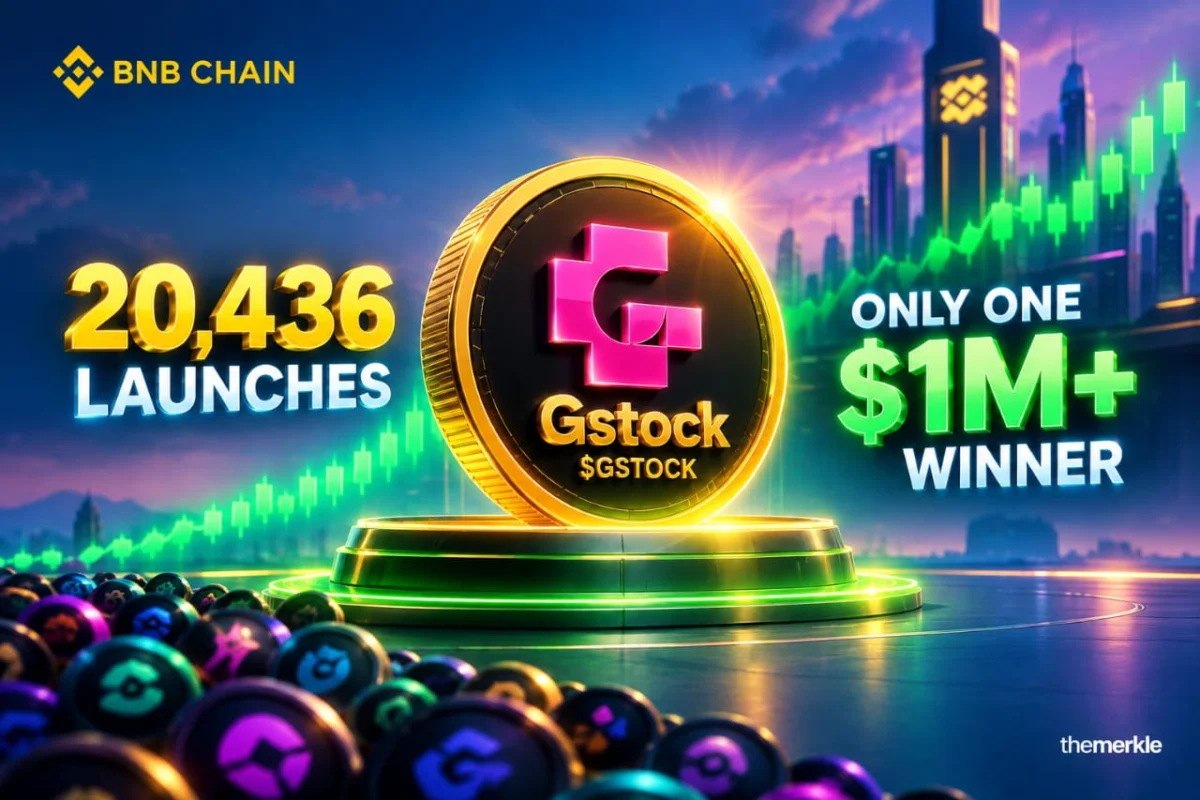
In a striking development within the decentralized finance (DeFi) ecosystem, the Genius.fun launchpad has recorded an astonishing surge in new token creations, surpassing 20,000 launches in less than three weeks since its inception. This unprecedented volume, however, belies a highly concentrated distribution of value, with a singular token, Gstock, currently commanding a market capitalization exceeding $7.5 million. This stark disparity highlights the intensely speculative and often challenging landscape of new cryptocurrency projects, even on platforms designed for rapid deployment.
Launched on the Binance Smart Chain (BNB Chain) on September 17, 2026, Genius.fun has quickly become a hub for aspiring token creators. The platform’s rapid adoption underscores a prevailing demand for accessible and cost-effective methods to introduce new digital assets to the market. With an average of approximately 1,000 tokens launched per day, Genius.fun has demonstrated its efficiency in facilitating the initial stages of token deployment. Yet, the data reveals a critical bottleneck: out of the more than 20,000 tokens launched, only 159 have successfully "graduated" to a locked liquidity pool on PancakeSwap, and of these, Gstock stands alone as the only project to break the $1 million market capitalization barrier. Its current valuation of $7.59 million dwarfs all other graduated tokens, with the second-highest valued token, Milan the Pug, sitting at a modest $147,000. This immense chasm between the top performer and the rest signals a marketplace characterized by extreme winner-take-all dynamics.
The Genesis and Mechanism of Genius.fun: An RWA-Focused Launchpad
Genius.fun positions itself as an innovative Real-World Asset (RWA) launchpad, an increasingly prominent narrative within the crypto sphere aiming to bridge traditional finance with blockchain technology. Developed by the Genius Foundation, the platform operates on the robust and scalable BNB Chain, leveraging its low transaction fees and high throughput to support a rapid pace of token launches. The core proposition of Genius.fun allows creators to pair newly minted tokens with tokenized public-company shares, such as bStocks, xStocks, and 4Stocks, alongside more conventional crypto assets like BNB, USDT, and USDC. The underlying premise is that trading activity generated by these new tokens can contribute to the accumulation of the associated real-world asset shares, thereby integrating a meme-coin-like speculative element with a tangible equity position.
The journey for a token on Genius.fun begins on a bonding curve. This mathematical mechanism dictates the price of a token based on its supply, typically increasing the price as more tokens are purchased. This setup encourages early adoption but also requires sustained buying pressure to gain momentum. A critical milestone for any project on the platform is "graduation," which occurs when a token accumulates 15 BNB in liquidity on its bonding curve. Upon meeting this threshold, the token transitions from the bonding curve model to a locked liquidity pool on PancakeSwap, one of the largest decentralized exchanges (DEXs) on the BNB Chain. This transition is crucial, as it provides a more stable and liquid trading environment. Post-graduation, creators are eligible to earn up to 1.25% of the trading fees generated, while an additional 0.25% is allocated to strategic buybacks and supply locking mechanisms, intended to support the token’s long-term value and stability. These financial flows are transparently tracked and made available on the platform’s analytics page, offering a degree of insight into project performance and sustainability.
The Graduation Gauntlet: A Staggering 0.8% Success Rate
The raw numbers paint a vivid picture of the formidable challenges faced by new projects on Genius.fun. Out of 20,436 tokens launched, a mere 159 have managed to clear the 15 BNB graduation threshold. This translates to an alarming success rate of approximately 0.8%, meaning that roughly 99 out of every 100 tokens launched on the platform fail to attract sufficient initial buying interest to secure a spot in a permanent liquidity pool. This metric serves as the first substantial filter for project viability, demonstrating that while the platform facilitates easy creation, it does not guarantee initial market traction.

Industry analysts suggest that such high attrition rates are not entirely uncommon in the highly speculative arena of new token launches, particularly in an environment designed for rapid, low-cost deployment. "The ease of launching a token has often inversely correlated with its long-term viability," stated a blockchain market observer. "Platforms like Genius.fun democratize access, but they also flood the market, making it exponentially harder for any single project to stand out and build a sustainable community or use case beyond initial hype. The 0.8% graduation rate, while seemingly low, might be a more realistic reflection of market demand for the vast majority of experimental projects." This early culling process, while harsh, does prevent projects without genuine market interest from consuming excessive network resources or diluting overall market sentiment with an overwhelming number of illiquid tokens.
Gstock: The Anomaly and Its Implications for Market Concentration
The solitary triumph of Gstock, boasting a market cap of approximately $7.59 million, is a significant outlier that underscores the ‘power law’ distribution often observed in venture capital and highly speculative markets. Launched 22 days prior to the analysis, Gstock’s pairing with BNCB (Binance Coin) has evidently resonated with investors, enabling it to accumulate substantial liquidity and command a valuation that is roughly 50 times greater than its closest competitor among graduated tokens. For context, Milan the Pug ($MILAN), an Alpha-tagged dog meme coin paired with BNB, which launched 18 days prior, holds a market cap of approximately $147,000, illustrating the vast chasm between the single dominant project and all others.
This extreme concentration of value in Gstock, representing approximately 0.005% of all tokens launched, raises critical questions about the sustainability of the Genius.fun model and the broader prospects for other projects. While the word "currently" is important—market capitalizations in the crypto space are notoriously volatile and can shift rapidly—the present data suggests a landscape where attracting significant capital is an exceedingly rare feat. This dynamic creates a challenging environment for new creators, as the vast majority will struggle to gain visibility and liquidity in a market dominated by a single, successful entity.
Investor Caution and Creator Challenges in a High-Volume Environment
For creators utilizing Genius.fun, the implications of this market concentration are profound. The platform’s revenue model for creators relies on a share of trading fees, which are directly proportional to trading volume. In a scenario where significant volume is almost entirely confined to one or a very few tokens, the economic incentive for the vast majority of creators becomes negligible. A project that never graduates, or graduates but fails to attract substantial trading activity, effectively earns almost nothing, regardless of the innovation or cleverness of its underlying concept. This can lead to a cycle of rapid launches and equally rapid abandonment, as creators move on after failing to gain traction.
For traders, the data serves as a compelling argument for extreme caution. The platform’s "Alpha" placements, which designate prominent spots for certain tokens, are paid advertising slots. This means that a token’s visibility on the platform’s explore page is not an inherent signal of quality, viability, or future success. Experienced traders are advised to conduct rigorous due diligence, meticulously checking on-chain data for liquidity depth, transaction volume, and holder distribution before committing capital. The presence of a significant number of "whale" holders, or thinly spread liquidity, can indicate high risk and potential for price manipulation.
Furthermore, the Real-World Asset (RWA) features, particularly the pairing with tokenized public-company shares, introduce an additional layer of complexity and potential risk. The redemption and ownership rights associated with these tokenized stocks are not universally guaranteed and depend heavily on the specific tokenization provider, the underlying legal frameworks, and the jurisdiction in which these assets are issued and traded. The Genius Foundation explicitly states that it makes no guarantee of governance rights for these tokenized positions, which is a crucial distinction for investors accustomed to the rights associated with direct equity ownership. This necessitates a thorough understanding of the legal and operational nuances of the specific RWA integration before considering investment.

Broader Context: The Evolving Landscape of Crypto Launchpads and RWA
The phenomenon observed on Genius.fun reflects a broader trend in the crypto launchpad sector. While platforms have democratized token creation, the challenge of building sustainable ecosystems around these tokens remains. The sheer volume of new projects means that investors are increasingly discerning, prioritizing genuine utility, strong community support, and transparent development over mere speculative hype. The RWA narrative, while promising, is still in its nascent stages. Its long-term success hinges on robust legal frameworks, reliable tokenization infrastructure, and clear pathways for redemption and interoperability with traditional financial systems. Projects attempting to integrate RWA must demonstrate tangible value beyond mere tokenization to gain widespread acceptance and investor confidence.
From a regulatory perspective, the rapid proliferation of tokens, particularly those linked to real-world assets, could attract increased scrutiny. Jurisdictions globally are grappling with how to classify and regulate digital assets, and platforms facilitating their launch must navigate an evolving legal landscape. The "Wild West" era of crypto is gradually giving way to a more regulated environment, and platforms that fail to adapt to these changes may face significant challenges.
Future Watch: Key Indicators for Genius.fun’s Trajectory
As Genius.fun continues its operations, several key performance indicators will determine its long-term viability and whether it can evolve beyond a "one-hit wonder" platform. Investors, creators, and market observers should closely monitor:
- Emergence of a Second $1M+ Token: The appearance of another project achieving a market capitalization above $1 million would signal a broader distribution of success and potentially a more robust ecosystem. This would indicate that Gstock is not merely an isolated anomaly but that the platform can consistently foster projects capable of attracting substantial investment.
- Improvement in Graduation Rate: A sustained increase in the 0.8% graduation rate would suggest that more projects are finding initial market traction and that the platform’s mechanisms or community engagement strategies are becoming more effective. An improved rate could indicate a healthier project pipeline and better odds for creators.
- Measurable Impact of Stock Accumulation: The core RWA value proposition of Genius.fun lies in its ability to feed share accumulation through trading activity. Demonstrating a tangible, measurable impact of this mechanism, perhaps through transparent reporting on share purchases or strategic asset management, would validate the platform’s unique selling point and differentiate it from purely speculative meme coin launchpads.
The journey of Genius.fun, marked by an impressive volume of launches but a highly concentrated distribution of success, offers a compelling case study in the current state of the DeFi launchpad landscape. While the platform has proven its capacity to facilitate rapid token creation, its ultimate success will depend on its ability to cultivate a more diverse ecosystem of viable projects and deliver on its innovative RWA promise. A platform that enables the creation of over 20,000 tokens undoubtedly needs more than one standout winner to justify its prolific output and secure its place as a sustainable force in the decentralized economy.
Disclosure: This article is for informational purposes only and does not constitute trading or investment advice. Always conduct thorough research and consult with a financial professional before making any investment decisions in cryptocurrencies or related services.