


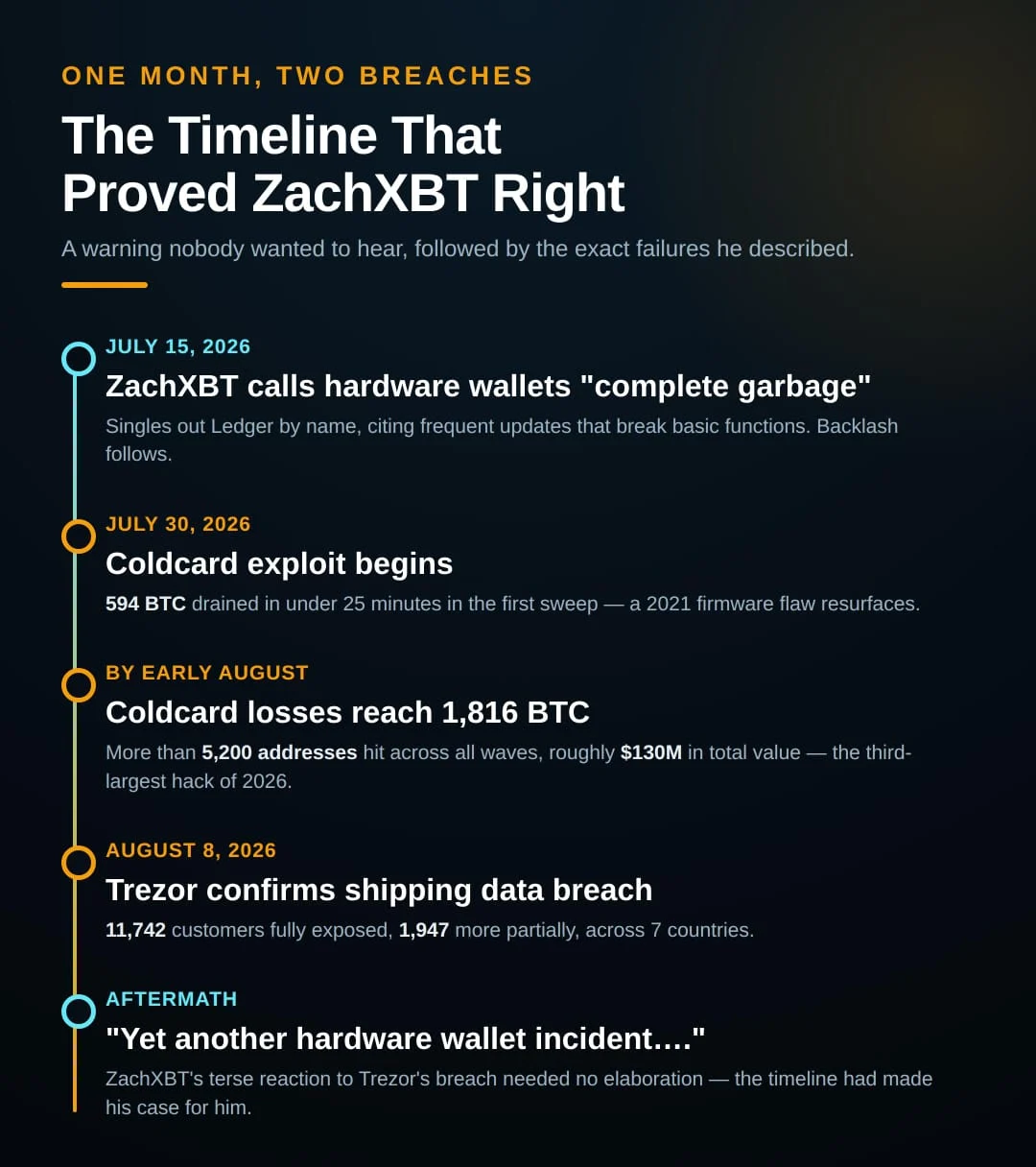
Just over a month ago, ZachXBT, a prominent on-chain sleuth revered for his investigative prowess in the cryptocurrency space, ignited a firestorm of controversy. His pronouncement that hardware wallets—the very devices the entire crypto industry champions as the ultimate safeguard for digital assets—were "complete garbage" was met with widespread incredulity and fierce backlash. He didn’t mince words, specifically naming Ledger as a primary offender, citing issues with frequent, disruptive software updates. The crypto community, long conditioned to view hardware wallets as the impregnable fortress for their life savings, pushed back hard against what many perceived as an irresponsible and unfounded claim. Yet, in a dramatic turn of events spanning mere weeks, two of the industry’s most respected hardware wallet manufacturers each endured significant security incidents, causing the initial backlash against ZachXBT to appear remarkably premature and his controversial assessment startlingly prescient.
The Unheeded Warning: ZachXBT’s Controversial Assessment
On July 15, 2026, ZachXBT leveraged his Telegram channel, a platform often used to disseminate critical investigative findings, to issue a stark warning. His message was unambiguous: he deemed current hardware wallets unsuitable for securing substantial amounts of assets or signing critical transactions, bluntly categorizing the entire class of devices as "complete garbage." This wasn’t a claim of a newly discovered zero-day exploit; rather, it was presented as a personal assessment forged from years of observing these devices’ real-world performance and vulnerabilities. He advised experienced users to instead adopt a separate, dedicated computing device, reserved exclusively for crypto activities, as a potentially more secure alternative. His most pointed criticism was reserved for Ledger, a market leader, which he accused of issuing frequent software updates that, in his view, inexplicably compromised basic functionalities.
The timing and nature of ZachXBT’s statement were particularly provocative. Hardware wallets, often referred to as "cold storage" solutions, are foundational to the crypto ecosystem’s security paradigm. They are designed to keep users’ private keys offline, insulated from internet-borne threats, thereby protecting digital assets from hackers and malware. Companies like Ledger, Trezor, and Coldcard have built reputations on the promise of impenetrable security, often employing secure elements and sophisticated cryptographic processes. For a figure of ZachXBT’s stature to dismiss them so cavalierly challenged a deeply ingrained belief system within the crypto community, hence the immediate and largely unfavorable reaction. The consensus was that while no system is infallible, hardware wallets represented the best available solution for self-custody, a core tenet of decentralization.
The Coldcard Catastrophe: A Flaw in the Foundation
Barely two weeks after ZachXBT’s controversial remarks, the first major crack appeared, validating, to some extent, his underlying concerns about systemic fragility. Starting on July 30, 2026, attackers began exploiting a critical firmware vulnerability in Coldcard, a Bitcoin-only hardware wallet manufactured by Canadian firm Coinkite. Coldcard had long distinguished itself by cultivating an image as one of the most security-focused cold storage options available, appealing to a segment of the Bitcoin community that prioritizes robust, open-source security. The revelation of a fundamental flaw in its seed generation process sent shockwaves through the industry.
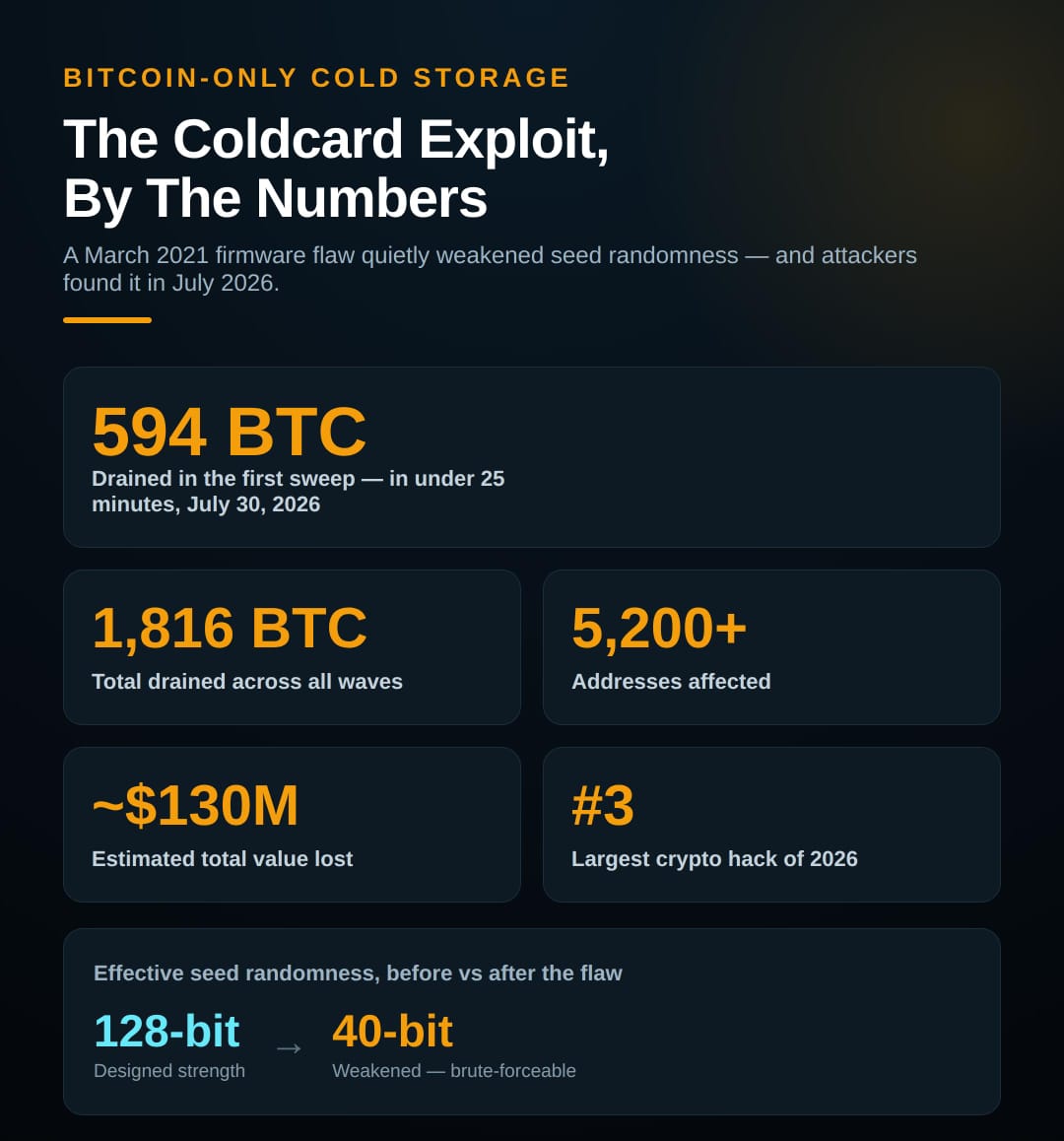
The root cause of the exploit was traced back to a specific firmware build released in March 2021. In a catastrophic oversight, this particular build mistakenly routed a crucial part of the seed generation process through a software-based random number generator (RNG) instead of the device’s dedicated, physically isolated hardware RNG. This subtle but profound error drastically weakened the effective randomness of affected seeds. Instead of the designed 128 bits of entropy, the compromised seeds possessed as little as 40 bits of randomness. To put this into perspective, 128 bits of entropy is considered practically un-brute-forceable with current computational power, offering an astronomically large number of possible combinations. Forty bits, however, is within the realm of brute-force attacks, meaning an attacker could systematically guess every possible seed combination without ever needing physical access to the device. This meant that any user who generated a seed on an affected Coldcard device between March 2021 and the subsequent patch had a demonstrably insecure wallet.
The damage was swift and substantial, unfolding in multiple waves. An initial assault on July 30 saw approximately 594 BTC drained from hundreds of single-signature wallets in under 25 minutes. Many of these wallets had been dormant for years, their owners likely feeling secure in their "cold storage." As subsequent waves of attacks were tallied and analyzed, Galaxy Research estimated total losses at approximately 1,816 BTC, impacting over 5,200 addresses. At the time of the attacks, some assessments placed the total monetary figure closer to $130 million, cementing it as one of the largest crypto hacks of 2026 and a stark reminder of the ever-present threat landscape.
What made the Coldcard incident particularly unsettling was the profile of its victims. These were not typically careless users who had fallen for phishing scams or exposed their private keys online. Instead, they were individuals who had diligently followed industry best practices: storing their assets offline, never photographing or sharing their seed phrases, and using devices that never directly touched the internet. The exploit bypassed these layers of user diligence, striking at the very core of the device’s purported security. Furthermore, the nature of the flaw meant that merely updating the firmware did not retroactively fix an already compromised seed. Anyone who had generated a seed on the affected Coldcard devices during the vulnerable period was left with only one truly safe recourse: to migrate their assets to an entirely new, securely generated seed. The reputational damage to Coldcard and Coinkite was immense, challenging the perception of "Bitcoin-only" hardware wallets as inherently superior in security.
Trezor’s Own Ordeal: A Supply Chain Vulnerability
Before the industry could fully process the implications of the Coldcard exploit, another major incident unfolded, this time involving Trezor, one of the pioneering and most established names in cold storage. On August 8, 2026, Trezor directly addressed its user base via an official announcement on X (formerly Twitter), confirming a significant data breach. While different in nature from Coldcard’s firmware flaw, it nonetheless underscored a different, yet equally critical, vector of attack against hardware wallet users: the supply chain and associated customer data.
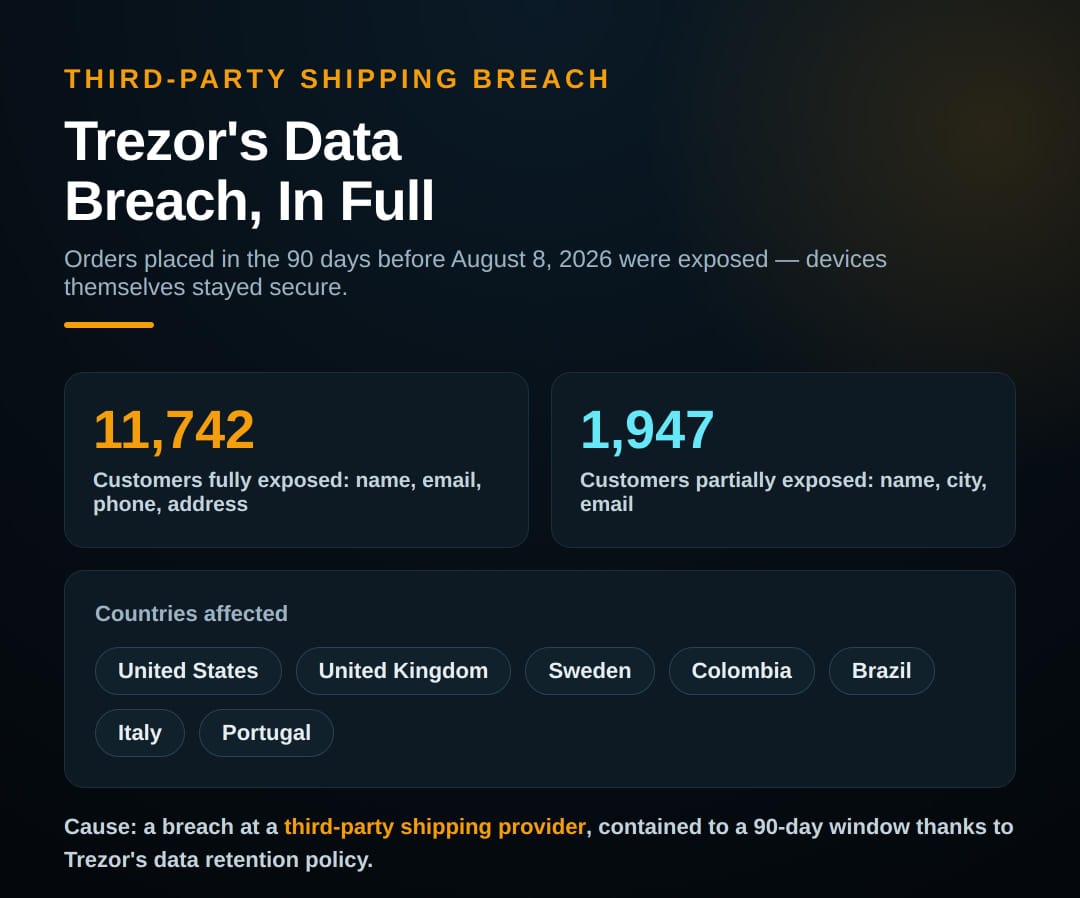
According to Trezor’s detailed statement, the breach originated with one of its third-party shipping providers. This provider experienced a data compromise that exposed sensitive order data belonging to a specific segment of Trezor’s customer base. The affected customers were new purchasers in the US, UK, Sweden, Colombia, Brazil, Italy, and Portugal who had placed an order within the 90 days prior to August 8, 2026. The exposed information was alarmingly comprehensive, including full names, shipping addresses, phone numbers, and email addresses. Trezor confirmed that 11,742 customers experienced "full exposure," meaning all four data points (name, email, phone number, and shipping address) were compromised. An additional 1,947 customers suffered "partial exposure," limited to their name, city, and email. The company credited its strict 90-day data storage policy, which it had successfully negotiated with its fulfillment partners, for limiting the overall scope of the breach. Without this policy, the number of affected users could have been significantly higher.
Trezor was forthright about the practical implications for its affected customers. While the company emphatically stated that its internal systems and, crucially, its devices themselves remained secure and uncompromised, the exposed personal data presented a significant risk. Attackers now possessed real names, physical addresses, and contact details, enabling them to craft highly convincing and sophisticated phishing attempts. This type of social engineering attack, often termed "spear phishing," is notoriously difficult to detect, as the attacker can leverage legitimate-looking information to trick users into divulging their private keys or seed phrases. Trezor urgently advised users to exercise extreme caution, reiterating the cardinal rule of crypto security: never enter a wallet backup phrase on any website or share it with anyone. Furthermore, the company stressed that users should only ever check for firmware or app updates through official Trezor channels, directly addressing a common vector for malware distribution.
ZachXBT’s Succinct Validation
Amidst the unfolding crises, ZachXBT’s reaction to Trezor’s announcement was brief, yet profoundly impactful. His simple reply, "Yet another hardware wallet incident…," resonated with significant weight, particularly given the preceding month’s events. The brevity of his statement was its strength; it didn’t require a lengthy explanation or an "I told you so." The sequence of events — his controversial "garbage" claim, followed by a major firmware exploit in Coldcard, and then a significant data breach affecting Trezor — had, in essence, constructed the argument for him. Two of the industry’s most trusted hardware wallet brands had suffered major security failures, albeit of different kinds, within the very window he had been criticized for painting the entire category with too broad a brush.
This rapid succession of incidents effectively shifted the narrative. What was initially dismissed as hyperbole began to look like a prescient warning. The community’s initial knee-jerk defense of hardware wallets gave way to a more sober reflection on the inherent vulnerabilities, both technical and logistical, that even the most robust security solutions can possess. Security experts and commentators who had initially been skeptical of ZachXBT’s sweeping generalization began to acknowledge the validity of his underlying concerns about systemic fragility and the need for continuous vigilance, even with "cold storage."
Trezor’s Proactive Response: The Anonymous Delivery Initiative
To its credit, Trezor did not stop at simply acknowledging the breach and offering warnings. The company announced a significant, proactive measure designed to structurally address the very vulnerability that led to the data breach: the development of an "Anonymous Delivery" option. This initiative represents a genuine structural fix, moving beyond reactive statements to implement a fundamental change in its logistics and customer experience.
Trezor aims to launch this feature in the EU by September and in the US by the end of the year, underscoring its internal priority. The Anonymous Delivery option is specifically engineered to prevent the kind of identity-linking data breach that occurred. Its core principle is to decouple the hardware wallet purchase from the customer’s real identity and home address. This will be achieved through a multi-faceted approach:
- Dedicated Checkout Flow: A separate process for anonymous orders.
- Nickname or Label ID: Customers will use a non-identifying nickname or label ID instead of their real name.
- Automated Parcel Lockers: Deliveries will be directed to automated parcel lockers for pickup, rather than directly to a home address. This eliminates the need for residential address information.
- Unbranded Packaging: The hardware wallets will be shipped in unbranded packaging with a generic sender label, further obscuring the nature of the contents and the sender.
- Secure Pickup PINs: The carrier will only send pickup PIN codes via email or SMS, ensuring that the final stage of delivery is secure and linked only to a chosen contact method, not a physical address.
Trezor has publicly described this project as a "top priority internally," reflecting the severity with which it views the recent incident and its commitment to enhancing user privacy and security. This response is significant because it directly targets the exact vector that caused the breach, demonstrating a commitment to learning from the incident and implementing preventative measures. However, as the article notes, this crucial improvement arrives after the fact, following an incident that now sits alongside the $130 million Coldcard exploit as compelling evidence for the systemic fragility ZachXBT highlighted a month earlier, before many in the community had reason to take his warnings seriously.
Broader Implications and the Future of Crypto Security
The events of the past month represent a critical inflection point for the hardware wallet industry and the broader cryptocurrency ecosystem. The Coldcard and Trezor incidents, while different in their technical specifics, collectively underscore a crucial truth: no security solution is entirely impervious to risk, and vulnerabilities can manifest in unexpected ways, from deep within a device’s firmware to external supply chain logistics.
Erosion of Trust and Redefining Cold Storage: The most immediate and significant implication is the potential erosion of user trust. Hardware wallets have long been positioned as the ultimate bastion of crypto security, a "set it and forget it" solution for long-term hodlers. These incidents challenge that perception, forcing users to reconsider the fundamental assumption that their assets are absolutely safe once moved to cold storage. The term "cold storage" itself might need re-evaluation, moving from an implied impenetrable state to a more nuanced understanding of "reduced attack surface."
Industry Standards and Audits: These events are likely to spur a renewed focus on rigorous security audits, not just of device firmware but also of the entire supply chain, from component manufacturing to shipping and delivery. The industry might see a push for more transparent and verifiable security claims, potentially leading to new certification standards or independent validation processes. Open-source hardware and software, while not a panacea, might gain further traction as a means of allowing community scrutiny.
User Best Practices Revisited: The incidents reinforce the need for multi-layered security and continuous vigilance from users. Diversification of storage methods (e.g., using multiple hardware wallets from different manufacturers, or combining hardware wallets with multi-signature solutions) may become more common. Users will be more acutely aware of the risks associated with providing personal information during purchases and the ever-present threat of sophisticated phishing attacks. ZachXBT’s original suggestion of using a separate, dedicated device for crypto transactions, effectively creating a "hardware wallet computer," might gain traction as an advanced best practice for those managing substantial assets.
Regulatory Scrutiny and Innovation: As cryptocurrencies become more mainstream, such high-profile security failures could attract increased attention from financial regulators. Governments may begin to explore mandating minimum security standards for self-custody solutions, mirroring regulations in traditional finance. Simultaneously, these challenges could spur innovation in private key management. We might see the emergence of new, more resilient forms of key storage, advanced multi-party computation (MPC) solutions integrated with user-friendly interfaces, or even fully decentralized hardware authentication mechanisms.
In conclusion, the past month has served as a powerful, albeit painful, lesson for the cryptocurrency industry. ZachXBT’s initially controversial "complete garbage" assessment, once dismissed, now resonates with an unsettling clarity. The Coldcard firmware flaw and Trezor’s data breach have unequivocally demonstrated that even the most trusted hardware wallets are susceptible to vulnerabilities that can lead to catastrophic losses or significant privacy compromises. These incidents compel a critical re-evaluation of current security paradigms, demanding enhanced vigilance, structural improvements, and a collective commitment to bolstering the resilience of self-custody solutions in an ever-evolving threat landscape. The promise of secure self-custody, a cornerstone of the decentralized vision, remains a vital goal, but one that requires continuous adaptation and an honest appraisal of its inherent challenges.














