


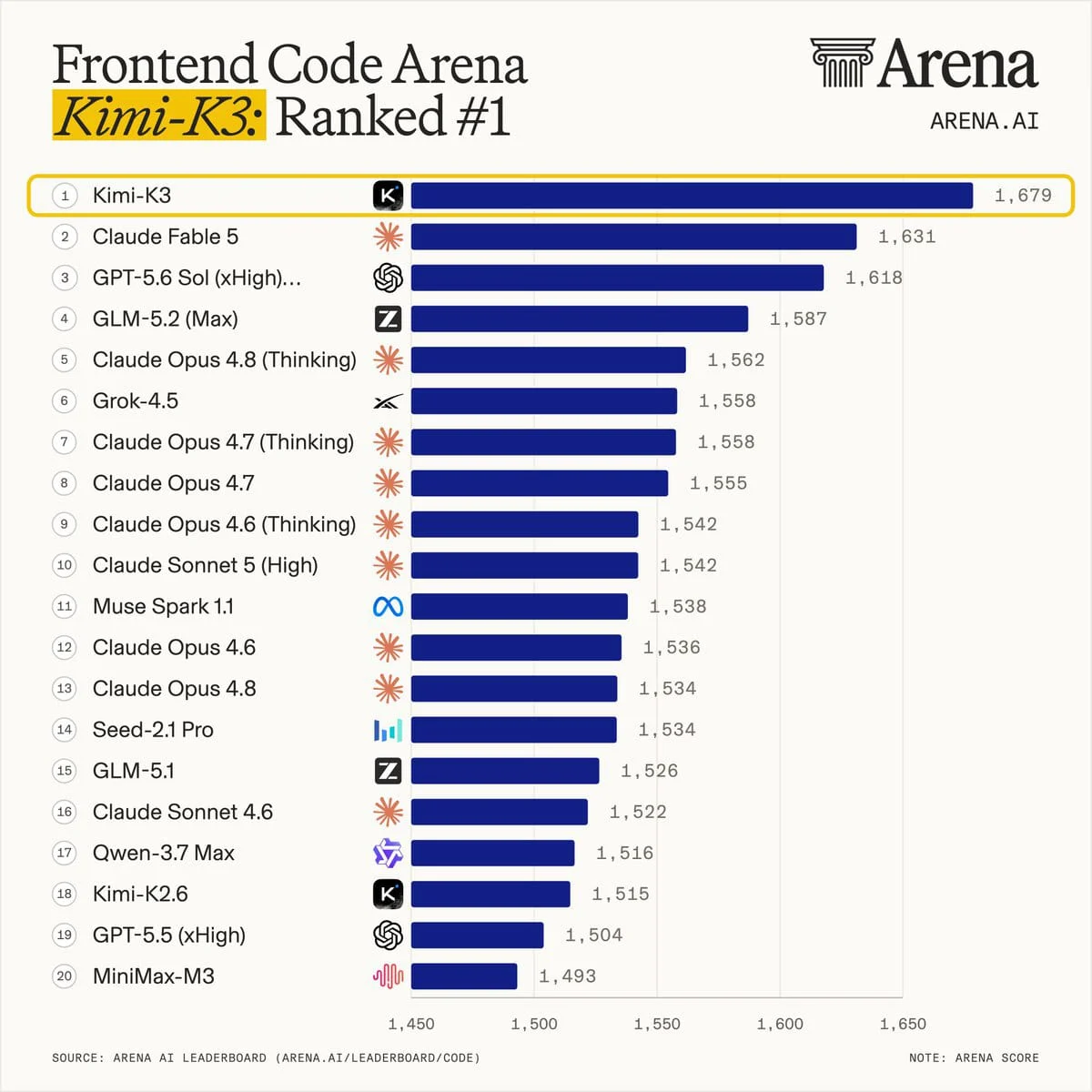
Moonshot AI, a prominent Chinese artificial intelligence firm, has launched Kimi K3, a massive 2.8-trillion-parameter open-weight model that is fundamentally challenging established perceptions of the global AI frontier. This release is supported by substantial third-party benchmark data, marking a significant milestone as a Chinese model actively compels a re-evaluation of where the cutting edge of AI development truly resides. Unveiled yesterday, Kimi K3 claims performance levels comparable to leading Western models such as Anthropic’s Claude Fable 5 and OpenAI’s GPT-5.6, setting a new competitive standard in the rapidly evolving landscape of advanced AI.
The architecture underpinning Kimi K3 is a Mixture-of-Experts (MoE) design, contributing to its unprecedented scale as the largest open-weight model released to date. This gargantuan model is also equipped with an extraordinary 1 million-token context window, an attribute that grants it the capacity to process and analyze extensive datasets, including entire codebases, comprehensive literary works, or lengthy scientific research papers, all within a single prompt. This capability alone positions Kimi K3 as a formidable tool for complex, long-horizon tasks, offering a paradigm shift in how AI can interact with and interpret large volumes of information.
A New Benchmark for Frontend Code Generation
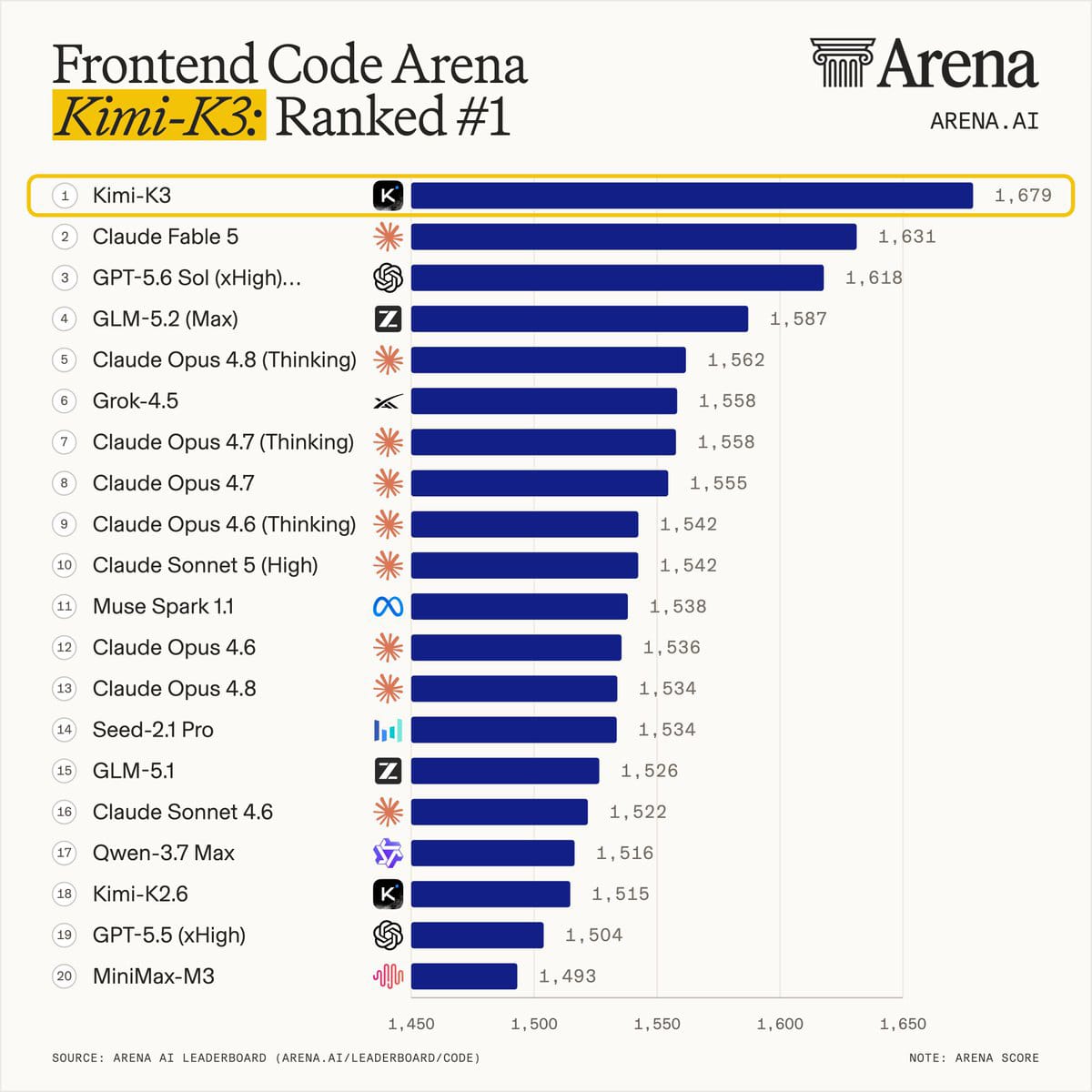
One of the most compelling and immediately impactful results from Kimi K3’s release is its performance on the Frontend Code Arena. The model achieved a first-place ranking with an impressive score of 1679 points, representing a dramatic 17-place ascent from its predecessor, Kimi K2.6, which previously held the 18th position. This is not merely a marginal improvement; Kimi K3 demonstrated overwhelming superiority by securing the top spot in six out of seven frontend domains. These domains encompass critical areas such as brand and marketing design, reference-based design, data and analytics applications, consumer product interfaces, interactive simulations, and content creation tools. Its only second-place finish was in the highly specialized gaming category, where it trailed behind Anthropic’s Fable 5.
The significance of Kimi K3’s dominance in frontend code generation cannot be overstated. In the current AI development landscape, frontend code generation has emerged as a crucial proxy for real-world utility and practical application. The ability of an AI model to accurately and efficiently translate design specifications into functional code, handle intricate user interface logic, and integrate various data sources is a direct indicator of its potential to automate and accelerate software development workflows. By outperforming nearly every major AI lab in this critical domain, Kimi K3 has delivered a result that is far from marginal, suggesting a profound impact on industries reliant on rapid and precise software development. This achievement signals a maturity in Kimi K3’s reasoning capabilities, demonstrating not just an understanding of code syntax but also an implicit grasp of design principles, user experience, and functional requirements.
Advancements in Agentic Performance
Beyond code generation, Kimi K3 has also made substantial strides in agentic performance, a critical area for AI systems designed to undertake complex, multi-step tasks and demonstrate autonomous reasoning. On the GDPval v2 agentic benchmark, Kimi K3 recorded an Elo rating of 1668. This marks a significant leap from K2.6’s 1190, allowing it to surpass other formidable models such as GLM-5.2 (1514), GPT-5.5 (1494), and even Claude Opus 4.8 (1600). While it still trails Fable 5’s top score of 1760, the margin has narrowed considerably, indicating that Kimi K3 is now operating within a competitive tier previously dominated by Western models.
Further reinforcing its agentic capabilities, Kimi K3 participated in AA-Briefcase, a proprietary evaluation designed to assess long-horizon agentic knowledge work. Here, K3 achieved an overall Elo score of 1547, a remarkable 732-point improvement over K2.6. This performance secured its second-place position, once again behind only Fable 5. The model’s rubric scoring and analytical quality in these agentic tasks have drawn close comparisons to Fable 5’s benchmarks, suggesting a high degree of sophisticated problem-solving and task execution. While GPT-5.6 Sol retains a specific lead in presentation quality, Kimi K3’s overall agentic prowess indicates that the perceived gap in capability between Chinese and leading Western models is rapidly closing, moving from a categorical difference to a more nuanced distinction. This means Kimi K3 can effectively plan, execute, and monitor complex tasks, making it highly valuable for automated workflows, research assistance, and advanced data analysis.
Strategic Pricing and Market Positioning
From a commercial perspective, Kimi K3 presents a compelling value proposition, particularly in its pricing strategy for high-volume agentic workloads. At an estimated cost of $0.94 per task, Kimi K3 positions itself favorably against leading models. It is priced closely to OpenAI’s GPT-5.6 Sol, which costs $1.04 per task, and notably undercuts Anthropic’s Claude Opus 4.8, priced at $1.80 per task, by nearly half. This significant cost advantage could be a decisive factor for enterprises and developers seeking to deploy frontier-level AI capabilities without incurring prohibitive expenses.
However, it is important to note that Moonshot AI has also implemented a substantial increase in its own pricing compared to its previous iteration, Kimi K2.6. The cost for output tokens has surged to $15 per million, a significant jump from the previous $4. The first-party API pricing is set at $3.00 per million input tokens and $15.00 per million output tokens. A 90% discount on cached input tokens brings the input cost down to $0.30 per million. While Kimi K3 offers a competitive edge against the most expensive US-based frontier models, it is priced higher than other open-weight counterparts. For instance, GLM-5.2 costs $0.32 per task, and DeepSeek V4 Pro is priced at an exceptionally low $0.04 per task. This indicates that Kimi K3 is competing within the premium, frontier-tier segment of the market, rather than the budget-friendly open-weight category, even before its full weights are made publicly available. This strategic pricing reflects Moonshot AI’s confidence in Kimi K3’s performance and its ambition to capture a significant share of the high-value AI services market.
Efficiency Gains and Future Prospects
Beyond raw performance and pricing, Kimi K3 demonstrates notable advancements in operational efficiency. A detail that might have been understated in initial reports is its token efficiency. Across all nine evaluations on the Artificial Analysis Intelligence Index, Kimi K3 consumed approximately 132 million output tokens. This represents a significant 21% reduction in token usage compared to Kimi K2.6, which required about 166 million output tokens for the same set of evaluations, all while achieving higher scores across the board. This efficiency gain translates directly into lower operational costs and faster processing times for users, enhancing its overall commercial appeal.
The model also ships with native multimodal input capabilities, allowing it to process both text and images, although its output currently remains text-only. This multimodal input opens up new avenues for applications that require understanding and reasoning across different data types, such as visual content analysis combined with textual instructions. Looking ahead, Moonshot AI has confirmed ambitious plans to release the full 2.8 trillion parameter weights of Kimi K3 by July 27. Should this materialize, Kimi K3 would become the unequivocally leading open-weight model by a substantial margin, dwarfing current leaders like GLM-5.2 with its 753 billion parameters and DeepSeek V4 Pro with 1.6 trillion parameters. This move would democratize access to frontier-level AI capabilities, fostering innovation and competition across the global AI ecosystem. The implications of such a release for research, development, and commercial applications are profound, potentially accelerating the pace of AI advancement worldwide.
Market Reactions and Domestic Competition in China
The announcement of Kimi K3’s impressive capabilities sent ripples not only through the international AI community but also through the domestic Chinese AI market. The immediate aftermath saw significant impacts on the stock valuations of other prominent Chinese AI companies. Zhipu, a competitor, experienced a sharp decline of 28% in its stock value, while MiniMax saw its valuation fall by 16%. This strong market reaction is a crucial indicator, suggesting that investors and analysts are perceiving Kimi K3 not merely as another promotional release, but as a genuine, formidable competitive threat to other established Chinese AI laboratories.
Such a drastic market response underscores the high stakes within China’s rapidly expanding AI sector. When a model launch results in the erosion of nearly a third of a competitor’s market capitalization within a single trading day, it sends a clear message about the perceived shift in the competitive landscape. This reaction implies that Kimi K3’s capabilities are seen as truly disruptive, potentially altering market share and future growth trajectories for domestic players. It highlights the intense pressure on Chinese AI companies to innovate and deliver cutting-edge performance, as the market is quick to reward perceived leaders and punish those who fall behind. This internal competition is often seen as a catalyst for rapid technological advancement, pushing companies to achieve new heights in AI development.
Broader Implications for the US-China AI Race
The emergence of Kimi K3 marks a pivotal moment in the ongoing US-China AI race, signaling a new phase of intense competition. For the first time, a Chinese model has not only secured the top position on a globally recognized benchmark like the Frontend Code Arena but is also demonstrating near-frontier performance across several other critical benchmarks simultaneously. This is not an isolated incident or a one-off result; it represents a genuine inflection point that necessitates a reassessment of the global AI power balance.
The narrative emerging from this development often juxtaposes the rapid advancements of Chinese labs like Moonshot AI, which are swiftly delivering frontier-competitive models, with the regulatory environment in the United States. Arguments are being made that while China’s AI sector benefits from a comparatively less restrictive policy landscape, American policymakers are increasingly focused on implementing regulations, such as data center restrictions and broader AI governance frameworks. Proponents of this view suggest that such regulations, while intended to ensure safety and ethical development, might inadvertently slow down the pace of innovation in the US.
Conversely, a substantial counter-argument posits that guardrails and thoughtful regulation are not merely bureaucratic hurdles but essential safeguards. The stakes of getting AI safety wrong at this scale, it is argued, are profoundly asymmetric in a way that previous technological revolutions, such as the early internet, were not. The potential for misuse, bias, or unintended consequences from advanced AI systems necessitates a cautious approach to development and deployment. This perspective emphasizes that responsible innovation is paramount, and that a headlong rush without adequate ethical and safety considerations could lead to severe societal repercussions.
Regardless of where one stands on the policy debate, the concrete results delivered by Kimi K3 are undeniable. Its technical achievements are real, and they underscore China’s growing prowess in advanced AI. The fundamental argument currently playing out is not whether Kimi K3’s performance is legitimate, but rather what the appropriate response should be from other nations and policymakers: whether to reduce regulatory burdens to accelerate development, or to focus on smarter, more adaptive regulatory frameworks that foster innovation while mitigating risks. This launch does not definitively settle this complex debate, but it certainly intensifies it, ensuring that the intersection of AI development, national policy, and international competition will remain a central focus in the years to come. The capabilities demonstrated by Kimi K3 necessitate a renewed strategic outlook from all major global players, influencing investment, research priorities, and geopolitical alliances in the realm of artificial intelligence.














