The future of digital interaction, where artificial intelligence seamlessly navigates the internet on behalf of users, took a significant leap forward this week with Microsoft Research’s unveiling of Fara1.5. This new family of "computer use agents" promises to transform how individuals and enterprises interact with online platforms, automating complex tasks with unprecedented accuracy and efficiency. Fara1.5, notably available with publicly released weights, has demonstrated superior performance against established proprietary models like OpenAI’s Operator and Google’s Gemini 2.5 Computer Use on critical benchmarks, signaling a potential paradigm shift in the burgeoning field of agentic AI.
The Dawn of Computer Use Agents: A New Frontier in AI Automation
The concept of a "computer use agent" is straightforward yet revolutionary: AI designed to observe, understand, and interact with a browser interface in much the same way a human would. This involves clicking buttons, scrolling through pages, typing into forms, and making informed decisions based on visual cues and contextual understanding. The ultimate vision is to delegate tedious, multi-step online processes to AI, freeing up human users for more creative or strategic endeavors. Imagine instructing your computer to scour multiple vacation rental sites, compare amenities and prices, pre-fill booking forms, and even confirm the best option closest to the beach, all while you attend to other tasks. This level of autonomous digital assistance is the core promise of agentic AI.
The race to develop effective computer use agents has been intensifying. OpenAI, a frontrunner in general AI development, ventured into this space with "Operator," launched in January 2025. Priced at a substantial $200 per month, Operator aimed to offer a personal assistant upgrade to ChatGPT, capable of performing browser-based actions. However, despite its initial ambition, Operator was eventually folded into ChatGPT Agent and subsequently shut down by August of the same year, highlighting the inherent complexities and challenges in building robust, commercially viable agents. Google also entered the fray with Gemini 2.5 Computer Use, integrating its powerful Gemini model with browser interaction capabilities. Both OpenAI’s and Google’s offerings are proprietary, relying on vast, cloud-based infrastructure, which contributes to their high operational costs and limits their accessibility for broader development and customization. These early iterations, while demonstrating the potential, underscored the need for more efficient, flexible, and perhaps more open solutions.
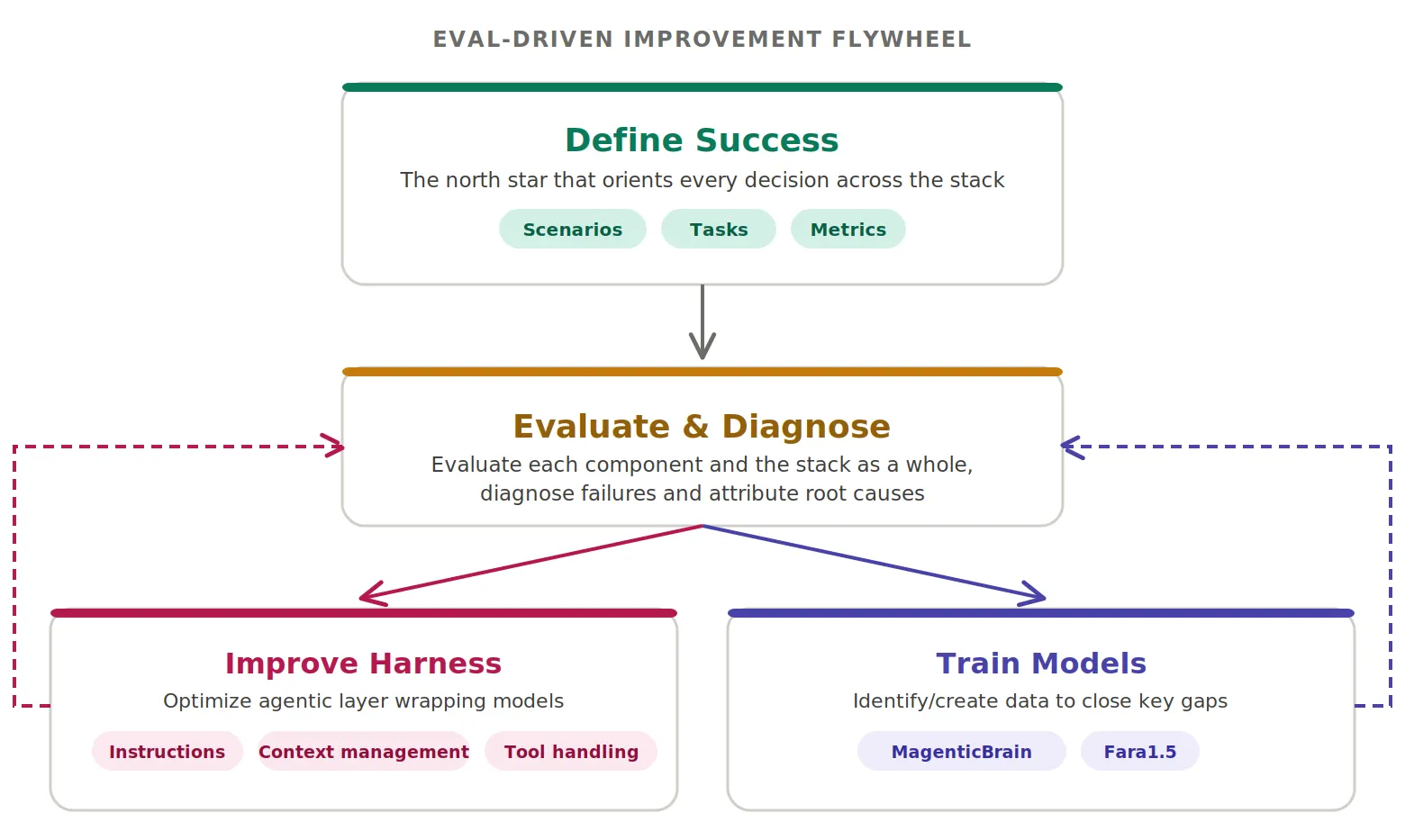
It is against this backdrop that Microsoft Research’s Fara1.5 emerges as a formidable contender, offering a compelling blend of performance, efficiency, and openness. The project, stemming from Microsoft’s AI Frontiers team, specifically aimed to answer a fundamental question: "What does it take to make a small model genuinely good at agentic tasks?" The answer, as articulated by the researchers, necessitated a comprehensive re-evaluation of the entire development lifecycle—from data generation and training objectives to model design and orchestration. This holistic approach, rather than isolated improvements, proved crucial to Fara1.5’s breakthrough.
Unprecedented Performance: Fara1.5 Outpaces Giants
The true measure of an AI agent’s capability lies in its real-world performance. Microsoft Research rigorously tested Fara1.5 against industry-standard benchmarks, and the results are striking. The Online-Mind2Web benchmark, a critical evaluation for browser-based agents, assesses how accurately an AI agent completes 300 diverse, real-world tasks across 136 popular live websites. These tasks range from comparing products and filling out complex forms to booking services, all scored based on the percentage of tasks correctly finished on the dynamic, ever-changing internet.
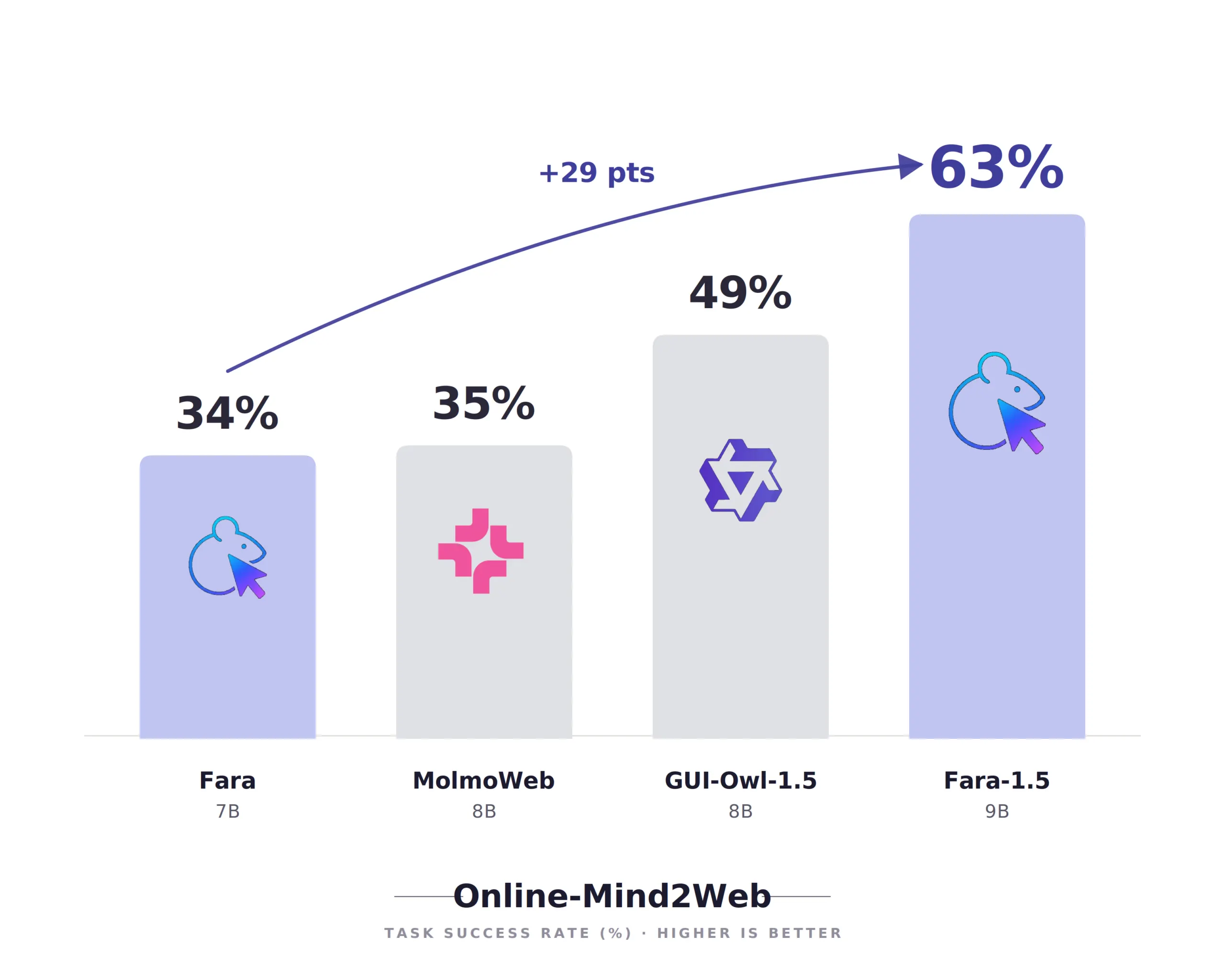
Fara1.5’s largest variant, Fara1.5-27B (27 billion parameters), achieved an impressive 72% success rate on Online-Mind2Web. This figure significantly surpasses its key proprietary rivals: OpenAI Operator scored 58.3%, and Google’s Gemini 2.5 Computer Use managed 57.3%. Even Yutori’s Navigator n1, another top proprietary alternative, fell short at 64.7%. What makes Fara1.5’s achievement even more remarkable is the performance of its mid-sized model, Fara1.5-9B (9 billion parameters), which scored 63.4%. This means that a considerably smaller, more efficient Fara1.5 model still outperformed both OpenAI and Google’s flagship offerings in this crucial real-world test.
The dominance extended beyond proprietary solutions to the open-source landscape as well. Alibaba’s GUI-Owl-1.5, with 8 billion parameters, scored 48.6%, while AI2’s MolmoWeb achieved 35.3%. Even Microsoft’s own previous model, Fara-7B, scored 34.1%. Fara1.5’s nearly doubled performance over its predecessor at a comparable size underscores the profound advancements made in its development pipeline.
A second crucial benchmark, WebVoyager, which also measures task success on the live web, further solidified Fara1.5’s lead. Fara1.5-27B hit 88.6%, narrowly edging out OpenAI Operator’s 87.0% and comfortably surpassing H Company’s 30-billion-parameter Holo2, which scored 83.0%. These consistent top-tier results across demanding, real-world scenarios position Fara1.5 as a new benchmark in agentic AI capabilities.
The "Secret Sauce": A Redesigned Training Paradigm
Fara1.5’s exceptional performance is not merely a product of larger models but rather a testament to a fundamentally reimagined training pipeline. Microsoft Research leveraged a sophisticated system named FaraGen1.5 for generating the massive datasets required to train such a capable agent. The most intriguing aspect of this methodology is the innovative use of a "teacher agent." In a strategic move, Microsoft employed GPT-5.4—OpenAI’s highly advanced and powerful model—to demonstrate how to effectively complete a wide array of browser tasks. These meticulously generated demonstrations then became the high-quality training data for Fara1.5. This clever approach essentially harnesses the capabilities of a leading proprietary model to bootstrap and refine a rival open-source agent, a significant development in the competitive AI landscape.
Beyond leveraging a "teacher agent," Microsoft Research addressed a critical challenge in agent training: handling "gated" tasks that involve sensitive or irreversible actions, such as logging into accounts, sending emails, or booking flights. To mitigate risks and enable comprehensive training, they developed six fully functional, yet synthetic, replicas of real-world websites. These replicas included simulated email clients, calendars, and marketplaces. This "synthetic domain training" allowed Fara1.5 to practice complex, multi-step tasks requiring logins or irreversible actions in a safe, controlled environment, without ever interacting with real user accounts. This innovative approach is a significant factor in Fara1.5’s superior handling of such sensitive interactions compared to its predecessors and competitors.
The Fara1.5 family itself is built upon Qwen3.5, an Alibaba base model, which Microsoft then extensively fine-tuned for optimal browser interaction. The models are available in three distinct sizes: 4 billion, 9 billion, and 27 billion parameters. The number of parameters typically correlates with an AI model’s breadth of knowledge and capacity, with larger models generally exhibiting higher performance. However, Fara1.5’s success demonstrates that intelligent design and a refined training methodology can yield disproportionately high performance even from smaller parameter counts. The public release of all model weights is a critical aspect, fostering transparency and enabling broader research and development within the AI community.
Prioritizing Safety and User Control: Navigating the Risks of Agentic AI
The power of computer use agents to interact with web services also brings inherent risks, particularly concerning data privacy and security. OpenAI itself acknowledged these dangers upon the launch of ChatGPT Agent, warning users that signing the agent into websites or enabling connectors could grant it access to sensitive data such as emails, files, or account information. This highlights the critical need for robust safeguards and transparent user control mechanisms.
Microsoft Research has proactively addressed these concerns with Fara1.5. The model operates within MagenticLite, a meticulously designed sandboxed browser environment. This isolation ensures that all actions performed by the agent are logged and contained, providing an audit trail and preventing unauthorized access to the broader system. Crucially, MagenticLite is integrated with a user interface, Magentic-UI, which empowers users to intervene and halt the agent at any point.
Yash Lara, Senior PM Lead at Microsoft Research, emphasized the importance of this balance, stating, "Balancing robust safeguards such as Critical Points with seamless user journeys is key. Having a UI, like Microsoft Research’s Magentic-UI, is vital for giving users opportunities to intervene when necessary, while also helping to avoid approval fatigue." This focus on "Critical Points" means the model is designed to stop and seek user confirmation before executing any irreversible actions, ensuring that users maintain ultimate control over their digital interactions and sensitive data. This layered approach to security and control is paramount for building trust and enabling widespread adoption of agentic AI.
The Strategic Implications: Open-Source Advantage in a Crowded Field
The release of Fara1.5 carries significant strategic implications, particularly its open-source nature. Unlike the proprietary, cloud-based models offered by OpenAI and Google, Fara1.5 features public weights and open inference code, which is readily available on GitHub. This commitment to open science and accessibility represents a powerful differentiator in a rapidly evolving market.
The open-source model democratizes access to advanced AI agent technology. Developers, researchers, and enterprises can download, inspect, customize, and deploy Fara1.5 on hardware they control, rather than being reliant on expensive, third-party cloud services. This not only reduces operational costs but also fosters innovation by allowing a wider community to build upon, adapt, and improve the technology. For many organizations, the ability to run such powerful agents locally, with full transparency into their workings, will be a compelling advantage, particularly for tasks involving sensitive internal data or proprietary workflows.
The browser AI space is becoming increasingly crowded, with various players offering specialized solutions. Google has integrated Gemini capabilities into Chrome, Perplexity offers its Comet browser AI, and Anthropic’s Claude is available for Chrome. In this competitive landscape, Fara1.5’s unique edge lies in its combination of benchmark-beating performance and its open-source framework. This dual advantage positions it as a highly attractive option for those seeking both cutting-edge functionality and the flexibility of open-source development.
Microsoft’s strategic vision for Fara1.5 extends beyond mere browser automation. The company has explicitly stated its plans to expand Fara1.5’s capabilities to encompass desktop applications and broader enterprise software. This move signals an ambition to create a universal agent that can interact with virtually any digital interface, whether web-based or native, further cementing its utility and market potential. The Fara1.5-9B model is already available on Azure AI Foundry, with the 4B and 27B variants slated for release shortly, indicating a clear path for commercial deployment and integration into Microsoft’s broader ecosystem.
The Future Landscape of Agentic AI
Fara1.5 represents more than just an incremental improvement in AI; it embodies a significant step towards a future where intelligent agents are ubiquitous and indispensable tools. Its ability to autonomously and accurately perform complex online tasks, combined with robust safety mechanisms and an open-source model, has the potential to profoundly impact productivity across industries. From automating customer service inquiries and data entry to streamlining research and complex online transactions, the applications are vast.
However, the proliferation of such powerful agents also necessitates ongoing discussion and development around ethical AI. Ensuring transparency, accountability, and user control will remain paramount as these technologies become more integrated into daily life. The ability for users to understand, oversee, and intervene in agent actions, as emphasized by Microsoft’s Magentic-UI, will be crucial for fostering trust and responsible adoption.
Microsoft Research’s Fara1.5 marks a pivotal moment in the evolution of agentic AI. By demonstrating that smaller, open-source models can not only compete with but surpass the performance of large, proprietary systems, Microsoft has opened new avenues for innovation and accessibility. As Fara1.5 expands its reach from browsers to desktop and enterprise applications, it promises to usher in an era where AI agents become truly intelligent, reliable, and pervasive digital assistants, fundamentally altering our relationship with technology and the digital world.