



Bitcoin’s long-standing dominance over the digital asset market is facing a critical juncture as technical indicators and capital flow patterns suggest a significant shift in investor behavior. Market analyst Justcryptopays has observed that Bitcoin’s recent break below a primary ascending trendline may serve as the catalyst for a broader market rotation, potentially ushering in the long-awaited "altcoin season." This transition comes as Bitcoin struggles to maintain its footing above the psychologically significant $90,000 threshold, a level that has historically acted as both a magnet for liquidity and a formidable barrier to further upside momentum. As the cryptocurrency market enters the first quarter of 2026, the focus is increasingly shifting toward Ethereum, Solana, and a diverse array of decentralized finance (DeFi) and Web3 protocols that appear poised to capture the capital currently exiting the flagship cryptocurrency.
The Technical Breakdown of Bitcoin’s Dominance
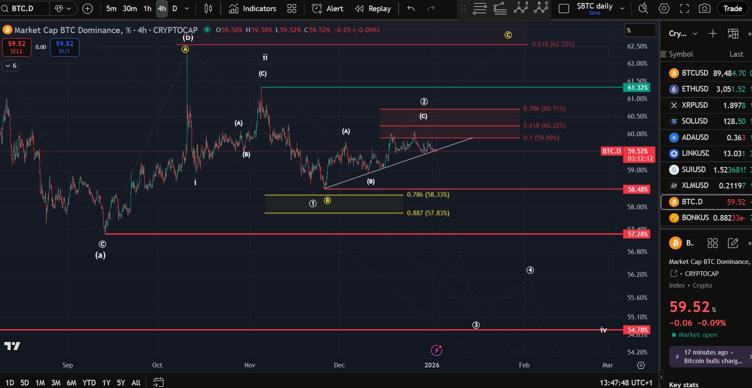
The current market dynamic is defined by a perceptible cooling of the "Bitcoin-only" narrative that dominated much of the previous year. For the better part of 2025, Bitcoin served as the primary vehicle for institutional and retail entry into the crypto space, bolstered by the maturation of spot Exchange-Traded Funds (ETFs) and its reputation as a "digital gold" hedge against global fiscal uncertainty. However, technical analysis provided by Justcryptopays highlights a structural change: Bitcoin has breached a key support trendline that had previously guided its upward trajectory.
When a benchmark asset like Bitcoin breaks below such a trendline, it often signals a period of consolidation or a "distribution phase," where large-scale holders begin to take profits. Historically, this profit-taking does not necessarily exit the ecosystem entirely; instead, it frequently migrates down the "risk curve" into alternative coins (altcoins). This capital rotation is a hallmark of crypto market cycles, where Bitcoin leads the initial charge, followed by large-cap assets like Ethereum, and eventually trickling down to mid-cap and small-cap tokens.
The struggle to hold the $90,000 mark is particularly telling. At the time of reporting, Bitcoin is trading near $90,525, hovering precariously around a level that serves as a barometer for market sentiment. A sustained failure to stay above $90,000 could confirm a local top, encouraging traders to seek higher returns in assets that have remained relatively undervalued during Bitcoin’s ascent.
Historical Context: Moving Beyond the 2025 Bearish Momentum
To understand the potential for an altcoin rally in 2026, one must examine the context of the preceding year. The 2025 market was characterized by significant volatility and periods of bearish exhaustion. While Bitcoin reached new heights, many altcoins struggled to regain their previous all-time highs, leading to a massive divergence in performance. This divergence created a "coiled spring" effect, where many high-utility projects are now trading at significant discounts relative to Bitcoin’s valuation.
The transition from 2025 to 2026 represents more than just a change in the calendar; it signifies a potential shift in the "Bitcoin Dominance" index (BTC.D). When BTC.D declines while the total crypto market capitalization remains stable or grows, it indicates that altcoins are outperforming Bitcoin. Analysts suggest that we are currently seeing the early stages of this decline, as investors grow weary of Bitcoin’s sideways movement and look toward the innovation occurring in the broader ecosystem.

Capital Rotation and the Rise of Layer-1 Competitors
The primary beneficiaries of a capital rotation are typically established Layer-1 (L1) blockchains. Ethereum (ETH), the second-largest cryptocurrency by market cap, remains the primary candidate for leading an altcoin surge. Despite facing stiff competition, Ethereum’s recent network upgrades and the expansion of its Layer-2 (L2) ecosystem have solidified its position as the foundational layer for decentralized applications.
However, the 2026 outlook places a heavy emphasis on "Ethereum killers" like Solana (SOL) and Cardano (ADA). Solana, in particular, has seen a resurgence in trading volume, driven by its high throughput and low transaction costs, which have made it the preferred home for both retail-driven memecoin frenzies and institutional DeFi experiments. The break in Bitcoin’s trendline provides the necessary liquidity for these assets to test major resistance levels.
Furthermore, XRP has remained a focal point for investors following various regulatory clarifications. Its ability to act as a bridge currency for cross-border payments continues to attract interest from financial institutions, positioning it as a "utility-first" asset that could thrive during a period of Bitcoin stagnation.
The Role of DeFi, Web3, and Emerging Sectors
Beyond the large-cap assets, the current market shift is expected to breathe new life into specialized sectors such as DeFi, Web3, and Artificial Intelligence (AI) integrated tokens. During the 2025 lulls, developers in these spaces continued to build, resulting in more robust and user-friendly platforms.
- Decentralized Finance (DeFi): Projects focusing on decentralized lending, borrowing, and yield farming are seeing a return of Total Value Locked (TVL). As Bitcoin’s volatility decreases, the search for yield becomes a primary driver for capital movement into protocols like Aave, Uniswap, and newer L2-based DeFi solutions.
- Web3 and Gaming: The integration of blockchain into gaming and social media (SocialFi) is expected to be a major narrative in 2026. Tokens associated with decentralized infrastructure (DePIN) are also gaining traction as investors look for tangible use cases for blockchain technology.
- Memecoins: While often viewed as speculative, memecoins serve as a gauge for retail liquidity. A rally in assets like Dogecoin or newer community-driven tokens often precedes or accompanies a broader altcoin season, indicating that retail "risk-on" sentiment has returned.
Institutional Influence and Market Sentiment
One of the most significant differences between previous altcoin seasons and the potential 2026 rally is the presence of institutional capital. In 2017 and 2021, altcoin rallies were largely driven by retail speculation. In 2026, however, institutional players are better equipped to participate. The approval and success of Bitcoin and Ethereum ETFs have created a regulated pathway for capital to enter the market.
There is growing speculation that institutional interest will eventually broaden to include other assets. "Once the appetite for Bitcoin is satiated, the natural progression for an institutional portfolio is to seek diversification," noted one industry researcher. This diversification is expected to benefit assets with clear regulatory status and high liquidity, further fueling the altcoin resurgence.
Binance Research has frequently pointed out that market cycles are becoming more nuanced. Rather than all altcoins rising simultaneously, we are seeing "sector-specific" rallies. This suggests that while a general "alt-season" may be in sight, the winners will likely be projects that demonstrate genuine technological progress and user adoption.
Implications for Investors and the Road Ahead
The potential for an altcoin rally presents both opportunities and risks. For short-term traders, the increased volatility in altcoins offers the chance for significant gains compared to the relatively stable Bitcoin. For long-term investors, this period represents a strategic window to position themselves in projects that may become the leaders of the next decade’s digital economy.
However, the challenge for "bulls" remains the lingering bearish sentiment from 2025. Shaking off the psychological impact of previous market downturns requires sustained volume and a clear break above multi-month resistance levels for many altcoins. If Bitcoin were to experience a more severe correction—falling well below $85,000—it could temporarily drag the entire market down, delaying the altcoin season as investors flee to the safety of stablecoins or fiat currency.
The current data suggests a "more balanced market" is emerging. The era of Bitcoin’s absolute dominance may be giving way to a multi-polar ecosystem where various blockchain networks compete for dominance based on utility, speed, and decentralization.
Conclusion
As 2026 unfolds, the cryptocurrency market appears to be at the doorstep of a structural transformation. Bitcoin’s struggle at the $90,000 level and its breach of key technical support are not necessarily signs of a dying bull market, but rather indicators of a maturing one. The rotation of capital into Ethereum, Solana, XRP, and the broader altcoin market suggests that the "Alt-Season" many have predicted is no longer a distant possibility, but a brewing reality.
Investors and traders must remain vigilant, as the transition from a Bitcoin-led market to an altcoin-driven one is often marked by high volatility and rapid shifts in sentiment. Nevertheless, the underlying trend is clear: the digital asset landscape is expanding, and the opportunities for growth are increasingly found beyond the shadow of the flagship cryptocurrency. Whether this rally will be a short-term spike or the beginning of a sustained "altcoin summer" will depend on the market’s ability to maintain liquidity and the continued evolution of blockchain utility.














