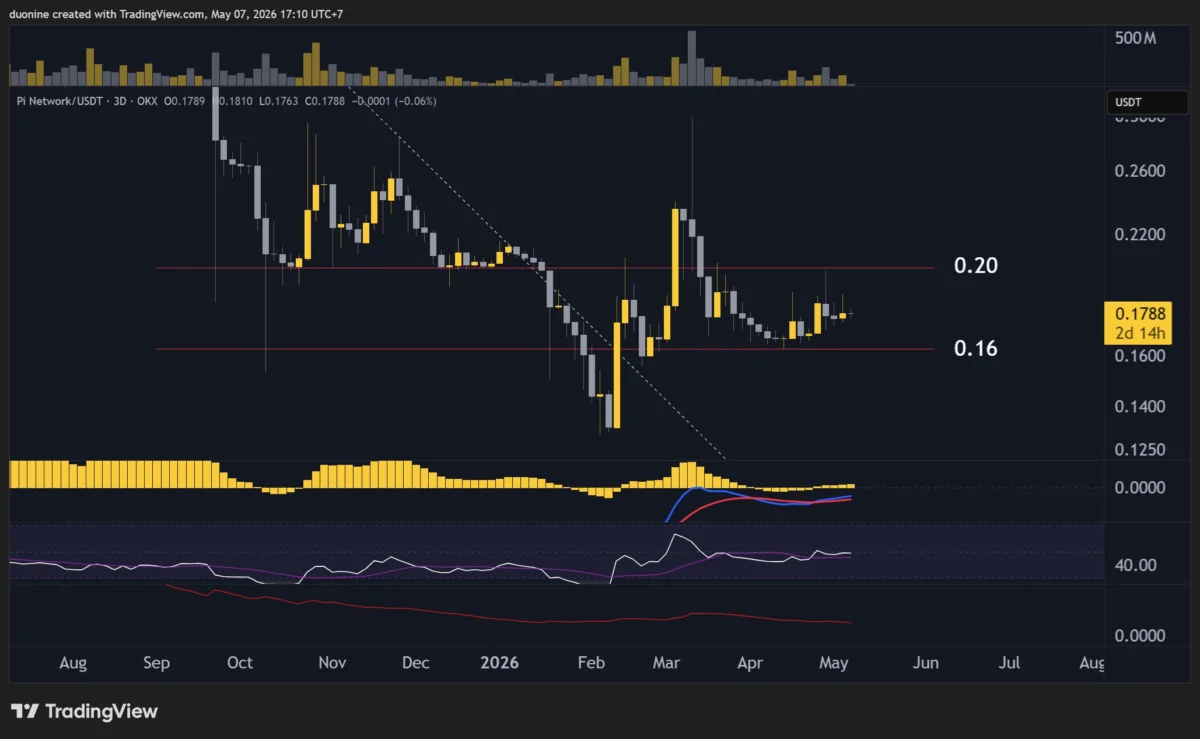
The price of PI Network (PI) has entered a consolidation phase, trading within a defined horizontal channel, leaving investors and market observers to question its potential for a significant breakout. Since hitting a low of approximately $0.13, PI has found itself confined between key support at $0.16 and resistance at $0.20. This trading range has persisted since early March, with multiple attempts to breach these levels being met with swift reversals, indicating a stalemate in market sentiment.
PI Network Stuck in a Persistent Trading Channel
The cryptocurrency market, known for its inherent volatility, often exhibits periods of consolidation where prices move within a defined range. PI Network is currently experiencing such a phase. After a notable price dip to $0.13, the digital asset has established a trading floor at $0.16 and a ceiling at $0.20. This sideways movement has been the dominant trend for PI since the beginning of March, highlighting a lack of decisive directional momentum. Each endeavor by buyers to push the price above the $0.20 resistance level has been thwarted. A particularly notable instance occurred in late April, when a surge in buying pressure was quickly neutralized by a significant spike in selling volume on two separate occasions. This aggressive selling pressure effectively pushed the price back towards the established support at $0.16, reinforcing the boundaries of the current channel.
This pattern of repeated rejections at resistance and bounces off support is a classic indicator of market indecision. It suggests that neither buyers nor sellers have gained a significant upper hand, leading to a stalemate. For PI Network, this means that until a substantial catalyst emerges, its price is likely to remain within this established range. The implications of such prolonged consolidation can be varied. On one hand, it can lead to increased investor frustration and a loss of interest. On the other hand, it can also build up underlying pressure, suggesting that a breakout, when it eventually occurs, could be particularly explosive. The market is effectively in a holding pattern, awaiting a trigger to shift the balance of power.
Examining the Momentum: A Flat Trajectory
The momentum indicators for PI Network mirror the price action, displaying a flat or sideways trend since March. This lack of clear directional bias is consistent with the price’s oscillation within its trading channel. Technical indicators, which are designed to gauge the strength and direction of price movements, are currently hovering around their mid-range values. This suggests that neither bullish nor bearish sentiment is dominating the market at present.

Despite the overall flat momentum, there were periods of increased trading volume observed in late April and throughout May. While this surge in activity might initially suggest an impending breakout, it ultimately failed to propel PI above the crucial $0.20 resistance level. The fact that these volume spikes were accompanied by strong selling pressure indicates that a significant number of sellers were active at these higher price points, effectively absorbing the buying demand.
However, the persistence of these attempts to break higher is noteworthy. If another attempt at breaching the $0.20 resistance materializes, and this time is supported by sustained buying pressure and a reduction in selling volume, it could signal a shift in market dynamics. In such a scenario, if buyers successfully overcome this hurdle, the next significant target for bulls would be the resistance level at $0.28. This level represents a more substantial psychological and technical barrier, and its breach would confirm a strong bullish reversal. The interplay between volume, price action, and the psychology of market participants will be critical in determining the outcome of future attempts to break out of the current channel. The market is waiting for a confirmation signal, and increased volume accompanied by price appreciation will be key indicators.
The Daily RSI: A Midpoint Standoff
The Relative Strength Index (RSI) on the daily chart for PI Network has been notably hovering around the 50-point mark over the past week. The RSI is a momentum oscillator that measures the speed and change of price movements. A reading above 70 typically indicates that an asset is overbought, while a reading below 30 suggests it is oversold. A reading around 50, as seen with PI, signifies a neutral market sentiment and a lack of clear directional momentum.
This consistent trading around the midpoint of the RSI reflects the price’s sideways movement and the indecision currently prevalent in the market. The price has been consolidating around the $0.18 level, a point that sits precisely between the upper and lower bounds of its trading channel. For a bullish bias to be established and for the price to potentially break out of its current range, the daily RSI would ideally need to move decisively above 50 and begin trending towards the 70-point level. Such a movement would signal a growing strength in buying pressure and an increasing confidence among investors.
A sustained rise in the RSI above 50 would not only indicate a shift in momentum but could also coincide with a renewed effort to challenge the $0.20 resistance. If PI Network successfully breaks above this level, the RSI’s continued ascent towards 70 would further solidify the bullish sentiment and suggest that the asset has the potential to reach higher price targets, such as the $0.28 resistance. Conversely, if the RSI fails to break above 50 and instead falls back into the lower half of the indicator, it would reinforce the bearish sentiment and suggest that the price is more likely to remain range-bound or even test lower support levels. The RSI’s behavior will be a crucial barometer for predicting the next significant price move for PI Network.
Key Support and Resistance Levels: The Battlegrounds
The technical landscape for PI Network is clearly defined by its key support and resistance levels. The primary support level, acting as a floor for the current trading range, is established at $0.16. This level has proven resilient, absorbing selling pressure on multiple occasions and preventing further price declines. For any bullish momentum to be sustained, PI Network must maintain its position above this crucial support. A break below $0.16 could trigger further selling and lead to a deeper correction.
On the upside, the immediate resistance stands at $0.20. This level has acted as a formidable barrier, repelling numerous buying attempts. A decisive breach of this resistance is essential for PI Network to initiate a significant upward trend. The volume and conviction behind any attempt to break this level will be critical indicators of its potential success.
Beyond the immediate resistance, a more significant target lies at $0.28. This represents a higher resistance zone, and its breach would signal a substantial bullish move, indicating that PI Network has overcome considerable selling pressure and is entering a new price discovery phase. The path to $0.28 is contingent on successfully navigating the $0.20 hurdle.
The current price action suggests a battleground scenario where these levels are actively contested by buyers and sellers. The persistence of PI Network within the $0.16-$0.20 channel indicates a balance of power, but this equilibrium is inherently unstable. A catalyst, whether it be positive project developments, broader market sentiment shifts, or increased investor adoption, is needed to tip the scales in favor of either the bulls or the bears.
Broader Context and Implications for PI Network
The price action of PI Network occurs against the backdrop of a broader cryptocurrency market that has experienced significant volatility and evolving investor sentiment. While Bitcoin and Ethereum often dictate the overall market trend, individual altcoins like PI Network are subject to their own unique developmental cycles and community engagement.
PI Network, as a project, has focused on creating a cryptocurrency that can be mined on mobile devices, aiming for widespread accessibility and adoption. Its development has been characterized by a phased approach, with the primary goal of achieving a fully functional and decentralized ecosystem. The current price action, while appearing stagnant, can be interpreted in various ways. Some might view it as a period of accumulation by early investors or a natural consolidation phase before a larger move. Others might express concern over the lack of significant price appreciation since its initial low.
The implications of PI Network breaking away from its current channel are substantial. A successful breakout above $0.20, supported by sustained buying pressure and positive market sentiment, could attract renewed interest from investors and potentially lead to a rapid ascent towards the $0.28 resistance and beyond. This would validate the project’s underlying value and its potential for future growth. It could also signal a broader shift in investor confidence towards PI Network, potentially leading to increased trading volume and liquidity.
Conversely, a failure to break out and a subsequent breakdown below the $0.16 support level could lead to a period of further decline. This might be triggered by negative news, a broader market downturn, or a loss of confidence in the project’s development roadmap. In such a scenario, PI Network could experience a prolonged bear market, with prices potentially testing even lower levels.
The long-term success of PI Network will depend not only on its technical price action but also on the continued development of its ecosystem, the successful implementation of its roadmap, and its ability to foster a robust and engaged community. The current price consolidation, while appearing uninspiring, could be a crucial period of preparation for future growth. Market participants will be closely watching for any signs of a definitive breakout, as this will likely mark a significant turning point for the PI Network’s valuation. The project’s ability to deliver on its promises and adapt to the dynamic cryptocurrency landscape will ultimately determine its trajectory.