A deep dive into the raw performance data of prediction markets reveals a startling level of financial concentration, with Polymarket emerging as an undisputed leader among platforms offering transparent, on-chain, and officially verifiable revenue streams in 2026. This analysis, deliberately bypassing mere headlines to scrutinize the foundational numbers, underscores a significant disparity between Polymarket and its closest competitors within this specific, auditable segment of the burgeoning crypto industry. The findings suggest that Polymarket has not merely secured a lead but has established itself in an entirely different league, demonstrating a scale of revenue generation that dwarfs other verifiable players.
Defining the Scope: The Imperative of On-Chain Verifiability
To precisely frame this comparison, it is crucial to delineate the parameters from the outset. This examination is not an exhaustive global ranking of every prediction market platform. Instead, it meticulously focuses on applications whose financial operations—specifically fees and generated revenue—are openly tracked on-chain, making them independently verifiable by any interested party through official data sources. This distinction is paramount because a significant portion of the prediction market landscape operates off-chain, often as private entities, which do not publish audited revenue figures through public, checkable sources in the manner that on-chain protocols do. For instance, large-scale platforms like Kalshi, while processing substantial trading volumes and potentially generating considerable real-world revenue, conduct their trades and settlements off-chain via a centralized company structure. Consequently, there is no public smart contract data available for independent verification by analytics platforms like DefiLlama. Any revenue figure attributed to such off-chain platforms remains an external estimate, lacking the direct, immutable verification afforded by blockchain technology.
Conversely, platforms such as Polymarket, Predict Fun, and PancakeSwap Prediction distinguish themselves by conducting every trade, fee collection, and revenue generation through public smart contracts. This fundamental design choice means their financial metrics are not self-reported or estimated but are, instead, independently observable and auditable by anyone with access to the blockchain data. This rigorous adherence to on-chain transparency forms the bedrock of this analysis, ensuring that all comparisons are based on verifiable data, thereby offering the fairest and most honest assessment of revenue leadership within this specific, auditable sector.
Polymarket’s Meteoric Rise: A Strategy Validated by Numbers
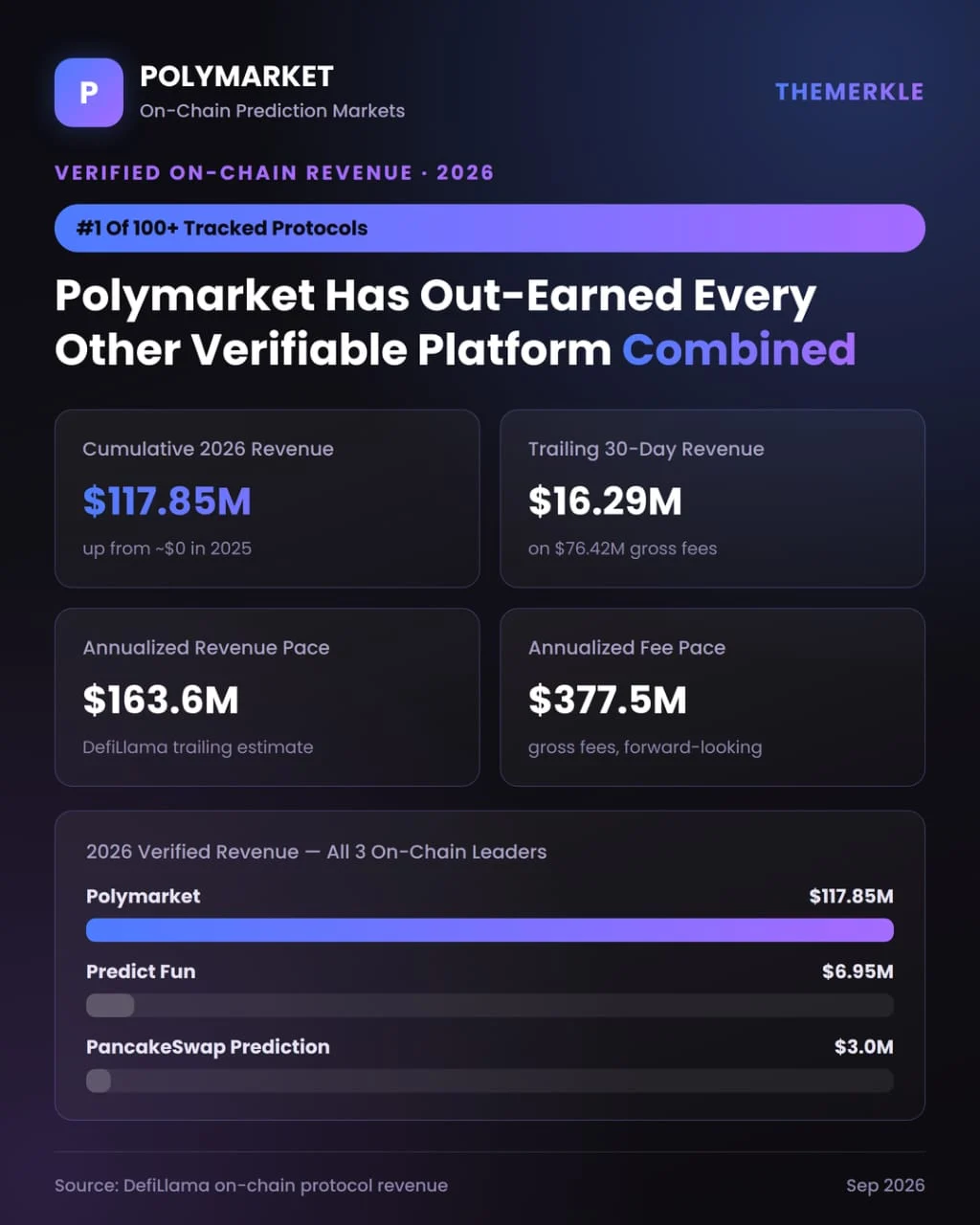
According to DefiLlama, the industry-standard analytics platform widely trusted for on-chain data verification, Polymarket has generated approximately $117.85 million in cumulative protocol revenue thus far in 2026. It is essential to clarify that this figure represents actual protocol revenue, not merely gross trading volume or total fees paid by users. Protocol revenue, in this context, is the net portion of fees that Polymarket retains after accounting for maker rebates, holding rewards, and referral incentives. This metric aligns with the "net revenue" standard used to evaluate the financial health and operational success of traditional businesses, providing a clear indication of the platform’s profitability and sustainability.
What makes this revenue figure particularly striking is Polymarket’s strategic journey to reach it. The platform operated with essentially zero revenue in 2025, a deliberate decision to forgo trading fees in favor of aggressively scaling global liquidity and fostering user growth. This period was characterized by a focus on market penetration and establishing a robust user base, preparing for a future where fees would be introduced. The moment the "fee switch" was activated, the transition from negligible revenue to well over one hundred million dollars within a single year was immediate and profound, serving as a powerful validation of its long-term strategy.
The platform’s recent performance further underscores its robust financial trajectory. Over the past 30 days alone, Polymarket reported $16.29 million in protocol revenue derived from $76.42 million in gross fees. DefiLlama’s trailing-year annualized estimate projects Polymarket to be on pace for roughly $163.6 million in revenue and $377.5 million in fees going forward, indicating sustained and accelerating growth. These figures paint a clear picture of a platform that has successfully converted years of strategic investment in user acquisition and liquidity building into significant, verifiable revenue.

The Strategic Underpinnings of Polymarket’s Dominance
Polymarket’s unparalleled success in the on-chain prediction market sector is not accidental but the result of a meticulously executed long-term strategy that focused on several key pillars:
-
Trust and Liquidity Building: The decision to operate without trading fees for an extended period in 2025 was a bold move aimed at cultivating trust and deep liquidity. By removing the financial barrier to entry, Polymarket encouraged widespread participation, allowing users to experience the platform without direct cost. This strategy fostered a strong network effect, creating vibrant markets with ample liquidity that could absorb large trades, a critical factor for any prediction market’s viability. The absence of fees lowered the friction for new users and solidified its reputation as a user-friendly platform.
-
Aggressive Market Expansion: Polymarket strategically expanded its offerings into highly engaging and high-volume market segments, particularly sports and political markets. These areas typically attract broad public interest and generate substantial speculative activity, providing a fertile ground for prediction market growth. By catering to these popular themes, Polymarket tapped into existing public discourse and events, making its markets relevant and appealing to a wider audience beyond traditional crypto enthusiasts.
-
Regulatory Proactiveness and Legitimacy: A crucial differentiator for Polymarket has been its proactive approach to regulatory compliance. The platform secured genuine regulatory standing in the United States through its CFTC-designated Polymarket US arm. This move is significant in the often-unregulated crypto space, providing a layer of institutional legitimacy and legal clarity that many smaller, purely crypto-native competitors lack. Regulatory approval not only reduces operational risks but also opens doors to a broader, more mainstream user base and potential institutional partners who require such assurances.
-
Strategic Institutional Investment: The platform’s credibility was further bolstered by a reported $2 billion combined strategic investment from Intercontinental Exchange (ICE), the parent company of the New York Stock Exchange. This landmark deal provided Polymarket with not only substantial capital but also an invaluable endorsement from a titan of traditional finance. Such institutional backing signals maturity and long-term potential, distinguishing Polymarket from numerous decentralized projects that primarily rely on venture capital from crypto-native firms. This investment likely facilitated further expansion, technological development, and enhanced operational robustness.
When Polymarket eventually activated its fee structure, all these accumulated advantages—trust, liquidity, regulatory clarity, and institutional capital—converted almost immediately into substantial revenue, demonstrating a scale unmatched by other on-chain prediction markets.
The Verifiable Contenders: A Distant Second and Third
While Polymarket commands a dominant position, it is important to examine the performance of other verifiable on-chain prediction markets to understand the full competitive landscape.

Predict Fun: A Niche Innovator on BNB Chain
The next largest earner among on-chain, officially trackable prediction markets is Predict Fun, a BNB Chain-based platform. According to its official DefiLlama tracking page, Predict Fun has generated approximately $6.95 million in cumulative protocol revenue so far this year. This figure, built off roughly $21.45 million in cumulative fees and a trailing 30-day revenue figure of just over $1 million, represents a legitimate achievement for a platform of its size.
However, when placed alongside Polymarket’s $117.85 million, the sheer scale difference becomes stark. Within this specific, verifiable category, Polymarket has out-earned Predict Fun by a factor of roughly seventeen to one in 2026 alone. Despite this significant gap, Predict Fun has successfully carved out a legitimate niche by offering a unique feature: DeFi-powered yield on open positions. This innovative approach aims to solve the "idle capital" problem, a common challenge in prediction markets where funds locked in open positions remain dormant. By enabling users to earn yield, Predict Fun enhances capital efficiency and provides an additional incentive for participation. The platform also benefits from serious institutional backing, having raised a strategic round from YZi Labs and Susquehanna earlier this year, signaling confidence in its model and potential. Nevertheless, its operational scale remains fundamentally different from that of the current market leader.
PancakeSwap Prediction: The Ecosystem Play with Direct Value Accrual
Rounding out the top three in the strictly on-chain, officially verifiable category is PancakeSwap Prediction, an integrated prediction market feature within the broader PancakeSwap ecosystem on BNB Chain. Its official DefiLlama revenue page indicates approximately $3 million in cumulative revenue generated so far in 2026. This revenue is segmented quarterly, with roughly $1.37 million in Q1, $1.01 million in Q2, and just over $600,000 recorded so far in the current quarter.
A particularly interesting aspect of PancakeSwap Prediction’s model is its revenue utilization. Every dollar of protocol revenue is automatically routed into buying back and burning CAKE, PancakeSwap’s native token. DefiLlama’s own methodology documentation confirms this direct, automated mechanism, highlighting the absence of separate treasury allocations or team discretion. This transparent and fully automated process ensures that protocol revenue directly contributes to the deflationary pressure on the CAKE token supply, theoretically enhancing its value for token holders. The cumulative total funneled through this buyback program since inception now stands above $16.7 million. While a smaller platform in absolute terms compared to Polymarket or even Predict Fun, its direct revenue-to-token-holder pipeline represents a highly efficient and transparent model for value accrual within the DeFi sector.
Understanding the Concentration: Implications for the On-Chain Sector
The side-by-side comparison of these three platforms reveals a picture of extreme concentration at the apex of the on-chain prediction market sector. Among the more than one hundred prediction market protocols tracked by DefiLlama with public, verifiable revenue data, Polymarket alone accounts for the overwhelming majority of all measurable revenue generated in 2026. Predict Fun and PancakeSwap Prediction, despite their respective innovations and successes, trail well behind in a distant second and third place, with the remainder of tracked protocols splitting a comparatively minuscule portion of the total revenue.
This pronounced concentration reflects several key dynamics in how this specific niche of the crypto market has evolved. Polymarket’s multi-year investment in building trust, deep liquidity, and a robust user base, coupled with its aggressive expansion into popular markets like sports and politics, created a powerful flywheel effect. Crucially, its proactive engagement with regulatory bodies, culminating in the CFTC designation for Polymarket US, provided a layer of institutional legitimacy that is a significant barrier for many smaller, crypto-native competitors. The strategic investment from Intercontinental Exchange further solidified its position, granting it both capital and traditional financial credibility that few, if any, other on-chain platforms can access. When Polymarket finally activated its fee structure, all these accumulated advantages converged, converting accumulated trust and volume into revenue at a scale that nothing else in the on-chain sector could match.

The Kalshi Factor: A Necessary Caveat
It is imperative to reiterate the exclusion of Kalshi from this comparison, a point that constitutes the most significant caveat in this analysis. Kalshi is not included because its revenue is not transparently measurable through the same official, on-chain channels utilized by Polymarket, Predict Fun, and PancakeSwap Prediction. As a centralized, private company, Kalshi does not publicly disclose its audited revenue figures. While Kalshi frequently leads the broader prediction market sector in raw notional trading volume, particularly in sports markets, its actual revenue could plausibly be significantly higher than any of the three platforms discussed here.
The honest summary is therefore precise: among prediction markets whose revenue is transparently and officially verifiable on-chain, Polymarket leads by an overwhelming margin, with Predict Fun and PancakeSwap Prediction occupying distant second and third positions. This is a fundamentally different claim from asserting a global ranking of every prediction market by total revenue. The exact position Kalshi would occupy in an all-inclusive ranking remains unquantifiable with a verifiable, official source at this time, underscoring the inherent challenges of comprehensive market analysis in an industry that blends transparent decentralized protocols with opaque centralized entities.
Broader Implications for the Prediction Market Sector
Pulling together these observations, the clearest takeaway is that the on-chain, transparently verifiable segment of the prediction market industry is increasingly becoming a story centered around a single dominant platform. Polymarket’s approximately $117.85 million in 2026 revenue is not just a lead over Predict Fun and PancakeSwap Prediction within this category; it surpasses the combined total of literally every other on-chain prediction market that DefiLlama tracks. For a platform that spent years deliberately foregoing revenue to cultivate market share and build a foundation of trust and liquidity, this level of financial success serves as an unambiguous validation of its long-term strategy, particularly when viewed through the lens of checkable, on-chain data.
This extreme concentration raises several questions for the future evolution of the sector. Will the substantial financial and strategic advantages enjoyed by Polymarket lead to further consolidation, or will specialized competitors like Predict Fun, with its unique DeFi yield integration, and PancakeSwap Prediction, with its robust tokenomics, manage to carve out sustainable and growing niches? The continued capital raises by platforms like Predict Fun suggest ongoing belief in alternative models, but closing such a significant revenue gap will require extraordinary innovation and execution. Furthermore, the success of Polymarket’s regulatory strategy could set a precedent for other on-chain projects seeking to bridge the gap between decentralized finance and traditional institutional legitimacy.
The narrative of verifiable, on-chain revenue highlights the power of transparency in an industry often plagued by opacity. For investors, analysts, and users, the ability to independently verify financial performance through immutable blockchain data provides a level of confidence and accountability rarely seen in traditional markets. As the prediction market sector matures, the interplay between regulatory frameworks, technological innovation, and transparent financial reporting will undoubtedly shape its competitive dynamics and overall growth trajectory. Based on the official, on-chain numbers available right now for anyone to inspect, Polymarket is not merely winning the on-chain prediction market revenue race in 2026; it is doing so with a margin that leaves little room for contention.