


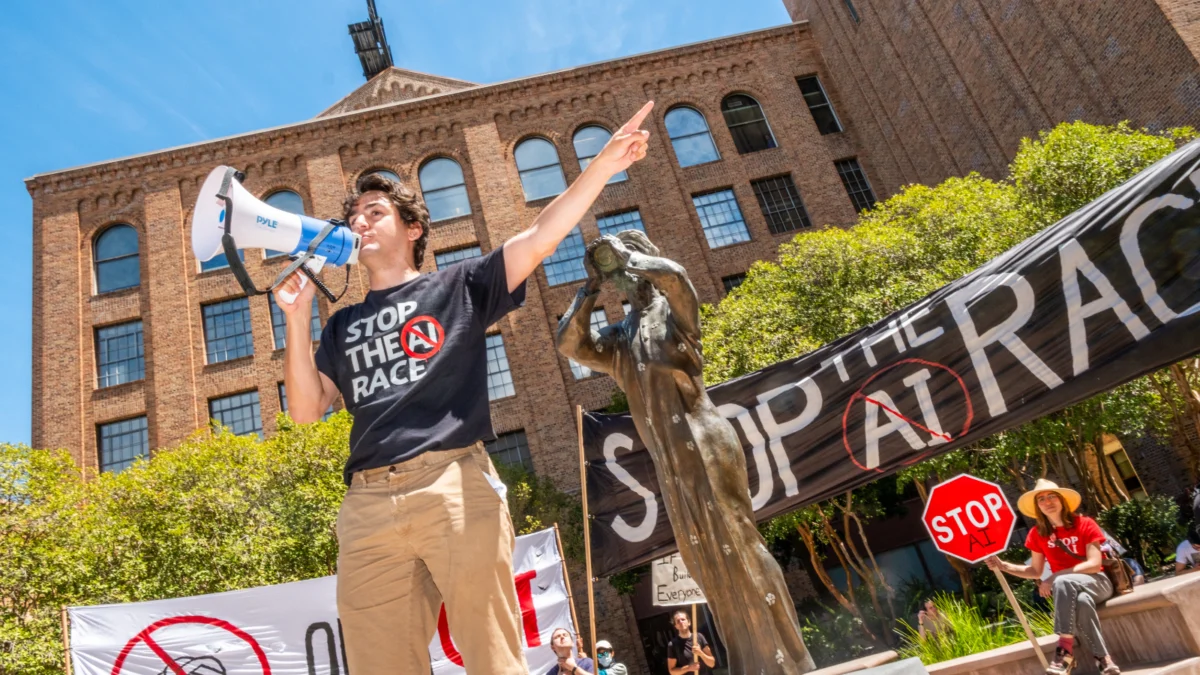
San Francisco, a global epicenter of technological innovation, once again became the focal point of a significant public demonstration as protesters marched between the offices of leading artificial intelligence developers OpenAI, Anthropic, and Google DeepMind. The demonstration, organized by the grassroots advocacy group Stop the AI Race, went beyond the frequently discussed concerns of AI safety and existential risk, encompassing a wider array of societal anxieties including potential job losses, the considerable environmental impact of advanced AI systems, the exacerbating housing crisis in San Francisco, and the escalating influence of major technology companies on civic life.
The protest, held on a recent Saturday, served as a powerful visual statement, bringing the abstract concerns surrounding AI development directly to the doorsteps of the corporations at the forefront of this technological revolution. Participants carried signs and chanted slogans calling for an immediate pause in the training of new frontier AI models, while advocating for existing systems to remain available. A central tenet of their demand was the redirection of research efforts toward robust AI safety and alignment protocols, urging a moratorium on further advancement until comprehensive safeguards and stronger regulatory frameworks are firmly in place. While the primary focus was on corporate responsibility, a segment of the demonstrators also voiced calls for more stringent local and state-level regulation to rein in the burgeoning industry.
A Growing Chorus Against Unchecked AI Development
The Stop the AI Race movement, spearheaded by former AI researcher Michaël Trazzi, has seen its goals evolve significantly since its inaugural protest earlier in the year. Trazzi articulated this shift to Decrypt, noting, "I think earlier this year I wasn’t thinking about raising political salience as much as I was thinking about convincing CEOs. I think I’ve updated toward CEOs actually listening, given the multiple blog posts and some exchanges I had with one of them. I also think having protests is useful to show that people care." This statement underscores a strategic pivot from direct corporate lobbying to broad public awareness and political pressure, recognizing the multi-faceted nature of the challenges posed by advanced AI.
The burgeoning public concern is not isolated to San Francisco. Across the globe, academics, policymakers, and civil society groups are increasingly grappling with the profound implications of AI’s rapid advancement. The demand for a pause in frontier AI development echoes sentiments expressed in various open letters and declarations from prominent figures in the AI community and beyond. These calls often highlight the potential for uncontrolled AI to pose societal risks ranging from economic disruption and job displacement to the propagation of misinformation, exacerbation of biases, and even catastrophic or existential threats if general artificial intelligence were to emerge without adequate controls.
The Multifaceted Demands: Beyond Existential Risk
While the specter of "catastrophic harm" often dominates headlines regarding AI safety, the San Francisco protest underscored a broadening scope of concerns that resonate deeply with the public. The protestors’ agenda meticulously outlined several critical areas where unchecked AI development poses significant risks.
Economic Disruption and the Future of Work
A major concern articulated by the demonstrators was the potential for widespread job losses due to AI automation. As AI models become increasingly sophisticated, capable of performing tasks traditionally requiring human cognitive abilities, fears of mass unemployment have grown. Reports from institutions like Goldman Sachs, which predicted in March that AI could automate 300 million full-time jobs, or the World Economic Forum, which projects significant job displacement alongside job creation, fuel these anxieties. Protesters fear that the current pace of AI development prioritizes technological advancement over societal readiness for such profound economic shifts, potentially leading to increased inequality and social instability. The protest implicitly argued that a pause would allow society to adapt, retrain workforces, and implement social safety nets to mitigate the impact of automation. The National Union of Healthcare Workers (NUHW) endorsing the protest is particularly noteworthy, signaling that organized labor is increasingly recognizing AI’s potential threat to its members and the broader working class.
The Environmental Footprint of AI’s Ambition
The environmental impact of large-scale AI development has emerged as another critical concern. Training and operating advanced AI models, particularly large language models (LLMs) and deep learning systems, demand immense computational power, which translates into substantial energy consumption. Data centers, the physical infrastructure housing these powerful computers, are notorious for their energy-intensive operations and significant water usage for cooling. Studies have indicated that training a single large language model can consume energy equivalent to hundreds of thousands of pounds of carbon dioxide emissions, or the annual energy consumption of several homes. The continuous development of increasingly powerful models exacerbates this issue, contributing to greenhouse gas emissions and putting a strain on natural resources. Protesters highlighted this often-overlooked aspect, arguing that the pursuit of more powerful AI models without a clear understanding and mitigation strategy for their environmental cost is unsustainable and irresponsible.
Local Impacts: San Francisco’s Housing Crisis and Tech Dominance
The protest also brought to light local socio-economic issues directly tied to the booming tech industry in San Francisco. The influx of high-paying tech jobs, driven by companies like OpenAI, Anthropic, and Google DeepMind, has long been identified as a primary driver of the city’s exorbitant housing costs. This phenomenon has led to severe gentrification, displacement of long-term residents, and a growing disparity between the tech elite and other working populations. By marching past these companies’ offices, protesters drew a direct line between the unchecked growth of the AI sector and the deepening housing crisis, framing it as a symptom of the tech industry’s broader impact on local communities. The concern over the "growing influence of major technology companies" extended beyond economic factors to encompass their perceived political sway and impact on urban planning and social equity.
A Chronology of Mounting AI Safety Concerns
The protest by Stop the AI Race is not an isolated event but rather a culmination of growing apprehension within the AI community and among the broader public. The group’s journey from its initial demonstration to its expanded platform reflects a rapidly evolving discourse around AI.
Stop the AI Race: A Movement’s Genesis and Evolution
The recent Saturday demonstration built upon an earlier Stop the AI Race protest held in March. That initial gathering saw approximately 200 individuals march between the offices of Anthropic, OpenAI, and xAI, specifically advocating for a coordinated pause on frontier AI development. Since then, the group has sustained its campaign through a combination of public protests and broader advocacy efforts. Michaël Trazzi expressed encouragement at the movement’s growing support, stating, "I was pleasantly surprised to have the NUHW [National Union of Healthcare Workers] endorse the protest and repost it on their social media. I was also surprised by how quickly other groups in the Bay Area, like AI Action, were able to get up to speed and work with us. I’m also very grateful to QuitGPT for their help organizing this." This growing coalition of labor unions and other activist groups signifies a broadening of the AI safety movement beyond purely academic or tech-centric circles, bringing in diverse perspectives and larger organizational capacities.
Industry Responses and Regulatory Scrutiny
The targeted companies — OpenAI, Anthropic, and Google DeepMind — did not immediately respond to requests for comment by Decrypt regarding the latest protest. However, their public statements and recent actions indicate an awareness of the mounting pressure and a proactive (though often self-regulatory) approach to AI safety.
In May, OpenAI, facing lawsuits and investigations over claims its chatbot mishandled dangerous interactions, introduced new ChatGPT safety features. These enhancements were designed to better detect and respond to signs of self-harm and violence during user conversations, illustrating the company’s efforts to address immediate safety concerns and mitigate misuse. This move, however, is often seen by critics as reactive rather than preventative, implemented after issues arise.
Anthropic, another prominent AI developer, faced direct government intervention in June. The US government ordered the company to suspend access to its Claude Fable 5 and Claude Mythos 5 models. The reason cited was potential cybersecurity risks, highlighting a growing governmental concern not just with AI’s inherent safety, but also with its susceptibility to external threats and its potential impact on national security. This incident underscores the regulatory bodies’ increasing willingness to step in when perceived risks cross a certain threshold, moving beyond mere guidance to direct intervention.
Global Calls for Prudence: The International Perspective
The calls for caution extend far beyond individual companies or national borders. Earlier this month, the United Nations’ first independent scientific panel on AI issued a stark warning. The panel concluded that scientists "cannot rule out catastrophic harm" as AI technology continues to advance at a pace that outstrips both scientific understanding and governmental oversight. This high-level international assessment adds significant weight to the protesters’ demands, framing the current trajectory of AI development as a global risk that requires coordinated, international action.
This UN report aligns with other global initiatives, such as the EU AI Act, which aims to be the world’s first comprehensive legal framework on AI, and the G7 Hiroshima AI Process, which seeks to establish international guiding principles and codes of conduct for advanced AI systems. These efforts collectively indicate a worldwide recognition of the profound challenges and opportunities presented by AI, and a growing consensus that its development cannot proceed without robust ethical considerations, safety measures, and regulatory frameworks.
The Road Ahead: Sustained Advocacy and the Search for Safeguards
Organizers of the Stop the AI Race protest have made it clear that their recent demonstration is not an endpoint but a continuation of their advocacy. They plan to persist in their efforts to advocate for an international pause on frontier AI development, while simultaneously encouraging lawmakers to adopt stronger oversight mechanisms for advanced AI systems. This dual approach targets both the corporate actors responsible for development and the governmental bodies tasked with regulation, aiming to create a comprehensive push for more responsible AI.
The Evolving Role of Public Pressure
The increasing visibility of protests like the one in San Francisco highlights the evolving role of public pressure in shaping the discourse around emerging technologies. Historically, technological advancements have often proceeded with limited public input until their societal impacts became undeniable. However, with AI, the potential ramifications are so vast and complex that civil society groups are proactively demanding a seat at the table. These protests serve to politicize AI development, bringing it out of the exclusive domain of engineers and venture capitalists and into the realm of public debate and democratic accountability. The shift in Trazzi’s strategy from "convincing CEOs" to "raising political salience" is indicative of this broader trend, recognizing that genuine change often requires systemic pressure rather than individual persuasion.
Navigating the Innovation-Safety Paradox
The core tension at the heart of the AI debate lies in balancing the immense potential for innovation and societal benefit with the equally immense risks. Proponents of rapid AI development often emphasize its potential to solve grand challenges, from curing diseases to addressing climate change, arguing that a pause would stifle progress and allow competitors to gain an advantage. Conversely, advocates for a pause contend that without sufficient caution, the risks could outweigh any potential benefits, leading to unintended and irreversible negative consequences.
The demands of Stop the AI Race — a pause in new frontier model training while keeping existing systems available, and redirecting research towards safety — represent an attempt to navigate this paradox. It’s not a call to halt AI entirely, but to create a deliberate space for reflection, robust safety engineering, and societal adaptation before unleashing increasingly powerful and potentially unpredictable systems. As AI continues its rapid trajectory, the dialogue between innovation and caution, progress and prudence, will undoubtedly intensify, with protests like those in San Francisco serving as crucial reminders of the societal stakes involved. The outcome of this ongoing debate will shape not only the future of artificial intelligence but also the very fabric of human society.














