



The global cryptocurrency mining industry has entered a period of unprecedented turmoil following the successful completion of the Ethereum Merge, a transition that has effectively rendered the once-lucrative practice of GPU-based mining unprofitable across nearly all alternative Proof-of-Work (PoW) networks. As the Ethereum mainnet migrated from a PoW consensus mechanism to Proof-of-Stake (PoS), a massive migration of hashing power flooded into smaller ecosystems, causing mining difficulty to skyrocket and profits to plummet into negative territory. This seismic shift has left hundreds of thousands of miners worldwide facing a stark reality: the electricity costs required to power their rigs now significantly outweigh the value of the digital assets they produce.
The Great Migration: From Ethereum to a Saturated Market
For years, Ethereum was the undisputed king of GPU mining. Unlike Bitcoin, which transitioned to specialized Application-Specific Integrated Circuit (ASIC) hardware long ago, Ethereum’s Ethash algorithm remained accessible to consumer-grade graphics cards manufactured by NVIDIA and AMD. At its peak, the Ethereum network commanded a hashrate exceeding 850 to 1,000 Terahashes per second (TH/s), representing billions of dollars in hardware investment and operational infrastructure.
When the Merge occurred, this colossal amount of computational power was suddenly disconnected from its primary source of revenue. Seeking a new home, miners redirected their rigs toward "alt-coins" that utilize similar hashing algorithms. The primary beneficiaries—or victims—of this migration included Ethereum Classic (ETC), Ravencoin (RVN), Ergo (ERG), and Flux (FLUX). However, the fundamental problem was one of scale. The combined market capitalization and block rewards of these smaller networks were a mere fraction of Ethereum’s.
In the days following the transition, Ethereum Classic saw its hashrate surge by nearly 300%, jumping from approximately 60 TH/s to over 200 TH/s in a matter of hours. In a PoW system, as more miners join a network, the "mining difficulty" adjusts upward to ensure that blocks are produced at a consistent interval. When the hashrate increases exponentially without a corresponding increase in the coin’s market price, the reward per individual miner is diluted to the point of insolvency.

A Chronology of the Transition
The road to the Merge was nearly seven years in the making, characterized by numerous delays and technical milestones. Understanding the current profitability crisis requires a look at the timeline that led to this saturation.
- The Beacon Chain Launch (December 2020): This marked the beginning of Ethereum’s transition to PoS, running a parallel chain that did not yet process mainnet transactions but allowed users to stake their ETH.
- The Rise of the Mining Boom (2021): Despite the looming Merge, high ETH prices and the NFT craze led to a massive expansion in mining operations. GPU prices reached all-time highs as miners competed with gamers for inventory.
- The Difficulty Bomb and Terminal Total Difficulty (Mid-2022): Developers implemented a "difficulty bomb" to incentivize the transition. The final date for the Merge was set via a Terminal Total Difficulty (TTD) parameter, which triggered the switch once the network reached a specific cumulative difficulty level.
- The Merge (September 15, 2022): At 06:42:42 UTC, the last PoW block was mined. The network successfully transitioned to PoS, eliminating the need for miners and reducing the network’s energy consumption by an estimated 99.95%.
- The Profitability Collapse (Post-Merge): Within 24 hours of the Merge, data from mining calculators like WhatToMine began showing negative returns across every major GPU-minable coin.
Analyzing the Data: The Economics of Negative Returns
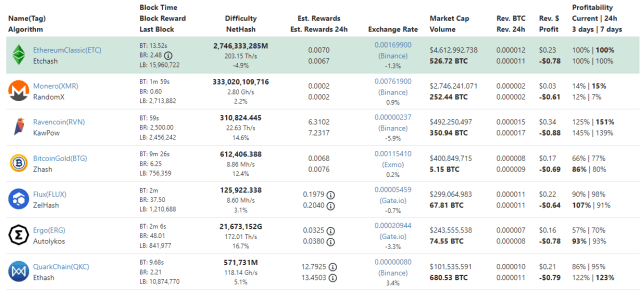
The current state of the market is best illustrated by the stark contrast between revenue and operational expenditure. According to data from WhatToMine, a popular mining profitability calculator, the most prominent PoW coins are currently yielding "net losses" for the average operator.
Using a benchmark of three AMD RX 480 graphics cards—a once-standard mid-range setup—mining Ethereum Classic currently results in a profit of approximately -$0.78 per hour. This calculation assumes an average electricity cost of $0.10 per kilowatt-hour (kWh). Even for industrial-scale miners with access to cheaper electricity at $0.05 or $0.06 per kWh, the margins remain razor-thin or slightly negative when accounting for cooling and hardware maintenance.
The situation is equally dire for owners of high-end hardware. An NVIDIA RTX 3090 Ti, the flagship consumer GPU at the time of the Merge, currently nets roughly -$0.50 per hour when mining ETC. For a miner to break even on a coin like Ravencoin or Ergo at current difficulty levels, the market price of those assets would need to increase by 300% to 500%, or a significant portion of the global hashrate would need to go offline, lowering the difficulty.
Industry Reactions and the Hardware Fire Sale
The mining community’s reaction has been a mix of resignation, pivot, and liquidation. On social media platforms and mining forums, the sentiment is overwhelmingly somber. Many small-scale "home miners" have already powered down their rigs, citing the inability to justify the monthly electricity bill.

"We knew this day was coming, but the speed at which the difficulty adjusted on secondary coins was staggering," noted one operator on a popular crypto-mining subreddit. "There is simply nowhere for all that hashrate to go. We are looking at a ‘mining winter’ that may never end for GPUs."
This exodus has triggered a secondary shockwave in the hardware market. Platforms like eBay and Facebook Marketplace have been flooded with used graphics cards as miners attempt to recoup whatever capital they can from their aging rigs. This "GPU Apocalypse" has been a boon for PC gamers, who saw the prices of high-end cards drop by 50% or more in the weeks following the Merge, but it represents a massive capital loss for the mining sector.
Large-scale industrial mining firms, which had invested millions in infrastructure, are exploring alternative uses for their hardware. Some are pivoting to high-performance computing (HPC) tasks, such as rendering for the film industry, providing computational power for artificial intelligence (AI) training, or supporting decentralized physical infrastructure networks (DePIN).
Broader Implications: Security and Decentralization
The collapse of PoW profitability carries implications beyond the bank accounts of miners; it raises significant questions regarding the security of the remaining PoW networks. The security of a PoW blockchain is directly tied to its hashrate. A higher hashrate makes it more expensive and difficult for a malicious actor to conduct a "51% attack," where they take control of the majority of the network’s computing power to double-spend coins or halt transactions.
With hashrates currently in a state of extreme flux and many miners operating at a loss, smaller networks are potentially more vulnerable. If a large pool of "homeless" hashrate decides to target a small-cap coin, the cost of an attack is significantly lower than it was pre-Merge. Developers of coins like Ergo and Ravencoin are closely monitoring these developments, emphasizing the need for community-driven decentralization to prevent hashrate centralization in a few large pools.
Furthermore, the environmental narrative of the cryptocurrency industry has shifted overnight. Ethereum’s transition to PoS has removed one of the most significant criticisms against the network: its massive carbon footprint. This has put increased pressure on Bitcoin and the remaining PoW coins to justify their energy consumption, potentially leading to further regulatory scrutiny in regions with strained power grids.
The Future of Proof-of-Work: Is It Dead?
While the current outlook for GPU mining is bleak, some analysts argue that the industry is merely undergoing a "great reset." Historically, the crypto market has moved in cycles. If a new project emerges with a PoW algorithm that captures significant market interest, or if one of the existing alt-coins sees a massive price appreciation, profitability could theoretically return.
However, the fundamental math remains challenging. Ethereum’s role as the "yield engine" for the GPU mining world was unique due to its massive ecosystem of decentralized finance (DeFi) and NFTs, which drove high transaction fees that were paid out to miners. None of the current PoW alternatives possess a comparable level of network utility or fee generation.
For now, the era of "easy money" via home-based GPU mining appears to have reached its conclusion. The market is currently in a discovery phase, seeking a new equilibrium where only those with the most efficient hardware and the lowest possible energy costs can survive. For the vast majority of the mining population, the Merge was not just a technical upgrade for Ethereum, but a definitive end to a decade-long gold rush.
As Ether’s price continues to fluctuate—currently hovering around the $1,400 mark with a 6% weekly decline—the focus has shifted from mining blocks to securing the network through staking. The transition is complete, and while the Ethereum network moves toward its next phase of scalability, the ghosts of its mining past are left to navigate a landscape where the cost of the "work" has finally exceeded the value of the "proof."














