The landscape of cryptocurrency mining has undergone a seismic shift following the successful completion of the Ethereum "Merge," a transition that effectively dismantled the world’s largest ecosystem for graphics processing unit (GPU) mining. As Ethereum migrated from a Proof-of-Work (PoW) consensus mechanism to Proof-of-Stake (PoS), it rendered the multi-billion dollar mining infrastructure built around the network obsolete for its original purpose. In the days following this transition, the resulting "Great Migration" of miners to alternative PoW blockchains has led to a catastrophic collapse in profitability, with nearly every major GPU-minable asset now yielding negative returns for operators.
The Ethereum Merge, which took place on September 15, 2022, was the culmination of years of development aimed at reducing the network’s energy consumption by more than 99.9%. While celebrated as a landmark achievement for environmental sustainability in the blockchain sector, the event triggered an immediate existential crisis for the global mining community. Deprived of the ability to secure the Ethereum network, hundreds of thousands of miners redirected their computing power toward alternative chains, including Ethereum Classic (ETC), Ravencoin (RVN), Ergo (ERG), and Flux (FLUX). However, the sheer volume of incoming hashrate has overwhelmed these smaller networks, driving mining difficulty to unprecedented levels and erasing profit margins across the board.
The Mechanics of the Hashrate Flood
To understand the current crisis, one must look at the disparity in network size between Ethereum and its PoW successors. Before the Merge, Ethereum’s hashrate—the total computational power securing the network—was significantly larger than all other GPU-minable coins combined. When this massive wave of computing power sought a new home, it acted as a digital tsunami.
Blockchain networks utilize a mechanism known as "mining difficulty" to ensure that blocks are produced at a consistent rate. When the hashrate on a network increases, the difficulty of the mathematical puzzles required to mine a block also increases. This prevents blocks from being generated too quickly, which would otherwise lead to inflation and network instability.

Following the Merge, Ethereum Classic, the most prominent destination for displaced miners, saw its hashrate surge from approximately 60 Terahashes per second (TH/s) to over 300 TH/s in a matter of hours. This nearly fivefold increase in competition meant that individual miners were earning a fraction of the coins they previously would have, even as their electricity costs remained constant. Consequently, the rewards distributed by these networks are no longer sufficient to cover the operational expenses of the hardware.
Analyzing the Data: A Portrait of Negative Returns
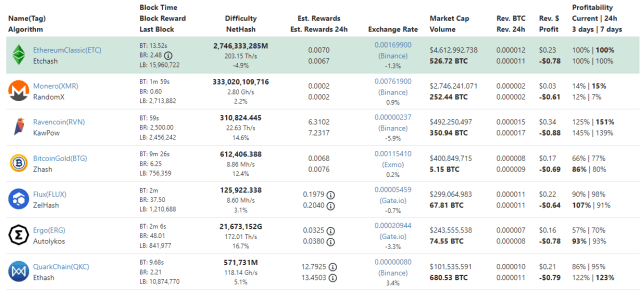
Data from the industry-standard mining calculator WhatToMine paints a grim picture for the current state of GPU mining. As of the latest market assessments, no major PoW cryptocurrency currently offers a positive net profit for miners paying average commercial electricity rates.
For a miner utilizing a standard rig consisting of three AMD RX 480 graphics cards—a once-popular and efficient setup—the daily return on Ethereum Classic stands at approximately -$0.78 per hour. This calculation assumes an electricity cost of $0.10 per kilowatt-hour (kWh), which is a standard baseline for many industrial and residential mining operations. Under these conditions, the miner is essentially paying the utility company more for the power consumed than the value of the cryptocurrency being generated.
Even those equipped with the most powerful consumer hardware on the market, such as the Nvidia GeForce RTX 3090 Ti, are unable to escape the trend. Despite the high hash-to-watt efficiency of these top-tier cards, mining ETC currently results in a loss of roughly -$0.50 per hour. The situation is even more dire for smaller cap coins like Ravencoin and Ergo, which have seen their profitability metrics plummet by over 80% since the Merge as they struggle to absorb the displaced hashrate.
Chronology of the Transition
The path to the current mining "ice age" was paved by several key milestones over the last two years:

- December 2020: The launch of the Beacon Chain, the foundation of Ethereum’s Proof-of-Stake future, allowing users to begin staking their ETH.
- August 2021: The London Hard Fork and EIP-1559 introduction, which began burning a portion of transaction fees, slightly reducing miner revenue but signaling the inevitable shift toward the Merge.
- June-August 2022: Successful Merge trials on the Ropsten, Sepolia, and Goerli testnets confirmed that the transition was technically viable.
- September 15, 2022: The Merge officially triggers at a total terminal difficulty of 58,750,000,000,000,000,000,000. Ethereum mining ceases instantly.
- September 16-20, 2022: Hashrate on Ethereum Classic, Ravencoin, and Ergo hits all-time highs. Mining difficulty adjustments kick in, rendering most operations unprofitable.
Industry Reactions and Market Sentiment
The reaction from the mining industry has been a mix of capitulation and strategic pivoting. Large-scale industrial mining firms, which often have long-term power purchase agreements (PPAs) and high-density data centers, have begun exploring alternative uses for their hardware. Some have transitioned their GPU clusters toward high-performance computing (HPC) tasks, such as artificial intelligence training, 3D rendering, and video transcoding, which can offer higher margins than cryptocurrency mining in the current environment.
Smaller "hobbyist" miners, however, have been hit the hardest. Many have flooded secondary markets like eBay and Reddit’s r/hardwareswap with used GPUs, leading to a significant drop in the resale value of graphics cards. This influx of supply, combined with the end of the mining-induced GPU shortage, has brought graphics card prices down to their lowest levels in years, providing a silver lining for the PC gaming community.
"We knew the Merge was coming, but the speed at which profitability hit a wall was startling," noted one independent miner. "There is no ‘safe haven’ coin right now. We are either mining at a loss and hoping for a future price surge, or we are turning off the machines to save on the power bill."
Broader Implications and Future Outlook
The current state of the market raises a fundamental question: Is GPU mining dead? In the short term, the answer appears to be yes for the vast majority of participants. The market capitalization of the remaining PoW coins is simply too small to support the massive amount of hardware that was once dedicated to Ethereum. For a coin like Ethereum Classic to become as profitable as Ethereum once was, its market price would likely need to increase by several hundred percent, or the total hashrate would need to drop significantly as miners exit the market.
Furthermore, the transition has significant implications for network security. While higher hashrates generally imply a more secure network, the extreme lack of profitability creates a volatile environment where miners may frequently hop between chains in search of temporary gains, leading to "hashrate instability."
From a macro perspective, the end of Ethereum mining marks the end of an era for the crypto industry. Ethereum was the last major stronghold for GPU-based PoW. Bitcoin, the original PoW network, moved long ago to specialized ASIC (Application-Specific Integrated Circuit) hardware, which is far more efficient than GPUs but lacks their versatility. Without a major "anchor" coin to provide steady revenue, the development of new GPU-minable projects may stall as developers move toward more energy-efficient or capital-efficient consensus models like Proof-of-Stake or Proof-of-History.
As of this writing, Ethereum (ETH) is trading at approximately $1,400, reflecting a 6% decline over the past week as the market adjusts to the post-Merge reality. While the network itself is functioning smoothly under its new PoS model, the ripples of its transition continue to destabilize the broader mining ecosystem. For the millions of GPUs that once secured the world’s second-largest blockchain, the future remains uncertain, marked by high electricity bills and a search for a new purpose in a post-Merge world.