For five years, the cryptocurrency community often quipped that UNI, the governance token of the pioneering decentralized exchange (DEX) Uniswap, was perhaps the most successful DeFi token that had never directly generated a cent for its holders. Billions of dollars in trading fees flowed through the Uniswap protocol, yet none of this revenue was directly captured by the UNI token itself. This long-standing narrative has dramatically shifted following the activation and subsequent expansion of the protocol’s fee switch, fundamentally altering UNI’s economic model and propelling its holders’ revenue to unprecedented levels. Public data now vividly illustrates this transformation, with September emerging as a landmark month for the protocol’s earnings.
The visual representation of Uniswap’s revenue trajectory paints a compelling picture: a series of modest, incremental gains from January through July, followed by a notable surge in August, culminating in September’s towering figures that dwarf all preceding months. This stark graphical shift signifies the arrival of a new "revenue season" for UNI, signaling a profound change in how the token interacts with the vast economic activity occurring on the Uniswap platform.
The Genesis of the "Joke": UNI’s Early Years and Tokenomics
To fully appreciate the significance of this recent surge, it is crucial to understand Uniswap’s foundational design and the initial role of its UNI token. Launched in November 2018, Uniswap quickly established itself as a cornerstone of the decentralized finance (DeFi) ecosystem, popularizing the automated market maker (AMM) model. This innovative approach allowed users to trade cryptocurrencies directly from their wallets without intermediaries, relying on liquidity pools funded by users (liquidity providers, or LPs) who earned trading fees in return.
The UNI token itself was retroactively distributed to early users in September 2020 as a governance token, granting holders the power to vote on key protocol upgrades and parameters. However, critically, the initial tokenomics did not include a mechanism for UNI holders to directly share in the trading fees generated by the protocol. All fees—typically a small percentage of each trade—were channeled directly to liquidity providers as an incentive for supplying capital to the pools. This design choice, while fostering robust liquidity, led to the widespread observation that despite Uniswap processing immense trading volumes and generating substantial fees, the UNI token itself remained a pure governance asset, devoid of direct economic capture. This created the "joke" that UNI was immensely successful for the protocol and its LPs, but not for its token holders in terms of direct financial returns.
The Pivotal UNIfication Proposal: A Timeline of Governance and Activation
The turning point for UNI’s economic model arrived with the "UNIfication proposal," a governance initiative that was approved in December 2025. This landmark decision sought to amend Uniswap’s fee structure, allowing a portion of the swap fees, previously entirely allocated to liquidity providers, to be diverted to the protocol. This mechanism aimed to accrue value directly to the UNI token, transitioning it from a purely governance asset to one with a more robust economic foundation.
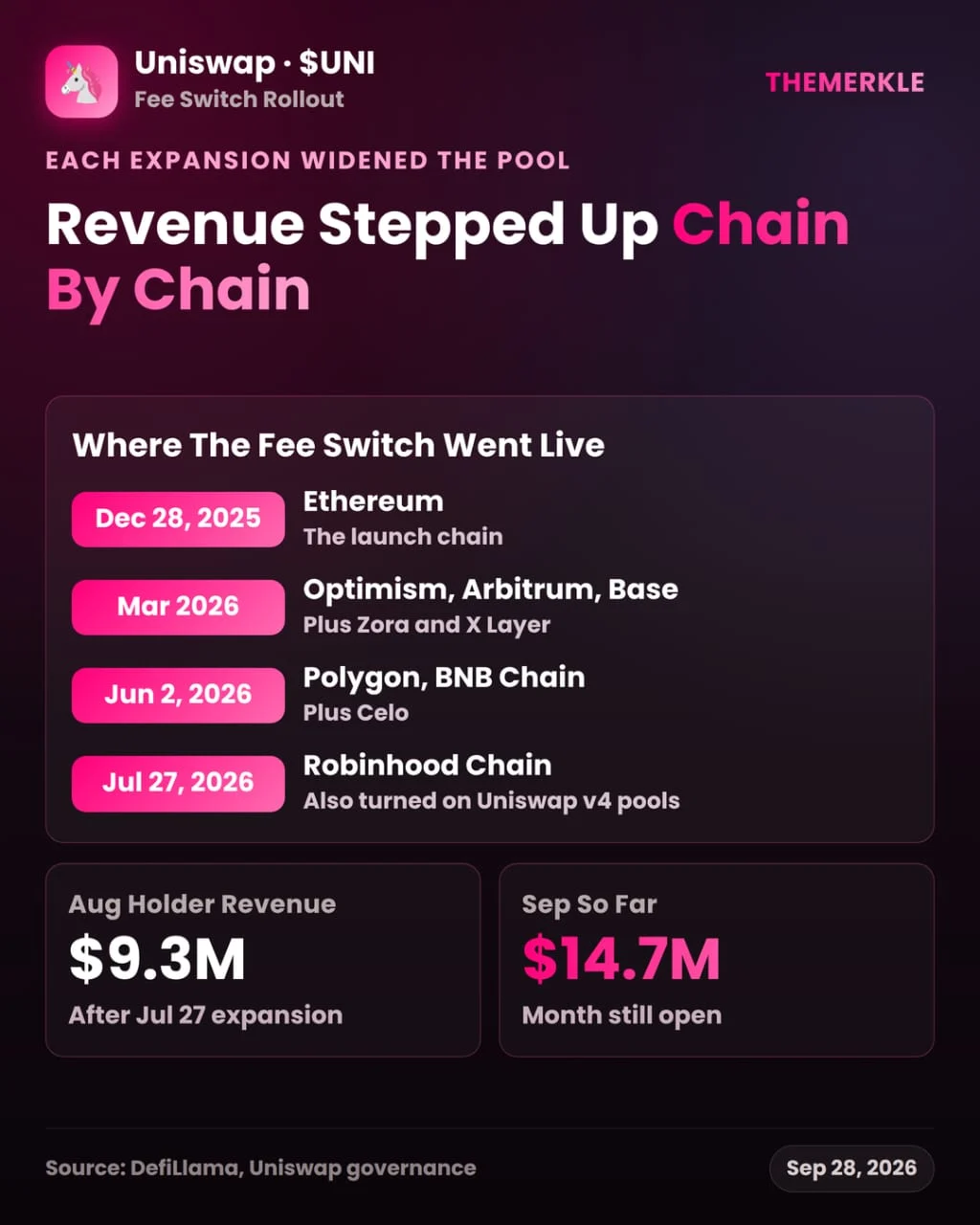
The implementation of the fee switch was not a single, instantaneous event but rather a carefully orchestrated rollout across various blockchain networks and Uniswap versions. The initial activation occurred on Ethereum on December 28, 2025, marking the first time the protocol began capturing a slice of the fees on its primary network. Following this, the fee switch’s reach was systematically expanded:

- March 2026: The fee switch went live on several prominent Layer 2 networks and alternative chains, including Optimism, Arbitrum, Base, Zora, and X Layer. This expansion significantly broadened the scope of fee capture, tapping into the growing activity on these scaling solutions.
- June 2, 2026: Further expansion saw the fee switch implemented on Polygon, BNB Chain (BSC), and Celo, bringing even more diverse trading environments under the protocol’s revenue-generating umbrella.
- July 27, 2026: A particularly crucial milestone was reached when the fee switch was extended to Robinhood Chain and, significantly, to Uniswap v4 pools. This last step was impactful because, according to DefiLlama, Uniswap v4 pools had been generating substantial trading volume without contributing to holder revenue prior to this activation. Each subsequent expansion systematically widened the pool of fees that could be captured by the protocol, setting the stage for the dramatic revenue increases observed in late summer.
Unprecedented Growth: Dissecting Uniswap’s Revenue Explosion
The impact of the fee switch activations is unequivocally clear in the public data, particularly from DefiLlama’s comprehensive tracking of Uniswap’s holders revenue. The numbers tell a story of rapid, exponential growth that has fundamentally redefined UNI’s economic profile.
In December, prior to the initial fee switch activation, monthly token-holder revenue was negligible, hovering near zero. For the first half of the year, from January through July, monthly figures stabilized in a modest range of roughly $3 million to $5 million. This period reflected the nascent stages of fee capture, primarily from Ethereum and the initial Layer 2 expansions.
However, the landscape began to shift dramatically in August. Monthly revenue for UNI holders leapt to approximately $9.3 million, nearly double the upper end of the previous range and establishing a new record at the time. This significant jump directly correlated with the July 27th activation on Robinhood Chain and Uniswap v4 pools, illustrating the immediate impact of these critical expansions.
September has proven to be an even more exceptional month. With the month still open at the time of reporting, revenue has already climbed to an astounding $14.7 million. This figure not only more than doubles the pre-summer run rate but also represents an approximately 60% increase over August’s already record-breaking performance. This sustained and accelerated growth trajectory indicates a powerful and compounding effect of the fee switch’s widening implementation.
Supporting these calendar-month figures, DefiLlama’s rolling 30-day data further reinforces the narrative of robust revenue generation. The platform’s main Uniswap page currently shows $15.67 million in protocol revenue over the last 30 days, out of a total of $207.64 million in fees generated by the protocol. This translates to an impressive annualized revenue rate of approximately $70 million. While calendar-month and rolling 30-day figures naturally differ slightly due to their distinct calculation methodologies, they consistently point to the same conclusion: the fee switch is now producing serious, quantifiable value for the Uniswap protocol and, by extension, for UNI token holders through its unique mechanism.
Key Catalysts: What’s Fueling the Surge?
Several interdependent forces have converged to drive Uniswap’s recent revenue surge, all of which are clearly traceable in the on-chain data:
Expanding Reach of the Fee Switch
As detailed previously, the systematic expansion of the fee switch across multiple blockchains and Uniswap versions has been the primary driver. Each integration—from Ethereum to Optimism, Arbitrum, Base, Zora, X Layer, Polygon, BNB Chain, Celo, and finally Robinhood Chain—has incrementally widened the addressable market for fee capture. The critical activation on Robinhood Chain, coupled with the inclusion of Uniswap v4 pools, marked a significant inflection point, as it brought substantial new trading volume into the revenue-generating framework. This phased rollout ensured that as the DeFi ecosystem diversified and spread across different networks, Uniswap’s fee-capturing mechanism could follow suit, maximizing its potential.

Strategic Volume Shift and Uniswap v4 Integration
The sheer volume of trading activity migrating to or originating from networks where the fee switch is active has been a major contributor. Over a recent 30-day period, Uniswap handled approximately $81.3 billion in total trading volume. A significant development within this period is the increasing dominance of Uniswap v4 pools, which accounted for roughly $43 billion of this volume, notably edging past the long-standing v3.
Crucially, a large proportion of this new volume emanated from Robinhood Chain, which alone contributed around $33 billion. Since the fee switch was extended to both Robinhood Chain and Uniswap v4 in late July, this substantial influx of new trading activity immediately began feeding into the protocol’s burn mechanism. This direct correlation perfectly matches the timing of the sharp revenue increases observed in August and September, underscoring the strategic importance of these specific activations. The ability to capture fees from high-volume, newly integrated chains and protocol versions has been instrumental in the current revenue explosion.
Market Sentiment and Price Action
While not a direct cause of revenue generation, positive market sentiment surrounding UNI has created a synergistic effect. The UNI token has experienced a robust rally, trading near $9 in recent days after closing around $5.84 on September 1. This upward price momentum often feeds on itself, attracting further investor interest and trading activity.
Reports have also linked this market movement to broader regulatory developments, particularly concerning tokenized stocks in automated pools. While cleanly separating cause from coincidence in such a dynamic market is challenging, and higher token prices do not inherently create revenue, stronger sentiment generally fosters increased trading activity. More trading, in turn, translates directly into more fees generated across Uniswap pools, thereby contributing to the protocol’s revenue and the UNI token burn. It creates a positive feedback loop where fundamental improvements reinforce market confidence, leading to greater utilization and, consequently, higher earnings.
Understanding "Holders Revenue": Scarcity Through Buy-and-Burn
It is essential to be precise about what "holders revenue" signifies in the context of UNI, as it deviates from the traditional dividend model. Under the UNIfication proposal, the slice of swap fees diverted to the protocol does not directly land in UNI holders’ wallets as cash or a direct payout. Instead, these collected fees gather in specialized vault contracts known as TokenJar. A second contract, dubbed Firepit, then makes these accumulated fees redeemable only in exchange for UNI tokens, which are subsequently destroyed, or "burned." DefiLlama accurately tracks this mechanism as buy-and-burn revenue.
The practical consequence of this design is that the fee income effectively reduces the total supply of UNI tokens in circulation, rather than distributing cash payouts to holders. Uniswap’s own documentation explicitly clarifies that UNI holders do not possess a direct claim on protocol revenue. Therefore, the value accrues to existing holders primarily through the principle of scarcity: as the supply of UNI tokens diminishes due due to the burning mechanism, the value of each remaining token theoretically increases, assuming constant or growing demand.
This is a crucial distinction for investors and analysts. While "$15 million in buybacks" serves as an accurate shorthand to describe the economic impact, it is not synonymous with "$15 million paid to holders" in the form of a dividend. Instead, it represents a form of capital appreciation driven by supply contraction, akin to a company executing a stock buyback program to reduce outstanding shares, thereby boosting earnings per share and, potentially, the stock price. Understanding this nuanced mechanism is key to accurately assessing UNI’s long-term value proposition.

Broader Implications for UNI and the DeFi Ecosystem
The recent surge in UNI’s captured revenue extends far beyond the immediate financial figures; it carries significant implications for the token’s valuation, Uniswap’s competitive standing, and the broader DeFi landscape.
Valuation Debate
The rapid growth in revenue has intensified the ongoing valuation debate surrounding UNI. With a current market capitalization of approximately $5.5 billion and an annualized revenue rate now around $70 million, UNI still trades at a rich multiple compared to traditional assets. Skeptics often highlight this high valuation, pointing out that the token only recently began earning anything, suggesting that its price may have already baked in much of the future growth.
However, proponents, or "bulls," counter that focusing solely on the current multiple overlooks the explosive growth trajectory. They argue that revenue is growing at an exceptionally fast pace from a historically low base, and the recurring buy-and-burn mechanism introduces a compounding effect on a fixed, and now shrinking, supply. This perpetual reduction in supply, coupled with increasing demand driven by utility and governance, presents a powerful long-term value accrual model. Both camps are, in essence, observing the same chart, but interpreting its future trajectory and present implications differently.
Sustainability and Future Growth
The shape of the revenue trend is particularly noteworthy. Rather than a gradual creep, holders’ revenue has demonstrably stepped up each time the fee switch expanded to a new chain or pool type. This pattern strongly suggests that the underlying business of Uniswap is robust and healthy, and previous lower numbers were primarily a function of configuration—i.e., the fee switch not being active—rather than a lack of demand or protocol activity. For a protocol boasting approximately $3.9 billion in total value locked (TVL) and generating nearly $1 billion in total annualized fees (including those paid to LPs), capturing even a modest share of that economic activity is profoundly meaningful.
The sustainability of this growth will depend on several factors: continued high trading volumes across supported chains, the potential for further fee switch expansions to new networks or future Uniswap versions, and Uniswap’s ability to maintain its market dominance in the competitive DEX landscape. The modular nature of the fee switch rollout implies a strategic approach to future growth, allowing the protocol to adapt to an evolving multi-chain environment.
Governance and Community Impact
The successful implementation and dramatic impact of the UNIfication proposal serve as a powerful testament to the efficacy of decentralized governance. It demonstrates that the UNI community can effectively propose, debate, and enact significant protocol changes that directly influence the token’s economic model. This precedent could inspire more active participation from token holders and signal a maturing approach to protocol development within the DeFi space. It validates the utility of governance tokens beyond mere voting, linking them directly to the economic health of the underlying protocol.
Competitive Landscape
Uniswap’s ability to capture protocol revenue and accrue value to its token through a buy-and-burn mechanism strengthens its competitive position. In an increasingly crowded market of DEXs and centralized exchanges, having a clear and demonstrable value accrual model for its native token can attract more liquidity providers, traders, and long-term investors. This economic edge could help Uniswap maintain and even expand its market share, further solidifying its status as a foundational piece of the DeFi infrastructure. It also provides a more tangible argument for its valuation against competitors whose tokens may lack similar direct value capture mechanisms.

Conclusion
The transformation of Uniswap’s UNI token from a purely governance-focused asset to one with a robust and rapidly growing economic engine marks a significant turning point in its history and for the broader DeFi ecosystem. The strategic activation and expansion of the fee switch, particularly its integration with Robinhood Chain and Uniswap v4, have unlocked unprecedented levels of protocol revenue, which is then channeled into a value-accruing buy-and-burn mechanism. This shift addresses a long-standing critique and provides a clearer, more compelling economic thesis for UNI holders. As September closes with record-breaking figures, the narrative around UNI has irrevocably changed, signaling a new era of economic viability and demonstrating the powerful potential of well-executed decentralized governance to reshape tokenomics and drive tangible value.
Disclosure: This is not trading or investment advice. Always do your research before buying any cryptocurrency or investing in any services.
Follow us on Twitter @themerklehash to stay updated with the latest Crypto, NFT, AI, Cybersecurity, and Metaverse news!