The digital asset market is currently navigating a pivotal transition as Bitcoin, the world’s largest cryptocurrency by market capitalization, faces intensified scrutiny following a breach of a critical long-term trendline. This technical shift, highlighted by market analyst Justcryptopays and supported by broader research from Binance, suggests that the period of absolute Bitcoin dominance may be yielding to a more diversified market structure. As capital begins to rotate from the flagship cryptocurrency into a variety of alternative assets, the industry is closely monitoring indicators that traditionally precede a full-scale "altcoin season."
For much of the preceding year, Bitcoin acted as the primary locomotive for the crypto economy, drawing the vast majority of institutional inflows and retail attention. However, recent price action indicates a cooling of this singular momentum. Bitcoin’s struggle to maintain its footing above the psychologically significant $90,000 threshold has introduced a layer of caution among traders. While the asset was recently observed trading at approximately $90,525, its inability to decisively clear and hold higher resistance levels has prompted a strategic reevaluation among investors. This stagnation often serves as a catalyst for capital flight toward high-beta assets—specifically altcoins—that offer higher potential returns during periods of Bitcoin consolidation.
The Mechanics of Capital Rotation and Market Dynamics
The concept of capital rotation is a cornerstone of cryptocurrency market cycles. Typically, a bull cycle begins with Bitcoin leading the charge, as it is perceived as the safest entry point for new capital. Once Bitcoin reaches a level of relative price stability or enters a range-bound phase after a major rally, investors often seek to maximize their returns by moving profits into Ethereum (ETH) and then further down the risk curve into large-cap, mid-cap, and eventually small-cap altcoins.
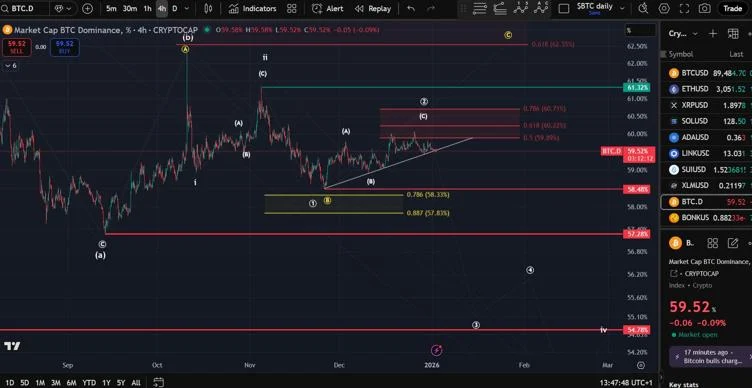
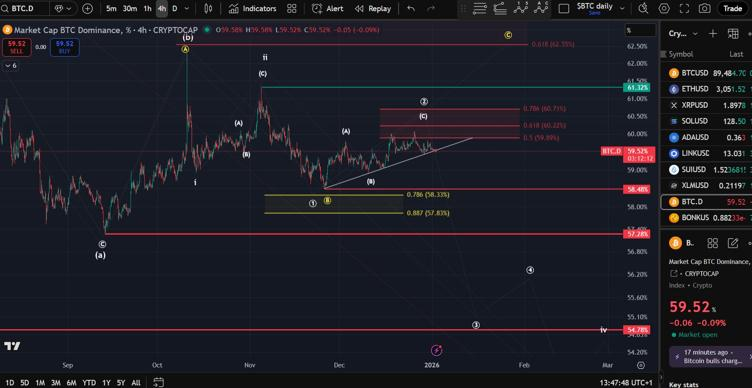
Technical analysis provided by Justcryptopays underscores that Bitcoin’s recent break below a key ascending trendline is not merely a localized price correction but a potential signal of a broader shift in market dynamics. When Bitcoin loses its immediate bullish structure, the "Bitcoin Dominance" index (BTC.D) often begins to decline. This decline is the primary mathematical indicator of an altcoin season, as it signifies that altcoins are collectively outperforming Bitcoin in terms of market cap growth.
The current environment suggests that the market is entering the "Ethereum and Large-Cap" phase of this rotation. Assets such as Ethereum, Solana (SOL), and XRP are increasingly being viewed as undervalued relative to Bitcoin’s recent peaks. As 2026 begins, the challenge for these assets lies in overcoming the bearish residue of 2025, a year characterized by significant volatility and regulatory adjustments.

A Chronology of the 2025-2026 Market Evolution
To understand the current "Alt-Season" anticipation, it is necessary to examine the timeline of events that led to this juncture. Throughout 2025, the market was largely defined by Bitcoin’s institutional adoption, driven by the continued success of Spot Bitcoin ETFs and the integration of digital assets into corporate balance sheets. This "institutional phase" pushed Bitcoin toward the $90,000 mark but left many altcoins lagging, creating a historic valuation gap.
By the fourth quarter of 2025, the market began to see the first signs of fatigue in Bitcoin’s vertical climb. While the "Orange Coin" remained resilient, its growth rate began to stabilize. Concurrently, technological milestones in the altcoin sector—such as Ethereum’s continued scalability upgrades and Solana’s expansion in the decentralized physical infrastructure networks (DePIN) space—started to attract independent capital.
In early January 2026, the breach of the aforementioned trendline served as the definitive technical trigger. This event coincided with a renewed interest in decentralized finance (DeFi) and Web3 tokens, which had spent much of the previous year in a consolidation phase. The current market state represents the first time in several quarters where the technical indicators for altcoins have aligned with a softening in Bitcoin’s dominance.
Supporting Data and Technical Indicators
Several data points support the thesis of an impending altcoin resurgence. Beyond the $90,000 support-resistance flip, the Relative Strength Index (RSI) for many major altcoins has begun to climb out of oversold territory on weekly timeframes.
- Ethereum (ETH): Often the bellwether for altcoins, Ethereum has seen a surge in network activity and a reduction in exchange supply. Analysts suggest that if ETH can reclaim key levels against its BTC pair (ETH/BTC), it will provide the "green light" for the rest of the altcoin market.
- Solana (SOL): Solana continues to demonstrate high relative strength, fueled by its dominance in the retail trading and memecoin sectors. Its ability to maintain high transaction volumes during Bitcoin’s volatility suggests a decoupling that favors altcoin-specific narratives.
- Chainlink (LINK): Recent reports indicate that Chainlink is breaking through its 21-day Moving Average (MA), a move that historically precedes an upward run lasting two to three months. This is particularly relevant as Chainlink serves as the infrastructure backbone for many other tokens.
- Stablecoin Inflows: Data from on-chain analytics platforms shows a steady increase in stablecoin minting. An increase in stablecoin supply on exchanges typically indicates "dry powder" waiting to be deployed into the market, often targeting altcoins when Bitcoin’s price action becomes stagnant.
Institutional and Regulatory Perspectives
The shift toward altcoins is also being influenced by a maturing regulatory landscape. Throughout 2025, clarity regarding the status of assets like XRP and Cardano (ADA) provided a foundation for institutional interest that was previously non-existent. Reactions from major financial institutions suggest a growing appetite for "diversified crypto portfolios" rather than Bitcoin-only exposure.
Inferred statements from market makers and liquidity providers indicate that the infrastructure for altcoin trading has improved significantly. The introduction of more sophisticated derivatives and hedging tools for assets beyond Bitcoin and Ethereum has allowed professional traders to take larger positions in altcoins with managed risk. This institutional "backstopping" provides the liquidity necessary for a sustained altcoin rally, rather than the short-lived "pump and dump" cycles seen in previous years.
Furthermore, the emergence of "Real World Assets" (RWA) as a dominant narrative has given fundamental value to tokens that facilitate the tokenization of gold, real estate, and treasury bills. This fundamental shift ensures that the potential "Alt-Season" is not driven solely by speculation but by tangible utility and revenue generation within blockchain ecosystems.
Broader Implications and Market Outlook
The transition toward a more balanced market has significant implications for both retail and institutional participants. For retail investors, an altcoin resurgence often brings increased volatility, which presents both high-reward opportunities and substantial risks. The "shaking off" of the bearish momentum from 2025 is a critical hurdle; if the bulls can maintain the current rotation, the market could see a sustained period of growth across multiple sectors, including AI-integrated tokens, gaming (GameFi), and modular blockchain solutions.
For the broader financial ecosystem, a successful altcoin season validates the multi-chain future of the digital economy. It proves that the value proposition of blockchain technology extends far beyond Bitcoin’s "digital gold" narrative. As capital rotates, we are likely to see a surge in innovation as developers are incentivized by higher token valuations and increased user engagement.
However, caution remains the watchword. Bitcoin’s struggle at $90,000 could lead to a deeper correction if macroeconomic factors—such as unexpected inflation data or shifts in central bank policies—turn unfavorable. Because altcoins generally possess higher beta, a sharp drop in Bitcoin’s price could lead to even more significant percentage losses for the rest of the market.
In conclusion, the data provided by Binance Research and independent analysts like Justcryptopays points toward a structural evolution in the crypto market. The break in Bitcoin’s trendline and the subsequent rotation of capital are the first chapters of what could be a defining period for alternative digital assets. As the market moves deeper into 2026, the ability of altcoins to capture and hold the attention of the global investment community will determine whether this is a fleeting rally or the start of a new, diversified era in digital finance. Vigilant investors will be watching the $90,000 Bitcoin level and the ETH/BTC pair as the ultimate arbiters of the market’s next major move.