The Latin American crypto economy reached a significant milestone between July 2025 and June 2026, recording $593.8 billion in on-chain activity and solidifying its position as the world’s sixth-largest cryptocurrency market. According to recent data, the region experienced a 9.8% year-over-year growth, a trend propelled by a unique "trifecta" of economic conditions: persistent inflation, extreme currency volatility, and restrictive capital controls. While the global crypto market faced a period of correction starting in late 2025, Latin American adoption remained resilient, driven more by financial necessity than by speculative interest. Brazil remains the regional leader and a global frontrunner in grassroots adoption, while nations like Venezuela and Argentina have turned to digital assets as essential lifelines amid political and economic upheaval.

Regional Market Dynamics and the Concentration of Activity
The Latin American crypto landscape is highly concentrated, with five major economies accounting for more than 80% of all regional activity. Brazil led the pack during the 2025–2026 period with $252.5 billion in transactions, representing nearly 43% of the region’s total volume. Argentina followed as the second-largest market with $88.5 billion, while Mexico secured the third spot with $77.6 billion. Venezuela and Colombia rounded out the top five, contributing $39.1 billion and $29.1 billion, respectively.
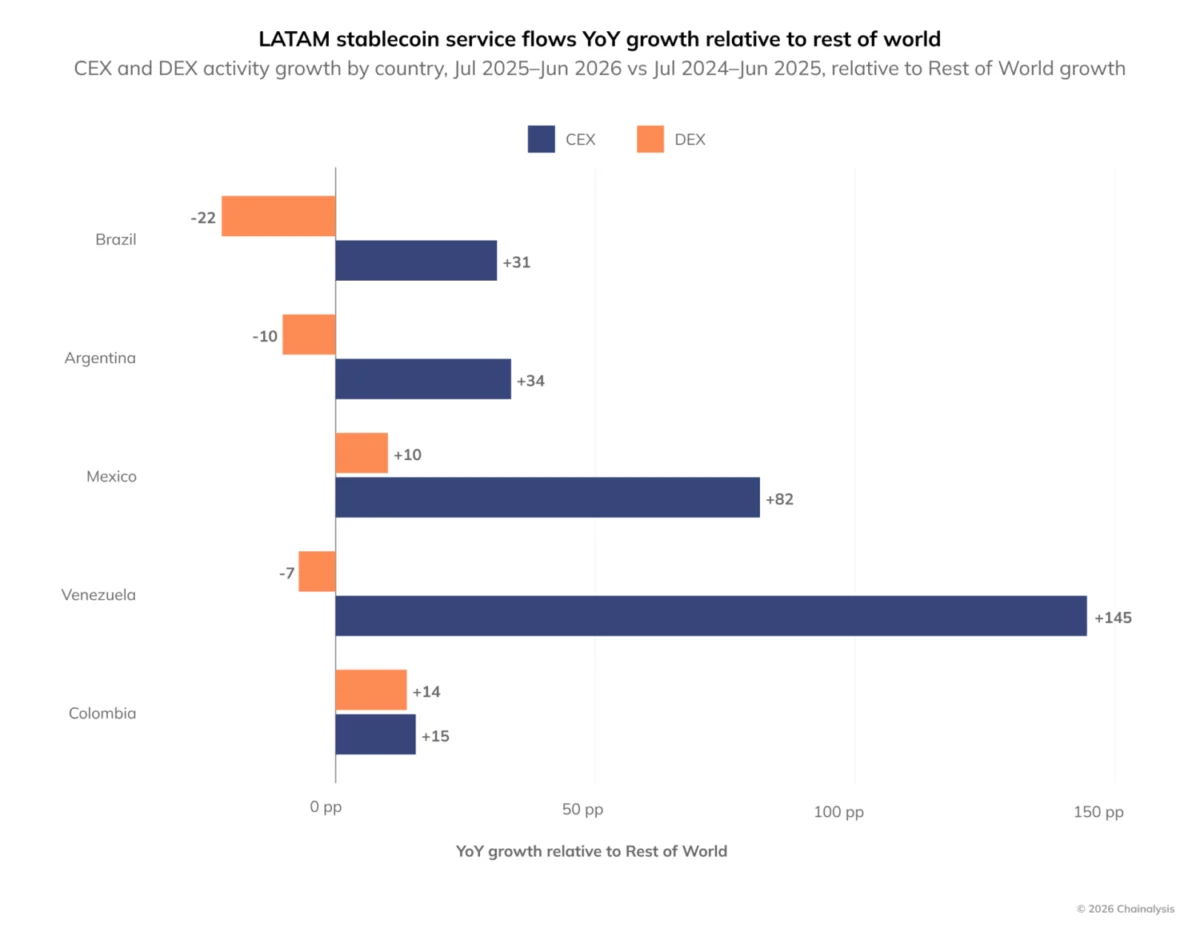
Despite Brazil’s dominance in terms of total value, its market saw a slight contraction of 1.6% during this specific reporting period. However, this was more than offset by explosive growth in other territories. Mexico’s crypto economy grew by 25.5%, Argentina’s by 15.3%, and Colombia’s by 13.8%. The most dramatic surge occurred in Venezuela, where activity skyrocketed by 107.2%. On a smaller scale, markets like Honduras and Nicaragua saw triple-digit growth percentages, albeit starting from much smaller bases, while Trinidad and Tobago and Guatemala experienced sharp declines of over 50%.

A Chronology of Growth and Market Shifts (2024–2026)
The trajectory of the Latin American crypto market over the past two years reveals a shift from speculative trading to functional utility. In early 2024, the region began seeing a steady increase in stablecoin adoption as a hedge against local currency devaluation. By October 2025, a global crypto market correction caused prices of major assets like Bitcoin to retreat from all-time highs. This period tested the resilience of the regional market.
A pivotal moment arrived in January 2026, when political instability in Venezuela reached a breaking point. The arrest of President Nicolás Maduro by U.S. authorities triggered a massive flight to digital assets within the country. This event caused Venezuela’s crypto economy to decouple from regional trends, leading to a surge in stablecoin payments and cross-border outflows.

By February 2026, the focus shifted to Brazil, where the Banco Central do Brasil (BCB) introduced landmark regulations for Virtual Asset Service Providers (VASPs). These rules established strict governance, risk management, and capital requirements, signaling a move toward "institutional maturation" that would define the first half of 2026.
The Ascendance of Stablecoins and Cross-Border Utility
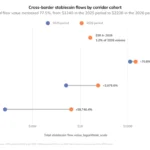
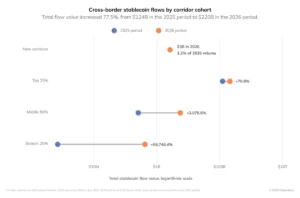
One of the most defining characteristics of the 2026 reporting period was the dominant role of stablecoins. Across the region, these assets—pegged to the value of the U.S. dollar—became the preferred medium for both domestic and international transactions. By June 2026, stablecoins accounted for 32.1% of all cross-border value moving through the region. They also represented 22.1% of domestic peer-to-peer (P2P) activity and 17.6% of all personal wallet balances.

Mexico has emerged as a critical hub for stablecoin-based cross-border flows, particularly within the U.S.-Mexico remittance corridor. Traditionally dominated by banks and traditional money transfer operators, this corridor is seeing a rapid influx of digital asset activity. Monthly stablecoin volume in Mexico reached $1.8 billion by June 2026, a fourfold increase from early 2024 levels. Experts suggest that businesses are increasingly using stablecoins like USDT and USDC—and even peso-denominated variants like MXNB—to bypass the inefficiencies and high costs associated with traditional banking rails.
In Colombia, stablecoin service inflows reached $3.5 billion by the end of the second quarter of 2026. Institutional confidence in the technology has grown to the point where corporate volumes are now a significant driver of liquidity. The trend suggests that stablecoins are no longer just a "crypto-native" tool but are becoming an integral part of the broader financial infrastructure.

The Structural Shift from Self-Custody to Platforms
A notable behavioral change observed during this period is the migration of users from self-custody wallets to centralized service platforms. Historically, Latin American crypto users favored holding their own private keys—a practice born out of a deep-seated distrust of domestic financial institutions and a desire for independence from intermediaries. However, the data shows that as of June 2026, 71.2% of regional crypto balances were held with services, surpassing the global average of 68.0%.
During the market correction that began in late 2025, self-custody balances in Latin America plummeted by 66.7%, while service-based balances fell by a more moderate 28.0%. This divergence indicates that users are increasingly looking for established platforms that offer a suite of financial services, including easy fiat-to-crypto ramps, payment processing, and liquidity access.

Financial institutions like Panama’s Towerbank have noted that customers are no longer looking for isolated crypto accounts. Instead, there is a growing demand for integrated relationships where users can receive, hold, convert, and spend both digital and traditional assets within a single ecosystem. This shift reflects a broader trend of crypto being put to work in the "real economy" rather than being held as a passive investment.
Brazil: Regulatory Clarity and Institutional Maturation
Brazil continues to be the engine of the Latin American crypto economy. While its share of regional value was roughly 31.6% in 2022, it has since grown to 43.7%. The Brazilian market is characterized by a high degree of sophistication and a move toward domestic, regulated exchanges. Local platforms, which once accounted for a negligible 1.5% of inflows, now command a 12.5% share, bucking the regional trend of international exchanges gaining ground.

The BCB’s regulatory framework, introduced in February 2026, has been a double-edged sword. While the high capital requirements and strict compliance rules have put pressure on smaller, crypto-native payment providers, they have simultaneously instilled a new level of trust among institutional players. Major banks and fintechs in Brazil are now more comfortable engaging with digital asset counterparties, facilitating B2B demand for stablecoins as a tool for liquidity management.
Furthermore, Brazil’s domestic on-chain economy is thriving. Stablecoin activity in the country grew by a staggering 495% during the period, far outpacing the rest of the region. Interestingly, the success of Pix—Brazil’s highly efficient instant payment system—has meant that stablecoins are used less for everyday retail payments and more for corporate treasury functions and high-value P2P transfers. The number of Brazilian wallets holding at least $10,000 in stablecoins increased by 347% since July 2024, indicating a growing class of high-value "savers" using digital assets as a primary financial vehicle.

Venezuela: Crypto as a Financial Lifeline
If Brazil represents the maturation of the market, Venezuela represents its most acute necessity. Following the political rupture in early 2026, the Venezuelan bolívar faced renewed pressure, and access to physical U.S. dollars remained limited. Consequently, the country saw an "accelerated redollarization" through digital means.
In the quarter immediately following the political shocks of January 2026, crypto outflows from Venezuela jumped by 891.7%. This massive movement of capital was a clear indicator of residents seeking to protect their wealth from domestic instability. Merchants in the country have reported that nearly 40% of their income is now received in USDT. The crisis also reactivated a large number of previously dormant P2P users, who turned to crypto to facilitate basic commerce and receive remittances from the Venezuelan diaspora.

Broader Implications and the Path Forward
The data from the 2025–2026 period underscores a fundamental truth about Latin America: crypto adoption is not a monolithic trend but a collection of diverse responses to local economic realities. In some nations, it is a tool for institutional efficiency and regulatory compliance; in others, it is a desperate measure for survival against hyperinflation.
The integration of digital assets into the real economy is the next major frontier. As regulatory frameworks continue to evolve—not just in Brazil but across the region—the gap between traditional finance and the crypto economy is narrowing. The shift toward centralized services suggests that users are prioritizing convenience and functionality over the ideological purity of self-custody.

As Latin America continues to lead the world in grassroots adoption, the region serves as a global case study for the utility of blockchain technology. Whether it is a business in Mexico using stablecoins to settle international invoices or a family in Venezuela using USDT to buy groceries, the practical applications of cryptocurrency are becoming deeply embedded in the financial fabric of the continent. The challenge for the coming years will be to ensure that this growth remains sustainable and that the benefits of digital finance reach the widest possible population while maintaining the trust and security that the maturing market now demands.