While many new product launches on cryptocurrency exchanges often experience a brief surge of interest followed by a decline into obscurity, Hyperliquid’s innovative HIP-4 outcome markets have charted a markedly different and increasingly significant trajectory. What began in May as a modest venture with a single Bitcoin binary contract, generating approximately $60,000 in day-one volume, has systematically compounded into a robust and genuine trading venue. The cumulative trading volume across these markets has now unequivocally surpassed $350 million, a figure verifiable on publicly accessible, on-chain dashboards, underscoring a period of accelerated growth for the platform. This milestone arrives amidst heightened attention on Hyperliquid’s broader ecosystem, fueled by renewed discussions regarding a potential full listing on Binance, one of the world’s largest cryptocurrency exchanges.
A Significant Milestone: $350 Million and Beyond
The core metric driving this narrative is the impressive cumulative trading volume achieved by Hyperliquid’s HIP-4 outcome markets. Since their mainnet launch in early May, these markets have collectively processed over $350 million in trades. Independent on-chain trackers, which meticulously monitor this category, indicate that the all-time total has edged even closer to $395 million as of mid-September. This upward revision suggests that the pace of growth has not only been sustained but has intensified in recent weeks, correlating with the introduction of more trading venues and an expanded array of market types. This organic growth stands in stark contrast to the often-inflated figures presented in promotional materials, highlighting a verifiable, user-driven expansion.
For those seeking direct verification of these figures, transparency is a cornerstone of the decentralized finance (DeFi) ethos. The most direct and reliable source is Loris Tools’ dedicated HIP-4 dashboard, accessible at loris.tools/hip4. This platform provides real-time updates on crucial metrics, including notional volume, total trade counts, the number of unique traders, accrued fees, and the current count of active outcome markets, all continuously updated from on-chain data. A complementary resource is Liquidiction’s HIP-4 stats page, found at liquidiction.xyz/hip4/stats. This tracker offers a granular breakdown of 24-hour volume and open interest for each individual market, aligning with Hyperliquid’s established settlement conventions. Both tools are purpose-built for this specific category, offering precise and timestamped data, thereby serving as authoritative references for validating the reported volume figures.
Understanding Outcome Markets: A Primer
To fully appreciate the significance of HIP-4’s performance, it is essential to understand the concept of outcome markets, often referred to as prediction markets. These platforms allow users to trade on the future outcome of real-world events, ranging from financial indicators and political elections to sports results and scientific breakthroughs. Participants buy and sell "shares" in an outcome, with the price of these shares reflecting the market’s collective belief in the probability of that event occurring. If an event happens, shares typically settle at a predetermined value (e.g., $1 or 1), and if it does not, they settle at zero. This mechanism allows for direct speculation on events without necessarily owning the underlying asset, and importantly, can serve as a robust indicator of public sentiment or probability.
Historically, prediction markets have existed in various forms, from academic experiments to regulated platforms like Kalshi in the US and decentralized protocols such as Polymarket, Augur, and Gnosis in the crypto space. While centralized platforms like Kalshi face stringent regulatory oversight due to their direct engagement with real-world events and potential classification as derivatives, decentralized counterparts navigate a more complex and evolving regulatory landscape. The appeal of decentralized prediction markets lies in their censorship resistance, global accessibility, and the transparency afforded by blockchain technology. However, they also face challenges related to liquidity, oracle reliability for event settlement, and user education. Hyperliquid’s entry into this space with HIP-4 builds upon this foundation, introducing its own unique operational model.
The Genesis and Growth of HIP-4: A Chronology
The journey of Hyperliquid’s HIP-4 outcome markets from an experimental feature to a significant trading venue can be traced through several key chronological milestones:
- Early May 2024: HIP-4 officially launched on the Hyperliquid mainnet. The initial offering was highly constrained, featuring only a single Bitcoin binary contract. Despite its limited scope, the product managed to generate approximately $60,000 in trading volume on its very first day. This initial volume, though modest compared to established players like Kalshi or Polymarket, was a credible showing for a nascent product.
- May – August 2024: During these months, the Hyperliquid team primarily managed the deployment of new markets. Growth was steady but contained, as the platform refined its underlying mechanics and user experience. Volume began to gradually increase as more users discovered the markets and confidence in the settlement process grew.
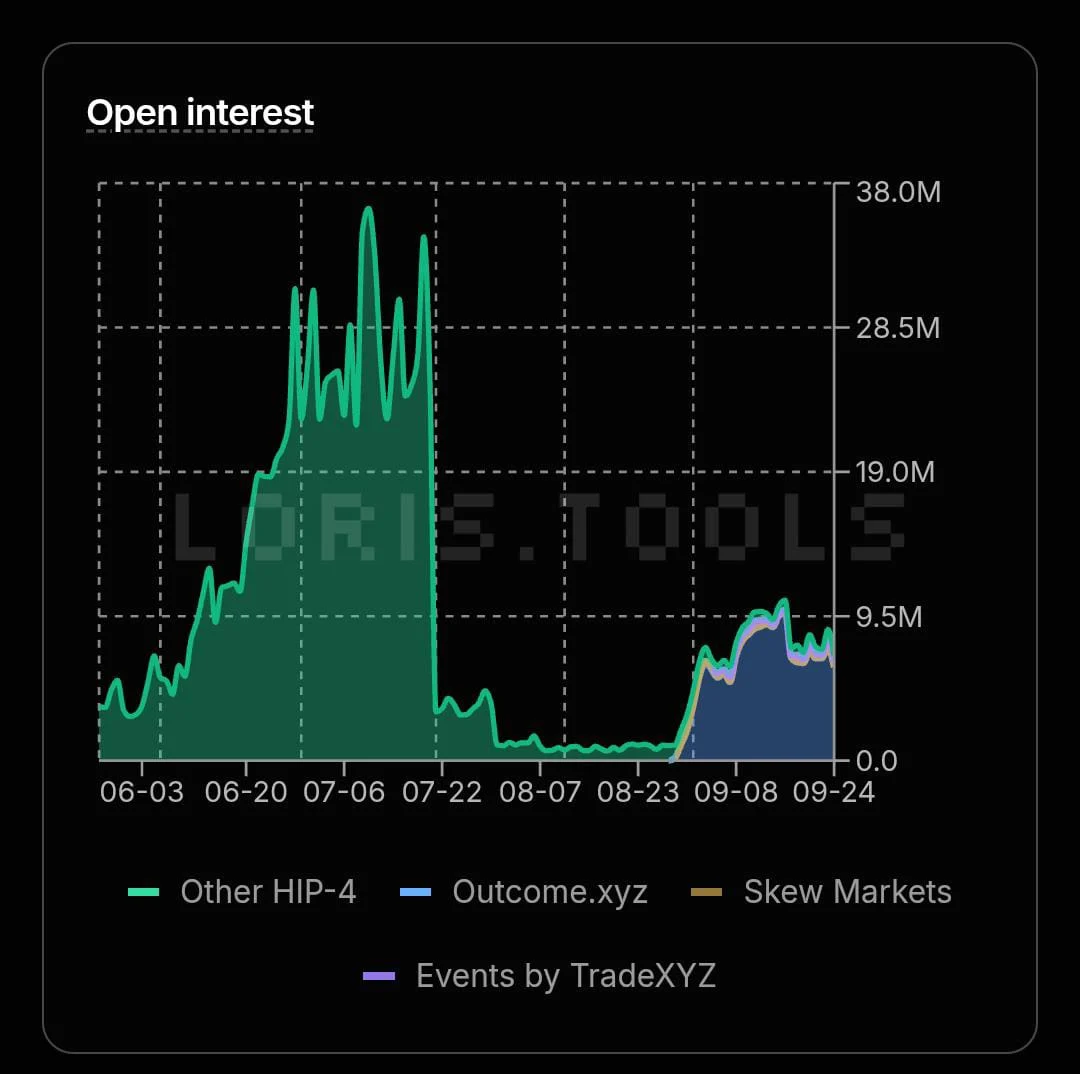
- August 29, 2024: The Inflection Point: A pivotal moment occurred when Hyperliquid significantly expanded the protocol’s capabilities by opening market deployment to external venues and builders. This strategic decentralization marked a critical shift. The impact was immediate and dramatic: daily trading volume reportedly tripled within just three days of this rollout. The daily average volume, which stood at approximately $545,000 in August, surged to nearly $2 million by August 31st.
- Early September 2024: Following the August 29th expansion, the pace of growth continued to accelerate. Two external platforms, Outcome and Skew, emerged as key contributors, each staking 500,000 HYPE tokens to deploy their own markets using validator-approved templates. Notably, Outcome quickly became a dominant force, consistently accounting for the majority of reported HIP-4 activity. This period saw the trailing daily volume figure reaching approximately $2.75 million.
- Mid-September 2024: The cumulative volume crossed the $350 million mark, with independent trackers indicating figures closer to $395 million. This acceleration was accompanied by a significant diversification of market types and a steady increase in active unique traders. Weekly snapshots during this period showed HIP-4 processing well over $16 million in volume and hundreds of thousands of individual trades within a single seven-day window.
This timeline clearly illustrates that the strategic decision to open up market creation to external parties was the primary catalyst for HIP-4’s exponential growth, transforming it from an internal experiment into a community-driven phenomenon.
Mechanics of Hyperliquid’s Outcome Markets: A Deep Dive
Hyperliquid’s HIP-4 introduces "outcome markets" with a distinct operational model designed to balance accessibility with security. These are fully collateralized contracts that trade within a price range of 0 to 1. This range reflects the implied probability of a real-world event occurring: a price of 0.80 suggests an 80% market-implied probability. Upon the event’s resolution, the contract settles at 1 if the event happens (representing a "Yes" outcome) and 0 if it doesn’t (representing a "No" outcome).
A key differentiating feature of HIP-4 markets, particularly when compared to Hyperliquid’s primary offering of perpetual futures, is the absence of leverage and liquidation risk. Traders are only able to lose the capital they initially commit, as all positions are fully backed at the time of deployment. This fundamental design choice simplifies risk management for participants and potentially attracts a broader user base less accustomed to the complexities of leveraged trading.

To launch a new outcome market, a builder is required to stake 1 million HYPE tokens. This staking mechanism serves multiple purposes: it acts as a commitment from the market creator, aligns their incentives with the integrity of the market, and potentially contributes to the overall security and value of the HYPE token. Once a market is live, Hyperliquid’s network of validators plays a crucial role in maintaining market integrity by publishing settlement prices. These prices are updated approximately every three seconds, ensuring that the contracts remain tightly anchored to real-world data and events, minimizing potential for manipulation or stale pricing. This rapid and decentralized oracle-like settlement process is vital for the credibility and functionality of prediction markets.
Catalyst for Compounding Growth: Decentralized Deployment
The compounding growth observed in HIP-4’s volume is directly attributable to its strategic shift towards decentralized distribution. Initially, the Hyperliquid team bore the responsibility for deploying markets, a necessary phase for establishing the product’s foundational infrastructure and validating its mechanics. However, the true inflection point arrived on August 29th, when the protocol made a crucial decision: it opened market deployment to external venues and independent builders.
This move transformed HIP-4 from a centralized product offering into a platform-as-a-service, significantly expanding its reach and scalability. The impact was immediate and profound. Daily volume figures reportedly tripled within just three days of this rollout, skyrocketing from an average of roughly $545,000 per day in August to nearly $2 million by the end of the month. This upward trajectory continued, with the trailing daily figure subsequently reaching approximately $2.75 million.
The success of this strategy is evident in the rapid emergence of external platforms like Outcome and Skew. Both entities demonstrated their commitment by posting 500,000 HYPE bonds each to deploy their own markets, leveraging validator-approved templates. Among these, Outcome has proven particularly influential, consistently accounting for the large majority of reported HIP-4 activity. This demonstrates the power of a decentralized model: by empowering a broader community of market creators, Hyperliquid has tapped into a vast reservoir of innovation and market demand, leading to a self-reinforcing cycle of growth and liquidity. The ability for external parties to create diverse markets catering to specific niches has been instrumental in the platform’s rapid expansion.
Diversification and Maturation of Market Offerings
Beyond the headline volume figure, a closer examination of HIP-4’s market composition reveals a significant maturation and diversification in just a few months. The platform’s early days were largely dominated by crypto-native contracts, primarily focusing on Bitcoin price predictions. While these markets remain a component, the landscape has evolved considerably.
Recent data indicates a substantial shift in category composition: sports markets now constitute approximately one-third of the weekly HIP-4 volume. This growing share signifies a broader appeal beyond the crypto-native audience, attracting users interested in traditional sporting events. Furthermore, markets related to stocks, commodities, and various economic events are also making up an increasing proportion of the overall volume. This diversification is a critical indicator of the product’s evolution. It suggests that HIP-4 is no longer merely a niche venue for cryptocurrency price speculation but is transforming into a more comprehensive prediction market platform capable of attracting a wider array of participants with varied interests.
This expansion into diverse categories is crucial for sustained growth. By offering a broader spectrum of events, Hyperliquid can appeal to different demographics, increase overall market participation, and enhance the resilience of its ecosystem against fluctuations in any single market segment. The platform’s ability to process well over $16 million in volume and hundreds of thousands of trades in a single seven-day window, coupled with a continuous increase in active wallet counts, further underscores this maturation. It signals that HIP-4 is fostering a vibrant and engaged community, rather than experiencing the fleeting interest common to many new crypto products.
Hyperliquid’s Broader Ecosystem and the Binance Factor
Any comprehensive discussion about Hyperliquid’s impressive momentum this year, including the success of HIP-4, is incomplete without acknowledging the omnipresent speculation surrounding Binance. While the exact status of a full Binance listing for the HYPE token remains unconfirmed, the relationship between Hyperliquid and the global exchange giant is already established in several ways.
The HYPE token currently trades as a perpetual futures contract on Binance Futures, one of the most active derivatives trading platforms globally. This presence provides significant liquidity and exposure for the token within the derivatives landscape. Additionally, Binance US, the American arm of the exchange, has opened spot buy, sell, and convert access for HYPE, making it accessible to a crucial North American market. These existing integrations lend credibility to Hyperliquid and introduce the HYPE token to a vast user base.
However, the speculation that generates the most buzz revolves around a full spot listing on Binance’s main global exchange. Such a listing would represent a monumental leap in visibility, liquidity, and perceived legitimacy for Hyperliquid and its HYPE token, often leading to significant price appreciation and increased user adoption. Prediction markets tracking this specific question have priced the odds of a full listing happening within the year in a modest range, suggesting that while it’s a possibility, it’s not yet considered a "done deal" by the collective market.
What is notable is that the sustained growth and increasing visibility of HIP-4 are integral to Hyperliquid’s broader strategy to enhance its profile and attract further institutional attention. Every new market category introduced, every significant volume milestone achieved, and every new integration partner onboarded adds another compelling reason for larger exchanges, including Binance, to pay closer attention. The success of HIP-4 demonstrates not just the technical prowess of Hyperliquid but also its ability to cultivate genuine product-market fit and foster a thriving trading environment. This tangible evidence of ecosystem growth and user engagement strengthens Hyperliquid’s overall value proposition, making it a more attractive candidate for a high-profile listing.

Competitive Landscape and Trajectory Analysis
While Hyperliquid’s HIP-4 outcome markets have achieved impressive growth, it is crucial to contextualize this within the broader landscape of prediction markets. Established players like Polymarket and Kalshi continue to move vastly more volume on any given day. Polymarket, a prominent decentralized prediction market, often sees millions in daily volume across a diverse range of political, financial, and cultural events. Kalshi, a CFTC-regulated exchange in the U.S., operates within a stricter framework but also commands significant trading activity in its approved event contracts. Therefore, crossing $350 million in cumulative volume does not instantly position HIP-4 as a direct threat to these titans overnight in terms of absolute scale.
However, the narrative of Hyperliquid’s success is less about the current snapshot of total volume and more about the trajectory and rate of growth. A product that managed to triple its daily volume within three days of opening its platform to outside builders demonstrates an exponential growth curve that is rarely seen. This rapid acceleration, coupled with a meaningful diversification beyond crypto-only markets into sports, stocks, commodities, and economic events, signals a robust and adaptable market strategy.
The transparent, real-time tracking on public dashboards like Loris Tools and Liquidiction.xyz further reinforces the credibility of HIP-4’s expansion. This level of on-chain verifiability is a significant advantage in the often opaque crypto industry, building trust and attracting sophisticated traders and builders. Unlike experimental features that often plateau after initial hype, HIP-4 is exhibiting the characteristics of a durable and expanding revenue line for Hyperliquid. Its ability to attract and retain unique traders and market creators suggests a sustainable model that leverages the power of decentralization and community participation.
This trajectory matters immensely. While Polymarket and Kalshi have established themselves, the prediction market space is still relatively nascent and ripe for innovation. Hyperliquid’s approach, emphasizing full collateralization, no leverage, and a builder-centric deployment model, carves out a distinct niche. The rapid compounding of volume suggests that this model resonates with a significant segment of the market, indicating strong product-market fit and the potential for continued, aggressive expansion in the coming months and years.
Strategic Implications and Future Outlook
The rapid ascent of Hyperliquid’s HIP-4 outcome markets carries several significant strategic implications for the platform, its token, and the broader decentralized finance ecosystem.
Firstly, the success of HIP-4 validates Hyperliquid’s innovative approach to expanding its offerings beyond traditional perpetual futures. It demonstrates that the platform can successfully incubate and scale new product categories, establishing a potentially durable new revenue line. This diversification is crucial for long-term sustainability, reducing reliance on a single product type and broadening the platform’s appeal. The fees generated from HIP-4 markets contribute directly to Hyperliquid’s economic model, strengthening its overall financial health.
Secondly, the opening of market deployment to external builders marks a pivotal shift towards a more decentralized and community-driven model. This strategy not only accelerates growth but also fosters an ecosystem where innovation is crowdsourced. As more builders engage, the variety and specificity of markets will likely increase, attracting even more users and creating a virtuous cycle of liquidity and participation. This approach contrasts with more centralized models, positioning Hyperliquid as a leading example of how decentralized protocols can leverage community contributions for rapid expansion.
Thirdly, the diversification of market types beyond crypto-native bets into sports, stocks, and economic events indicates a maturing product that can appeal to a broader, more mainstream audience. This expansion is critical for bridging the gap between niche crypto trading and broader financial markets, potentially attracting participants who are interested in specific events but not necessarily deep into cryptocurrency trading itself. This broader appeal could be a key driver for future user acquisition.
From a regulatory perspective, prediction markets, particularly those dealing with real-world events, operate in a complex and often ambiguous legal landscape. While Hyperliquid’s fully collateralized, no-leverage model for HIP-4 might offer some distinctions compared to traditional derivatives, regulators globally are increasingly scrutinizing decentralized finance. Hyperliquid’s ability to navigate this environment while maintaining transparency and robust settlement mechanisms will be crucial for its sustained growth.
Looking ahead, the trajectory of HIP-4 suggests continued expansion. Key watch points include the ongoing growth in daily and weekly volume, the further diversification of market offerings, and the number of active external builders. Should this momentum persist, it will undoubtedly bolster Hyperliquid’s position in the competitive DeFi landscape and significantly strengthen the case for greater recognition from tier-one exchanges like Binance. Whether this translates into the kind of exchange-level recognition that pushes a full Binance listing over the line is still an open question, but the tangible "receipts" of HIP-4’s growth provide a compelling narrative that cannot be easily dismissed by mere rumors or speculation. The outcome market phenomenon on Hyperliquid is a testament to the power of well-executed product innovation within the decentralized ecosystem.