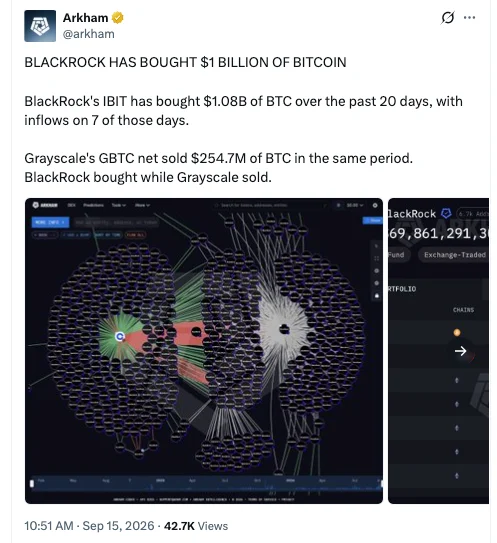
BlackRock’s iShares Bitcoin Trust (IBIT) has emerged as a dominant force in the burgeoning spot Bitcoin Exchange Traded Fund (ETF) market, amassing an impressive $1.08 billion worth of Bitcoin over the past 20 days. This significant accumulation, as reported by on-chain analytics firm Arkham, underscores the immense institutional appetite for the premier cryptocurrency and positions BlackRock as one of the largest holders within this rapidly evolving financial landscape. At present, IBIT holds approximately 785,900 BTC, a substantial stash valued at roughly $61 billion, with Bitcoin trading just above the $77,500 mark.
BlackRock’s broader cryptocurrency holdings now exceed $66 billion, a portfolio that extends beyond Bitcoin to include allocations in Ethereum and other smaller altcoins. However, the iShares Bitcoin Trust remains resolutely focused on Bitcoin as its primary asset. The recent surge in Bitcoin acquisitions by IBIT was largely facilitated through Coinbase Prime, a platform that has become a favored gateway for institutional investors seeking to navigate the complexities of digital asset markets. Arkham’s official announcement on the social media platform X (formerly Twitter) provided a snapshot of this remarkable inflow:
"The iShares Bitcoin Trust (IBIT) has purchased $1.08 billion in BTC over the last 20 days. It now holds 785,900 BTC valued at $61B. This makes IBIT one of the largest BTC holders in the world. Accumulation occurred via Coinbase Prime."

This substantial influx into BlackRock’s Bitcoin ETF stands in stark contrast to the performance of other spot Bitcoin ETFs, most notably Grayscale’s Bitcoin Trust (GBTC). Grayscale has been experiencing consistent net outflows, a trend attributed in large part to its significantly higher annual ETF fee of 1.5%, compared to IBIT’s more competitive 0.25% fee. Despite Grayscale’s long-standing reputation and extensive experience in Bitcoin custodial services, predating the approval of spot Bitcoin ETFs by the U.S. Securities and Exchange Commission (SEC), the cost differential appears to be a pivotal factor influencing investor decisions. This divergence in performance highlights the intense competition within the ETF market and the sensitivity of institutional capital to fee structures.
Collectively, American spot Bitcoin ETFs now hold an aggregate of over 1.2 million BTC, a figure translating to approximately $92 billion in value and representing more than 6% of Bitcoin’s total circulating supply. Analysts widely anticipate that these prominent ETF vehicles will play an even more critical role in shaping the future trajectory of Bitcoin’s market capitalization and adoption. The continued strong inflows, despite recent minor outflows observed in the past few days, suggest a robust underlying demand that is likely to persist, barring any unforeseen systemic market shocks.
The Evolving Landscape of Bitcoin ETFs
The advent of spot Bitcoin ETFs in the United States, which received SEC approval in January 2024, marked a watershed moment for the cryptocurrency industry. This regulatory milestone opened the door for a broader spectrum of investors, including retail and institutional players alike, to gain exposure to Bitcoin through familiar and regulated investment vehicles. Prior to this approval, accessing Bitcoin often required navigating the complexities of cryptocurrency exchanges, managing private keys, and understanding the inherent technical risks. ETFs, on the other hand, offer a regulated wrapper, allowing investors to buy and sell shares on traditional stock exchanges, akin to investing in stocks or other commodities.
The initial wave of approvals saw nine major issuers, including BlackRock, Fidelity, Ark Invest/21Shares, VanEck, and Grayscale, launch their respective spot Bitcoin ETFs. The competition to attract assets has been fierce, with issuers employing various strategies, including competitive fee structures, extensive marketing campaigns, and leveraging their established brand recognition. BlackRock, as the world’s largest asset manager, brought significant weight and credibility to the ETF market, and its iShares Bitcoin Trust has quickly become a frontrunner.
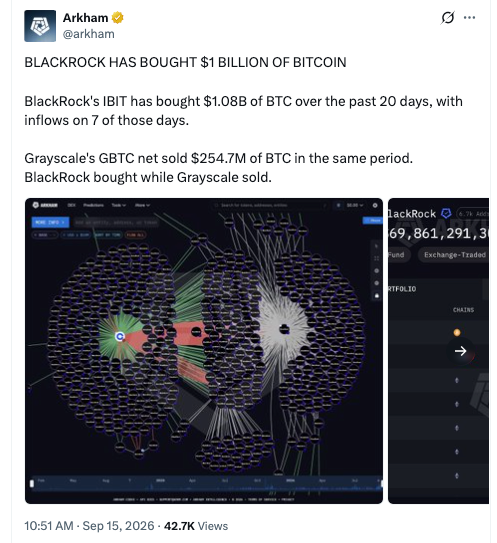
Grayscale’s GBTC, previously operating as a closed-end fund, underwent a conversion to an ETF. While it boasts a rich history and a substantial existing user base, its higher fees have presented a significant hurdle in retaining assets in the face of new, lower-cost competitors. The ongoing outflows from GBTC can be interpreted as a migration of capital towards more cost-efficient alternatives, a common phenomenon in the competitive ETF landscape.
Data-Driven Insights into ETF Flows
The Farside.co.uk/btc data tracker provides a crucial, real-time view of the daily inflows and outflows for spot Bitcoin ETFs. This granular data allows market participants to gauge the momentum of institutional adoption and identify trends as they emerge. The chart illustrating BTC ETF Flow reveals a pattern of significant net inflows into the aggregate of these ETFs, with periods of minor outflows often followed by renewed surges in buying activity.
The sustained inflow trend, even with occasional dips, points towards a persistent demand for Bitcoin exposure through regulated channels. This demand is not only driven by the potential for capital appreciation but also by the diversification benefits that Bitcoin can offer within a traditional investment portfolio. As more institutional capital enters the market via ETFs, it is expected to contribute to greater price stability and liquidity for Bitcoin, further solidifying its position as a legitimate asset class.
Looking Ahead: Q3 Winds Down and Q4 Beckons
As the third quarter of 2026 draws to a close, the ETF market presents a dynamic and evolving picture. While overall holdings for some major funds may have seen fluctuations throughout the calendar year, the recent performance, particularly the substantial inflows into ETFs like IBIT, indicates a strong recovery and a positive outlook. The underlying asset’s valuation has also played a crucial role, with Bitcoin’s price performance significantly influencing the overall value of ETF holdings.

The approaching end of September signals the culmination of Q3, and the market sentiment appears cautiously optimistic. The month of October has historically been a bullish period for Bitcoin, often characterized by significant price rallies. However, investors are likely to approach this October with a heightened sense of caution, a sentiment shaped by the dramatic "bearish bloodbath" of the previous year, which witnessed unprecedented levels of long liquidations and significant market volatility.
The potential approval of additional spot Bitcoin ETFs, or further product innovation from existing issuers, could also influence market dynamics. Furthermore, regulatory developments and macroeconomic factors, such as interest rate policies and inflation data, will continue to be closely watched by investors and analysts alike, as they can exert considerable influence on asset prices across the financial spectrum.
The significant accumulation of Bitcoin by BlackRock’s iShares Bitcoin Trust is a powerful testament to the growing institutional acceptance of Bitcoin as an investment asset. This trend, coupled with the competitive landscape of the ETF market, suggests a future where digital assets are increasingly integrated into mainstream financial portfolios, facilitated by regulated and accessible investment vehicles. The coming months will be crucial in observing whether this positive momentum can be sustained and how the broader cryptocurrency market will react to the continued influx of institutional capital. The ongoing narrative surrounding Bitcoin ETFs is not just about asset accumulation; it’s about the evolving perception and integration of digital assets into the global financial system.