Governance votes within the cryptocurrency landscape typically unfold with little fanfare, often decided by a concentrated handful of wallets and subsequently fading into obscurity. However, the ongoing governance proposal for World Liberty Financial (WLFI) has dramatically departed from this norm, sparking intense controversy and a deep schism within its community, even as the on-chain vote registers overwhelming approval. Barely a day into its voting period, a new initiative designed to incentivize WLFI holders for active governance participation has garnered a staggering nearly 9-to-1 lead in favor. Yet, paradoxically, the digital forums and social media channels are not echoing with celebration but rather with widespread fury and skepticism. This stark divergence between the raw data of the ballot box and the impassioned discourse in the comment sections represents the true narrative of this pivotal moment for WLFI, necessitating a thorough examination of the proposal’s mechanics and its broader implications before the September 28 deadline.
The Genesis of the Proposal: Addressing DAO Apathy
At its core, the WLFI proposal seeks to resolve a pervasive challenge confronting nearly every Decentralized Autonomous Organization (DAO): the problem of voter apathy. DAOs are designed to empower their token holders with direct influence over the project’s direction, treasury management, and protocol upgrades. However, in practice, participation often dwindles after initial enthusiasm, leaving critical decisions to a small, often unrepresentative, fraction of the total token holders. This "voter fatigue" can lead to governance centralization by default, undermining the very principles of decentralization and community-led development that DAOs espouse.
The current WLFI initiative, officially designated Proposal 0x33496f16e246d02b0059a3a3448df68624e5f886a9c93bf2d01d91fe787ce470, represents an evolution of WLFI’s earlier attempts to bolster governance engagement. Earlier this year, the project introduced a staking-linked governance framework, a common mechanism in the DeFi space to encourage token locking for voting power. While this initial step garnered some participation, it apparently did not fully address the issue of sustained engagement. The new proposal aims to go further by directly tying financial incentives to repeated and active participation.
Unpacking the Mechanics: Commitment for Yield
The proposal introduces a straightforward quid pro quo: commitment in exchange for yield. Under the proposed terms, WLFI holders would be required to lock their tokens for a minimum duration of 180 days. Crucially, merely locking tokens is insufficient to qualify for rewards. Participants must also actively cast votes in governance decisions at least once every 90 days throughout their lock-up period. Failure to participate within this recurring quarterly window results in the immediate lapse of reward eligibility. Conversely, consistent and timely participation triggers payouts from the WLFI treasury.

This structured approach is a deliberate attempt to cultivate a "standing electorate" – a consistently engaged base of voters rather than relying on sporadic spikes in turnout. By embedding a recurring 90-day voting cadence, WLFI is attempting to institutionalize active participation, shifting from a passive staking model to an active governance contribution model. The underlying logic is that financial incentives will motivate a broader segment of token holders to not only lock their assets but also to regularly engage with the protocol’s governance, thereby fostering a more robust and truly decentralized decision-making process.
For those interested in scrutinizing the exact mechanics, voting weight distribution, and real-time tallies, the proposal is publicly accessible on WLFI’s official governance portal, ensuring full transparency in the on-chain voting process.
Early Voting Dynamics: A Lopsided Approval
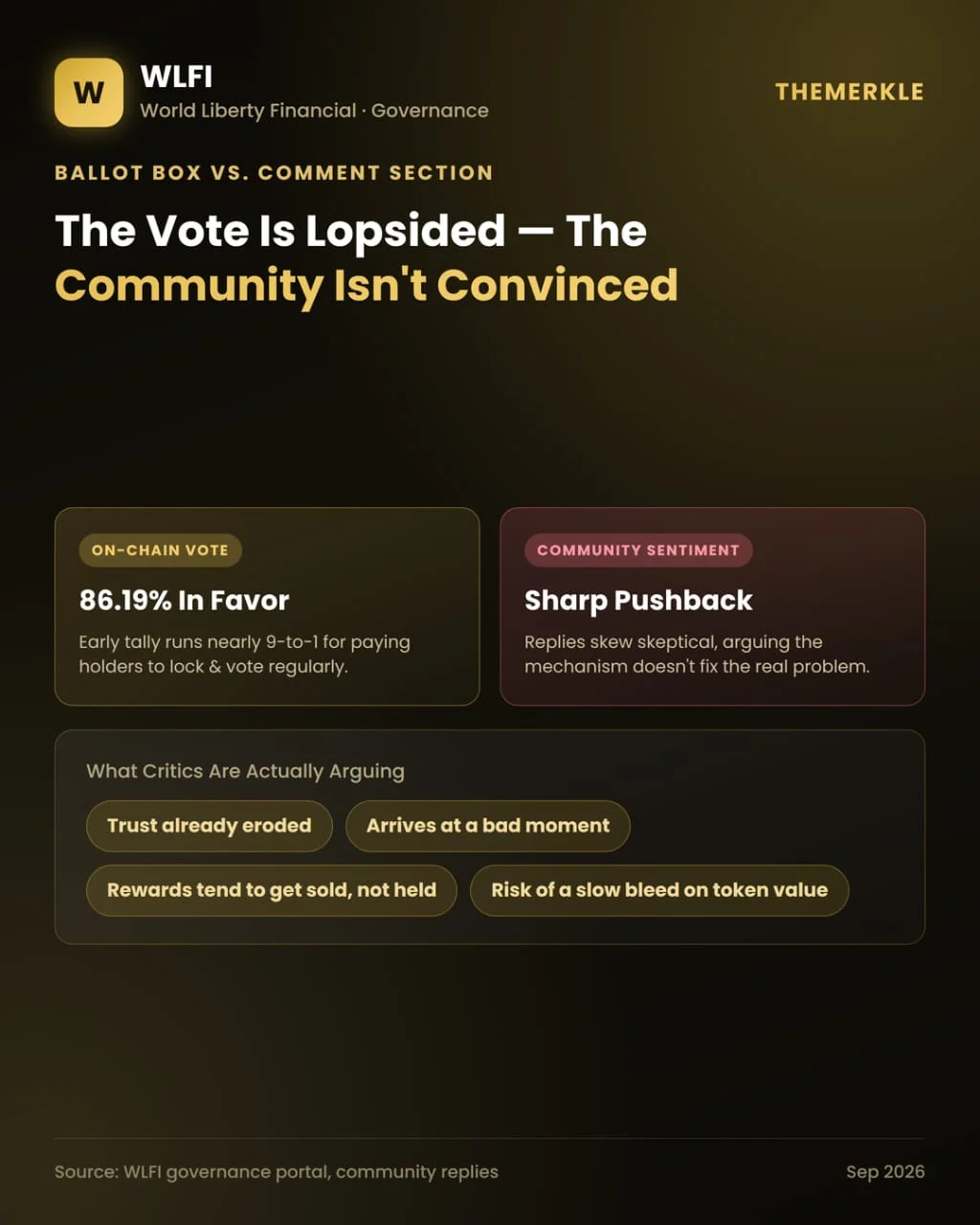
The initial 24 hours of voting presented a strikingly lopsided outcome, indicative of strong sentiment among the earliest participants. The proposal quickly amassed 86.19% in favor against a mere 12.91% opposed, a margin that leaves little doubt about the prevailing trend as the September 28 deadline approaches. These early figures, while not necessarily predictive of the final result, offer crucial insights into the initial momentum and the convictions of the first movers.
Such overwhelming early approval typically emerges under two primary scenarios: either the community genuinely perceives the proposal as highly beneficial, or the earliest voters are disproportionately composed of larger holders and project insiders who stand to gain most from its passage. WLFI’s own governance history provides context that leans towards the latter scenario playing a significant role. A previous, related staking proposal earlier this year concluded with an astounding 99% approval rate from approximately 1,800 total votes. However, a deeper analysis revealed that more than three-quarters of the total voting weight in that instance originated from just ten wallets. This historical precedent suggests that the current 86.19% approval might reflect a concentrated conviction among a powerful few rather than a broad, grassroots wave of enthusiasm. As more votes trickle in before the deadline, it will be critical to observe whether this pattern of concentrated voting weight persists, offering a more nuanced understanding of the community’s true sentiment.
The Discord in the Comment Section: A Narrative of Frustration
While the on-chain data paints a picture of near-unanimous approval, navigating to the community’s discussion forums and social media channels reveals a starkly contrasting narrative. The sentiment here is far from celebratory; it is charged with palpable frustration, skepticism, and even outright fury. Critics are not convinced that a rewards-for-participation model is a panacea, especially given the project’s recent trajectory.

One widely circulated post encapsulates the prevailing skepticism, arguing that trust in the WLFI token has already significantly eroded due to prior events and market performance. The timing of this reward structure is also heavily scrutinized, with many suggesting it arrives at a particularly inauspicious moment for the token. Furthermore, a common accusation leveled against the proposal is that WLFI rewards, once distributed, tend to be immediately sold off by recipients rather than being reinvested into the ecosystem. This behavior, critics contend, transforms the incentive mechanism into a "slow bleed" on the token’s value, rather than fostering the long-term alignment and commitment it purports to achieve. Such criticisms often conclude with accusations that the WLFI team either lacks a coherent long-term strategy or remains out of touch with the actual experiences and financial realities of its broader holder base.
These pointed criticisms highlight a fundamental disconnect that raw vote tallies cannot capture: even a proposal that sails through with overwhelming on-chain approval can fail to convince a significant segment of the community that its underlying tokenomics and strategic intent are sound. If governance rewards are indeed predominantly funded from the treasury and then promptly converted to fiat or other cryptocurrencies, critics argue, the mechanism risks becoming a destructive force. Instead of a tool for strengthening the community and token value, it could inadvertently contribute to persistent sell pressure, particularly in a market environment where WLFI has reportedly already faced sustained price challenges and public governance disputes involving some of its largest holders. This adds another layer of complexity to the debate, questioning the long-term sustainability and efficacy of such an incentive model.
Broader Implications: The Quest for Sustainable DAO Governance
Beyond the immediate yes-no tally, this WLFI proposal serves as a crucial stress test for a fundamental question facing every governance-token project: Can genuine, sustained participation truly be "bought," or does paying people to vote merely cultivate a different form of apathy? The underlying concern is that incentivized participation might lead to holders showing up on autopilot every 90 days simply to collect a reward, rather than engaging in a thoughtful, informed manner to genuinely weigh in on the protocol’s strategic direction. WLFI’s leadership, by advancing this treasury-funded incentive model, is making a clear bet that it can effectively solve the persistent turnout problem.
The skeptics in the replies, however, are placing their bet on a different premise: that no amount of yield can fundamentally fix a deeper trust problem or compensate for perceived missteps in tokenomics. They argue that if the community’s belief in the project’s long-term viability and the intrinsic value of its token is compromised, financial incentives alone will not foster genuine commitment or prevent value erosion.
This ongoing debate, publicly viewable through the on-chain tally and the vibrant community discussions, offers a live case study in the evolving landscape of decentralized governance. It forces a critical examination of whether financial incentives are a sustainable solution to voter apathy or merely a temporary palliative that could introduce new challenges. The outcome of this vote, therefore, carries implications that extend far beyond WLFI itself, potentially setting a precedent for how other DAOs approach the delicate balance between incentivizing participation and fostering authentic, value-driven engagement.
Chronology of Key Events:

- Proposal Launch: The specific date of the proposal’s launch marks the beginning of the voting period.
- Initial 24-Hour Mark: Within the first day, the proposal achieved an 86.19% approval rate, signaling strong early support.
- Ongoing Community Debate: Throughout the voting period, a significant divergence in sentiment between on-chain votes and community discussions persists.
- September 28 Deadline: The final date by which all WLFI holders must cast their votes, after which the official outcome will be determined.
The Road Ahead for WLFI:
Regardless of the final vote count by September 28, the implications of this contentious proposal will resonate within the World Liberty Financial ecosystem for some time. If the proposal passes, the team will face the challenge of proving that the new reward structure genuinely fosters active, value-add participation and does not merely increase sell pressure on the token. They will need to demonstrate that the treasury funding for these rewards is sustainable and contributes positively to the long-term health of the WLFI ecosystem.
Conversely, if the community backlash, despite the early vote tallies, somehow shifts the final outcome, or if the intense criticism leads to a re-evaluation, it would underscore the power of community sentiment even in the face of concentrated voting power. This scenario would compel WLFI to explore alternative solutions to governance apathy that address the deeper concerns about trust and tokenomics.
Ultimately, this episode highlights the inherent complexities of decentralized governance. While the promise of DAOs is to empower communities, the practical execution often involves navigating intricate incentive structures, managing community expectations, and addressing fundamental questions about value creation and distribution. The WLFI vote is a microcosm of these broader challenges, offering valuable lessons for the entire blockchain space as it continues its quest for truly effective and sustainable decentralized decision-making models.
Disclosure: This article is intended for informational purposes only and does not constitute trading or investment advice. Always conduct thorough research before engaging with any cryptocurrency or investment service.